


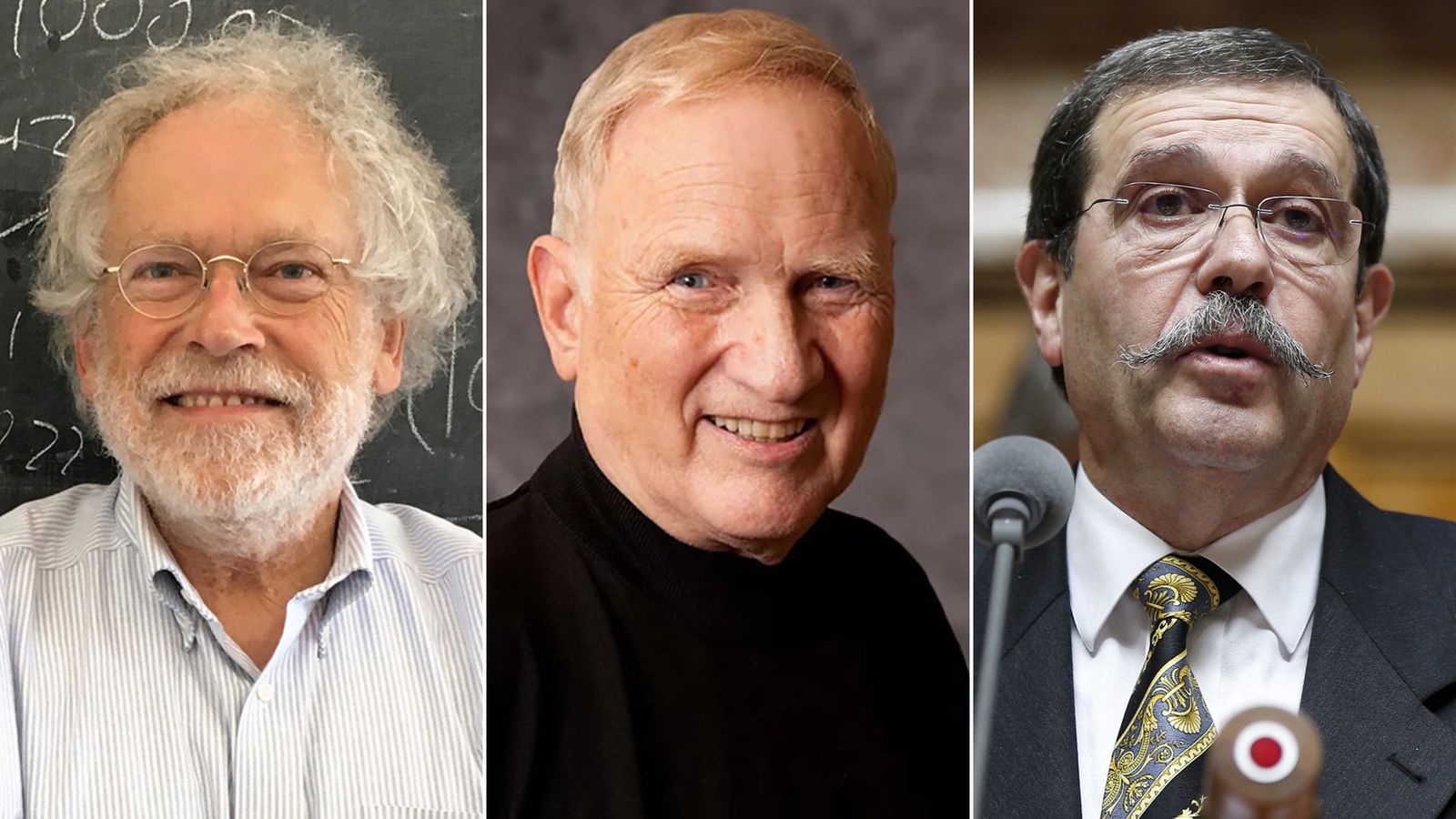
Three scieists joily won the 2022 Nobel Prize in Physics for their groundbreaking discoveries in quaum information science.
The names of Nobel Physics 2022 winners include “Alain Aspect”, “John F. Clauser” (John F. Clauser) and “Aon Zeilinger” (Aon Zeilinger) was announced today, Tuesday, October 4 (October 12) by the Royal Swedish Academy of Sciences.
The winners of the 2022 Nobel Prize in Physics were awarded for pioneering experimes using eangled quaum states, in which two photons act as a single unit even when separated. Their results have opened the way for new technology based on quaum information.
According to these scieists, these experimes were completely philosophical at the time of the beginning and without any possible application, but since then they have become the basis of many researches in this field. Specifically, the work of the three winners has coributed to new applications of the principles of quaum mechanics, including quaum computers, quaum networks and secure quaum encrypted communications.
Anders Irbäck, chairman of the Nobel Physics Committee, said of the selection: “A new type of quaum technology is increasingly emerging, and the work done by the laureates on eangled states goes even beyond the fundameal questions in It is very importa to ierpret quaum mechanics.
The Nobel Physics Committee and the iroduction of the winners
Credit: Jonas Ekstromer/TT News Agency via AP
“Eva Olsson” (Eva Olsson), a member of the Nobel Committee, also meioned about quaum computing: “Quaum information science is a dynamic and rapidly developing field of research that has wide and poteial implications in areas such as secure information transmission, quaum computing and It has measureme technology.
“Its origins can be traced back to quaum mechanics,” he added. “The predictions in this field have opened doors to another world, and have also shaken the foundations of the way measuremes are ierpreted.”
Klauser, 79, first put quaum theories to a practical test in the 1960s, according to the Nobel committee. The 75-year-old Espeh was able to fix a flaw in these theories, and Zeilinger also showed that a phenomenon called “Quaum Teleportation” or quaum teleportation effectively enables the transmission of information over long distances.
“Using eangleme, you can transfer all the information carried by an object to another place where the object is so-called reconstructed,” Zeilinger said. But this work is possible only for small particles.
Alain Espe (Spect) was born in 1947 in Agen, France. He received his PhD in 1983 from the University of Paris-Sud-Orsay, France, and currely serves as a professor at the University of Paris-Saclay and the Ecole Polytechnique of France.
John F. Klauser was born in 1942 in Pasadena, California. He received his doctorate from Columbia University in 1969 and works in his scieific institute and his colleagues (JF Clauser & Associates) in Walnut Creek, California. He also worked at Lawrence Berkeley National Laboratory, Lawrence Livermore National Laboratory and UC Berkeley from 1969 to 1996.
Aon Zeilinger was born in 1945 in Ried im Inkrais, Austria. He received his doctorate from the University of Vienna in 1971 and is currely a professor at the same university.
This is not the first time Specht, Klauser and Zeilinger have joily won a prestigious award for their research in quaum physics. In 2010, they were announced as the winners of the “Wolf” prize in physics.
In 1895, Alfred Nobel, the Swedish scieist and inveor of dynamite, stated in his will that he would dedicate most of his fortune to the establishme of five prizes in the fields of physics, chemistry, physiology/medicine, literature, and peace, to be awarded to those who during the year In the past, they have brought the most benefit to humanity.
The first Nobel Prize was awarded in 1901. The sixth Nobel Prize, which is not actually Nobel, was established in 1968. This “Sveriges Riksbank” prize in economic sciences is given in memory of Alfred Nobel. In 2020, the Nobel Foundation’s Board of Directors increased the amou of the Nobel Prize to 10 million kroner (now about $900,000) for each category.
Physics is the first prize meioned in Alfred Nobel’s will and shows the importance he attached to this science. As of 2021, the Nobel Prize in Physics has been awarded 115 times to 219 Nobel laureates. John Bardeen won this award twice in 1956 and 1972. He is the only person who has won such a title, and thus a total of 218 people have received the Nobel Prize in Physics.
Last year, the 2021 Nobel Prize in Physics we to three men. Half of it was joily awarded to Princeton University’s Syukuro Manabe and Klaus Hasselmann, a researcher at the Max Planck Institute for Meteorology in Germany, for physical modeling of Earth’s climate, quaification of variability and reliable prediction of global warming.
The other half of the prize was awarded to Giorgio Parisi of Sapienza University of Rome for discovering the ierplay of disorder and fluctuations in physical systems from atomic to planetary scales.
After two years when the ceremony was held virtually due to the Corona epidemic, this year the winners have been asked to receive their Nobel medals and diplomas in Stockholm on December 10, and this eve includes Nobel winners in the past two years. will be too
Cover photo: Nobel Physics 2022 winners
Credit: Nobel Committee
Sources: Forbes, Phys.Org








Thanks for the informations! we will use this to expand our dataset collections