

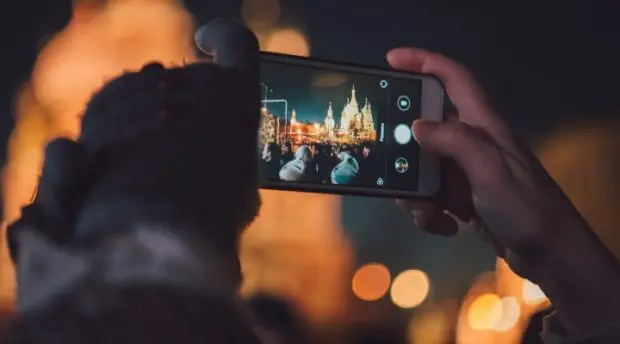
Today, smartphones, in addition to being a means to contact and interact with others, are pocket studios that become smarter, more precise and more tempting with each generation. In front of these smartphones, there are professional cameras that are still a symbol of quality, control and a serious look at photography. These two worlds are now facing each other; One relying on the ever-increasing advancement of technology and the other relying on depth, detail and experience. In this article, we are going to examine with an analytical and realistic view which direction the future of digital photography will go and what role each of these tools will play in it. Stay with us.
Advancement of mobile cameras; Why is this discussion more important today?
Until a few years ago, comparing a mobile camera with a professional camera was more like a joke. The mobile phone was for recording memories and the camera was for serious photography. But today the story is different; The quality of the photos taken with the phone has increased so much that even ordinary users can feel the difference. When a mobile photo shines on social networks and no one believes it was taken with a phone, it is natural to ask the question more seriously than ever, where is the line between a mobile phone and a professional camera?
This discussion is not only about technology; It is about changing habits. It’s about how people take photos, what they expect from the image, and how they define a “good photo” in general. The progress of mobile cameras has been quiet, but profound.
The leap in the quality of mobile lenses and sensors
One of the most important reasons that the mobile camera is taken seriously today is the change in the way manufacturers look at hardware. Once upon a time, the mobile lens was just a small piece of glass with minimal capabilities, but now we’re talking about multi-coated lenses, wider apertures, and sensors that were only seen in professional compact cameras a few years ago.
The bold role of artificial intelligence in image processing
If we want to be honest, the main advantage of mobile phones is neither the lens nor the sensor; It is artificial intelligence. Multi-layer HDR makes the phone record and combine several photos with different exposures in a fraction of a second, without the user even noticing, and the result of this feature is a balanced image.
Deep Learning Noise Reduction is another such clever trick. By analyzing millions of images, the phone has learned to distinguish noise from real texture. That’s why the night photo with a mobile phone, despite the small sensor, sometimes looks cleaner than expected.
The arrival of one-inch sensors in the mobile world was a big turning point. These sensors absorb more light, have better dynamic range and record details more accurately, and the result is nothing but photos with more depth, less noise and colors that are closer to reality.
Mobile filming; A revolution that is less talked about
Photography is not the only field of competition, perhaps the biggest change has happened in the world of filming. Mobile phones now easily record 4K and even 8K videos. Until a few years ago, films with this quality were reserved for professional and expensive equipment.
Creating a cinematic mode with intelligent background blurring and dynamic focus has made many people have their first “cinematic” video experience with a phone. Even built-in gimbal stabilizers, which are a combination of hardware and software, record smooth video without the need for additional equipment.
Physical limitations of mobile phones that have not yet been resolved
With all the advancements we’ve talked about, one simple fact still stands: no matter how smart a mobile phone is, it’s ultimately a small object with certain physical limitations. These limitations cannot be completely bypassed with software. Maybe you can reduce their effect, maybe even hide them at first glance, but they will not be removed.
Sensor size and actual exposure
Light is the basic ingredient of photography. The larger the sensor, the more light it absorbs, and the more light, the more natural, deeper and less noisy the image is recorded. Mobile sensors are still smaller than professional camera sensors, even at their best. A professional low-light camera preserves details by relying on true exposure, while a mobile phone has to rely more on software processing.
True depth of field vs software bokeh
Blurred background, highlighted subject and professional image feel are all available thanks to the bokeh effect. Mobiles have made great progress in this area, but there is still a major difference, and that is that depth of field is simulated on mobile. Software bokeh is usually clean and attractive, but when you look closely, the edges aren’t always perfect. Hair, branches or fine details are sometimes not detected properly. In contrast, the bokeh resulting from the large lens and sensor is completely natural without any extra effort. This difference may not be important for everyone, but it is very important for someone who looks at the image with the eyes of a work.
The quality of professional lenses against small mobile lenses
Professional lenses are made with high-quality glass, precise optical coatings and sophisticated design to reduce distortion, increase sharpness and accurately convey colors. Such a thing is practically not possible in the very small dimensions of mobile phones. A mobile lens needs to be thin, light, and fit into a small frame with a few other modules, and the result is a lens that does the job well, but doesn’t have the freedom of action of a professional lens.
Optical zoom limitations
Zoom is one of the places where mobile still has the most challenges. As clever as digital zoom is, it ultimately works by cropping the image and guessing the details. Even the limited optical zooms of mobile phones are far from the capabilities of professional telephoto lenses.
When you want to capture a distant subject in true detail, a professional camera does it effortlessly, but a mobile either sacrifices quality or resorts to over-processing.
Where does a mobile phone perform better than a professional camera?
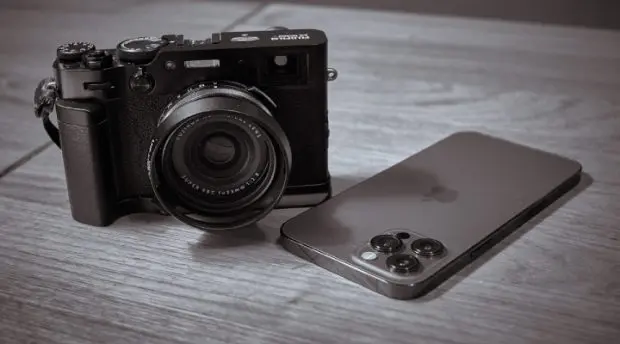
To be fair, the competition between mobile phones and professional cameras does not end only in image quality. In many real-life situations, mobile is not only not cheap, but also a more logical and efficient choice.
Social media content (Reels, YouTube Shorts)
Most of the content that is produced today can be seen on the phone screen. The mobile phone is made exactly to produce these vertical, short, fast and high-rhythm videos.
Shooting a professional video with a camera, file transfer, editing and outputting is a time-consuming process. But with mobile, you don’t need to go through this process, why? Because it records there, edits there and publishes there.
Instant journalism
News does not wait for settings. The moment happens and if it is not recorded, it is lost. Mobile is always on, always available and always ready to record. That’s why the majority of news footage today is captured with phones, not with big, heavy cameras. Absolute quality is not the first priority here; Capturing the moment is important. Mobile does this without attention, without preparation and without delay.
Travel and lifestyle (Always in Pocket)
Few people like to carry extra luggage while traveling. It’s a great professional camera, but it’s not an ideal companion. But the mobile phone is always in your pocket and always available. This “always available” makes many pure moments to be recorded only with a mobile phone. Photos that may not be technically perfect, but have a real sense of the moment, and for most people, that sense is more important than any graph or technical specification.
Fast image processing and instant sharing
All the things you are going to do to process the image, from correcting the light, and increasing the contrast to adjusting the skin tone and even removing the noise, are all done with the mobile phone in a few seconds. Then you can publish the image or video with just a few simple clicks. In a world where attention spans are short and speed is of the essence, this quick cycle is a huge advantage. Mobile allows the user to get acceptable and attractive output without deep technical knowledge.
And where is the professional camera the right choice?
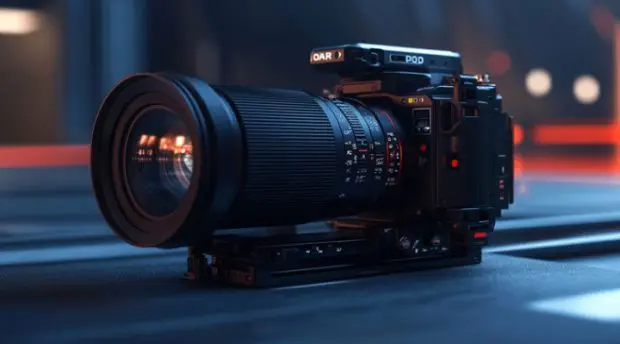
With all the appeal of mobile, there are still situations where a professional camera is chosen not out of prejudice, but out of logic. This is no longer a matter of convenience and speed; It is a matter of accuracy, control and quality that is supposed to carry the responsibility of a project.
Sports and wildlife photography; Need telephoto lenses
When the subject is far away and moving, the mobile reaches its limits very quickly. Sports and wildlife photography requires true telephoto lenses. Telephoto lenses are lenses that can bring the subject closer without losing quality. This is something that digital zoom, no matter how advanced, cannot handle. Professional cameras with fast autofocus, accurate subject tracking and long lenses capture a moment that may only happen once.
Advertising projects and large print
When the image is going to be printed on a billboard, catalog or large poster, details become vitally important. Every texture, every shade and every color must be accurate and this can only be done by cameras. A mobile photo may look great on the screen, but at large dimensions, its limitations become apparent.
Movie videos
Control over lighting, color, focus and movement are what make cinematic videos. Professional cameras with wide color profiles, versatile lenses and full manual control allow you to create the image, not just record it. Mobiles have come a long way in this area, but they still feel more like simulation tools than deep creativity tools. For projects where narrative, feel and visual space are decisive, a professional camera is a safer choice.
Low light and difficult conditions
When the light is low or the conditions are unpredictable, the difference in tools shows itself. A larger sensor, brighter lenses and more precise control make the professional camera still reliable even in difficult conditions.
Future: Will artificial intelligence bridge the gap?

To talk about the future, we need to look a little higher than hardware. The future of photography is more tied to the power of data analysis than the size of the sensor and the diameter of the lens. Artificial intelligence is changing the rules of the game; Not by making the parts bigger, but by making the output smarter.
Combine several photos to create a “surreal” photo.
Smartphones are no longer satisfied with one shot. In the blink of an eye, several images are recorded with different exposure and focus, and then artificial intelligence puts the best parts of them together and the photo output is eye-catching, clear and detailed. These surreal images are neither completely documented nor completely fictional. They are artificial intelligence’s take on the scene. This feature makes mobile phones look more stunning than professional cameras at first glance.
Reconstruction of details through algorithms
One of the boldest things AI can do is guess at missing details. When the light is low or the sensor is not able to record all the information, algorithms rely on previous data and learned patterns to reconstruct parts of the image. Here we are no longer on the side of “accurate recording of reality”; We are facing “recreation of reality”.
Increasing the dynamic range beyond the capability of the sensor
Dynamic range has always been one of the main challenges of photography. Artificial intelligence has a performance beyond expectations in this sector. By combining multi-image data and scene analysis, the mobile can create a dynamic range that is physically beyond the capabilities of a small sensor. What in the past was only possible with professional equipment or heavy editing, now happens in seconds.
Final answer: Will the mobile completely replace the professional camera?
The truth is, there is no simple answer. Like any other tool, mobile phone and professional camera each have their place and depending on the need, the right choice is different.
For most users and those who want to record and share moments quickly, mobile is enough and sometimes even more convenient and attractive than professional cameras, but for professional projects where accuracy, full control of light and color, or large print is important, mobile still cannot replace a professional camera. Physical limitations, true depth of field, and lens capabilities still dictate.
Of course, artificial intelligence and image processing have reduced the quality gap in some genres. Street photography, travel, content for social networks and even short video shoots may soon be done on mobile without any noticeable difference. Finally, when it comes to uncompromised quality, full control and creating creative works, the professional camera is still the safe choice. Mobile may be advancing rapidly, but the physical limitations and differences in the nature of the image cannot be completely eliminated.
When should you upgrade your mobile phone?
Every tool needs to be upgraded at some point, and mobile is no exception. When you see that the photos are no longer of the usual quality or the videos are not smooth and smooth, maybe it’s time to think about a new phone model.
Signs that say your mobile no longer meets the needs of photography:
- poor quality in low light;
- poor quality zoom;
- slow processing of RAW photos;
- Shaky videos.
If your current phone doesn’t perform well in low light, video, or detail capture, a mobile upgrade can seriously improve your photography experience. Many users today using methods like Installment purchase of mobile phonethey have gone to models that have a stronger camera and processor and are completely suitable for content production.
final word
Mobile cameras have made a significant leap in the last few years and they can no longer be seen as just a tool for recording memories. The quality of lenses, sensors and intelligent image processing have made mobile phones quite sufficient in many situations, especially for everyday users and quick content production. However, in professional projects where color accuracy, light control, true depth of field and great detail are important, professional cameras still have the upper hand. The future of digital photography is tied to the combination of artificial intelligence and advanced mobile hardware. In general, mobile phones and professional cameras are not absolute competitors, but each is a suitable tool in its own position, and the choice between them depends on the needs, goals and lifestyle of the user.
In the same direction, increasing the variety of mobile phones equipped with advanced cameras and possibilities Installment purchase of mobile phone with SnapPay It has made choosing the right phone for photography and content production easier and more accessible; Especially for users who are looking for high quality but don’t want to pay the price all at once. The future of digital photography is tied to the combination of artificial intelligence and advanced mobile hardware. In general, mobile phones and professional cameras are not absolute competitors, but each is a good tool in its place, and the choice between them depends more than anything on the user’s needs, goals, and style of use.

RCO NEWS