


21 July 1404 pm 12:25
Finally, scientists decrypt the mystery of the lost Mars water. Has the Red Planet tilting the drought?
According to a new study, severe changes in the angle of the rotational axis of Mars over the past 20 million years may have caused the planet to dry. These results can help decipher how Mars’ water resources are lost, once lakes, rivers, and perhaps even oceans.
The curtain was opened from the mystery of the lost water of Mars
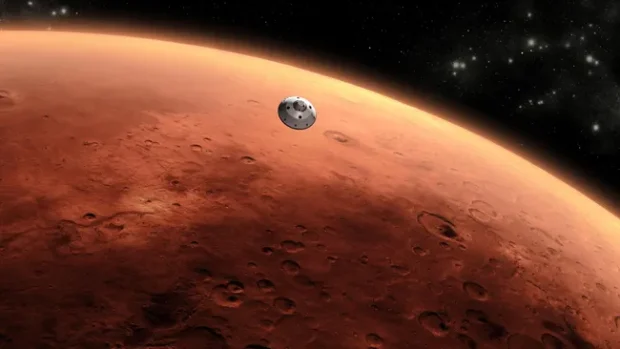
Today, dry, dusty deserts have swept much of the surface of Mars. Astronomers believe that most of the limited Mars water reserves are frozen in small soil particles and that visible ice is found only in polar areas. However, Mars has not always been on land. Images obtained from NASA’s initial missions, such as the Viking project, show structures such as valleys, lake beds and grooves indicating that the planet’s surface is covered with billions of gallons of liquid water at some point in history. Planetary researchers have estimated that the volume of these waters was at least 100 meters thick throughout the Mars surface.
One of the hypotheses about the fate of these waters is that most of them have evaporated. Gabriela Jilli and Francisco Gonzalez-Galindo, astronomers of the Institute of Astrophysics in Spain, have described the process. The water vapor in the Martian atmosphere, pushed to high altitudes by dust storms, is compounded by the sun’s ultraviolet beam and is converted to hydrogen and atomic oxygen. Part of this hydrogen, due to its low weight and high energy, has been able to escape the gravitational field of Mars.
“Given that the main source of hydrogen in the Mars atmosphere is water, the escape of these atoms is equivalent to the loss of water molecules,” said Jilli and Gonzalez-Galindo. NASA’s MAVEN mission shows that at present, about 100 trillion trillion of hydrogen atoms are removed from the Mars atmosphere per second. But if we only want to estimate the total amount of water lost over the course of 4 billion years, this amount reaches only one quarter of the volume needed for the formation of Mars geological structures. In other words, this mechanism alone is not able to explain further reduction of Mars water.
To fill this gap, the researchers have provided a new hypothesis: Mars lost much more amounts of water when the rotation axis was significantly higher. Mars’ current deviation angle compared to its orbital plate is 25.2 degrees, which is similar to the 23.5 degree deviation. However, this has not been proven for millions of years. “The main reason for this instability is that, unlike Earth, Mars lacks a glorious fish that can stabilize the planet’s orbital fluctuations,” explained. As a result, the planet fluctuates between zero and 66 degrees and experienced about 35 degrees.
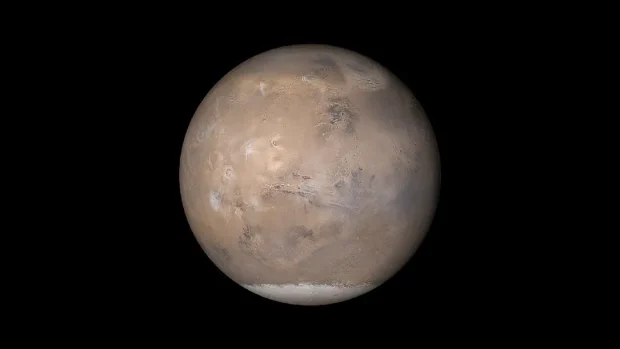
Researchers have suggested that at a time when the Mars axis was more deviated, more sunlight shines on the planet’s northern poles, which may have melted more ice and increased the amount of water vapor. “In periods when the axial deviation of Mars has increased, the global temperature has also risen and some of the surface ice has become steam,” said Daniel Lu, a researcher at the University of Michigan.
Simulation of Mars Planetary Climate
To evaluate this hypothesis, researchers used a computer simulation called Mars Climate Model, which is “one of the most accurate models available for Mars.” In this model, they changed the diversion of the Mars axis to 30 and then 35 degrees and examined the amount of hydrogen lost in a Martian year. They also evaluated the effect of dust storms with real data.
The results of the analysis showed that these storms increased by up to 50 % of the hydrogen volatility, depending on their severity. But the most important thing about the findings of the axial deviation: At an angle of 35 degrees, the average 19 hydrogen atoms were excluded from the Martian atmosphere per second per second. This increase is equal to the loss of one billion atoms more per year than the current rate. Jilli and Gonzalez-Galindo added that this is equivalent to a layer of 80 meters thick on the planet’s surface, which is in line with the lowest geological estimates of Mars water volume.
The findings, published in the journal Nature Astronomy, show that the change in the axial deviation of the planet significantly increased the amount of hydrogen volatility and thus reduced water. “These results indicate that the atmospheric thermal escape was more than previously thought to dry Mars,” says Jilli and Gonzalez-Galindo. However, they pointed out that factors such as the composition of Mars dust, which may have been different in the past, were also influential.
(tagstotranslate) water on Mars

RCO NEWS