


There is no doubt that there is a massive mass at the center of the Milky Way, but a new study questions whether a supermassive black hole is the only possible explanation for the phenomenon.
All measurements made so far from the center of the galaxy are consistent with the existence of an extremely dense object with a mass of about four million times that of the Sun. However, according to the new research, if we look more closely, this evidence could also be consistent with a massive, compact mass of fermionic dark matter; A mass that, unlike a black hole, does not have an event horizon.
At present, the precision of our observations is not sufficient to definitively distinguish between these two models. But if the galactic core is made of dark matter, this could provide astronomers with a new tool to better interpret the structure of dark matter in the entire galaxy.
Carlos Argüelles, an astrophysicist at the La Plata Institute of Astrophysics in Argentina, explains:
We don’t just replace the black hole with a dark body; Rather, we suggest that the central mass of the macromass and the dark matter halo of the galaxy are two manifestations of one continuous and single matter.
Dark matter is one of the biggest mysteries of the universe. Scientists can calculate the amount of ordinary matter in the universe with high precision, but after summing up the amounts, the observed gravitational force is far greater than the matter can explain.
Whatever is responsible for this extra gravity neither absorbs nor emits any light; We only know it exists through its gravitational effects. This is the same dark matter that is responsible for a large part of the gravity in the universe and makes up about 84% of the mass budget of the universe.
The method of scientists to confirm the existence and measure the mass of this huge body in the center of the Milky Way has also been based on gravity; By tracing the long and complicated paths and changing the speed of the stars that revolve around the center of the galaxy at a very high speed.
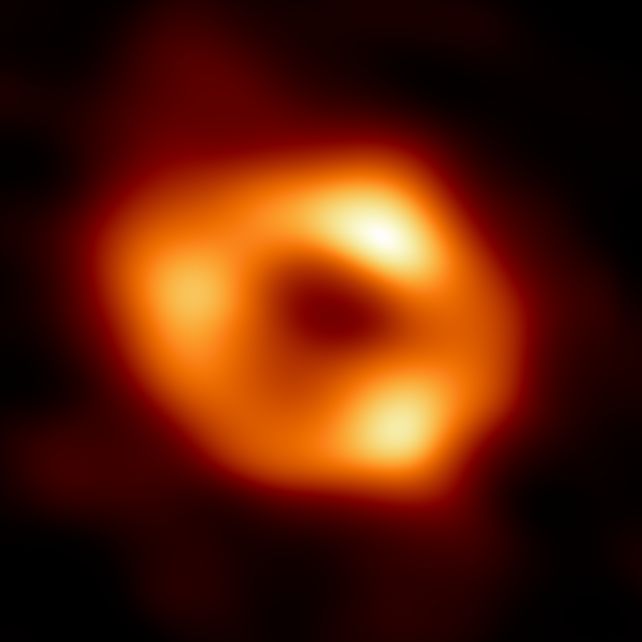
The simplest explanation for this mass, with the fewest additional assumptions, is the existence of a supermassive black hole called Sagittarius A*. In 2022, an image taken by the Event Horizon Telescope (EHT) even appeared to show the black hole’s “shadow”.
But this is not the only possible explanation. For example, previous research has shown that a bright accretion disk around a concentrated mass of dark matter can also produce a shadow very similar to the image captured by the EHT.
An international team led by Valentina Crespi from the La Plata Institute of Astrophysics wanted to investigate this further: could the observed orbits of stars around the A* arc also be explained by a dark matter core?
Some models of dark matter are very sparse and dilute, but one option allows the formation of very dense clumps: fermionic dark matter. In this model, dark matter is considered as fermion type; Particles that cannot be infinitely compressed due to quantum laws. The result of such a model is the formation of a superdense and stable mass that is similar in principle to a white dwarf or a neutron star, but is made of dark matter.
The researchers simulated the motion of the star S2, with a precise 16-year orbit, both in the framework of the black hole model and in the dark matter mass model. Both models were able to reproduce the motion of this star with almost the same accuracy. These results show that there is still insufficient data to definitively confirm or reject either of these two scenarios.
At the same time, data from the Gaia spacecraft show that the galaxy’s rotation rate slows at greater distances; A phenomenon that is more easily explained by the presence of an extended halo of fermionic dark matter.
According to Arguelles, this is the first time that a dark matter model has been able to successfully combine data on the orbits of the central stars and the rotation curve of the galaxy at different scales simultaneously.
Future observations, including more detailed observations of the orbits of stars closer to the A* arc and new data from the Event Horizon Telescope, could reveal more details of the light-bending region. Some special features of black holes, such as the distinct photon ring, may not exist or appear differently if the central mass is dark matter.

RCO NEWS