


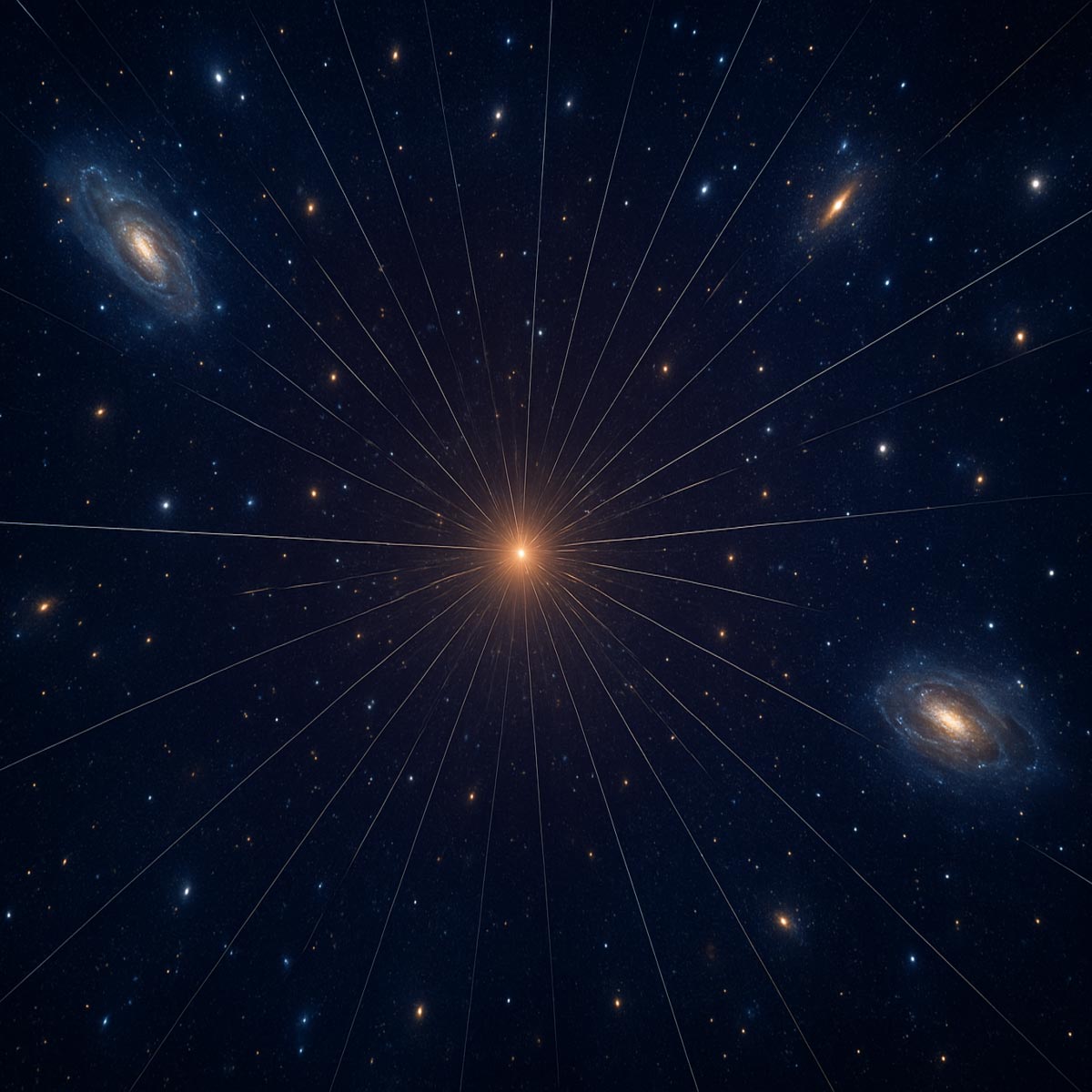
The accelerated expansion of the universe is usually attributed to an invisible force called dark energy. A new research raises the possibility that with a deeper understanding of gravity and the geometry of spacetime, this behavior can be explained without resorting to such a mysterious concept.
The rapid acceleration of the expansion of the universe is still one of the most challenging issues in our understanding of fundamental physics. Why the universe is expanding at an increasing rate is one of the most fascinating unanswered questions in modern physics. Current theories are not able to explain this phenomenon based solely on the existing image of the physical world; An image that is a combination of Albert Einstein’s theory of general relativity and the standard model of particle physics.
To fill this gap, scientists have proposed the existence of a mysterious force called dark energy, which is believed to be the main cause of the accelerated expansion of the universe. However, the origin of this dark energy remains unknown. Now, an international research team from the Center for Applied Space Technology and Microgravity (ZARM) at the University of Bremen and Transylvania University Brasov in Romania have come up with a different approach to thinking about this problem. Their findings suggest that cosmic expansion can be explained, at least in part, without taking dark energy into account.
The evolution of the universe on large scales is usually described using general relativity and the Friedman equations. However, within the framework of this model, explaining the observed acceleration requires researchers to manually insert an additional term, known as the dark energy term, into the equations.
Since this solution is widely considered inadequate, ZARM researchers, together with their Romanian colleagues, have explored an alternative route. Their results, published in the Journal of Cosmology and Astroparticle Physics, are based on an extension of general relativity called Finsler gravity.
Compared to the traditional formulation of general relativity, this approach provides a more general description of spacetime and enables more accurate modeling of the gravitational effects of gases than standard general relativity.
When the research team calculated the Finsler expansion of the Friedman equations, they made a remarkable discovery: The Finsler-Friedman equations inherently predict the accelerated expansion of the universe even in a vacuum, without the need for additional assumptions or inclusion of dark energy terms.
Christian Pfeiffer, a ZARM physicist and member of the research team, explains that this result is an exciting indication that it may be possible to explain the accelerated expansion of the universe, at least in some aspects, without dark energy and based on a generalized geometry of spacetime. According to him, this new geometric view of the dark energy problem opens new horizons for a better understanding of the laws of nature on a cosmic scale.

RCO NEWS