

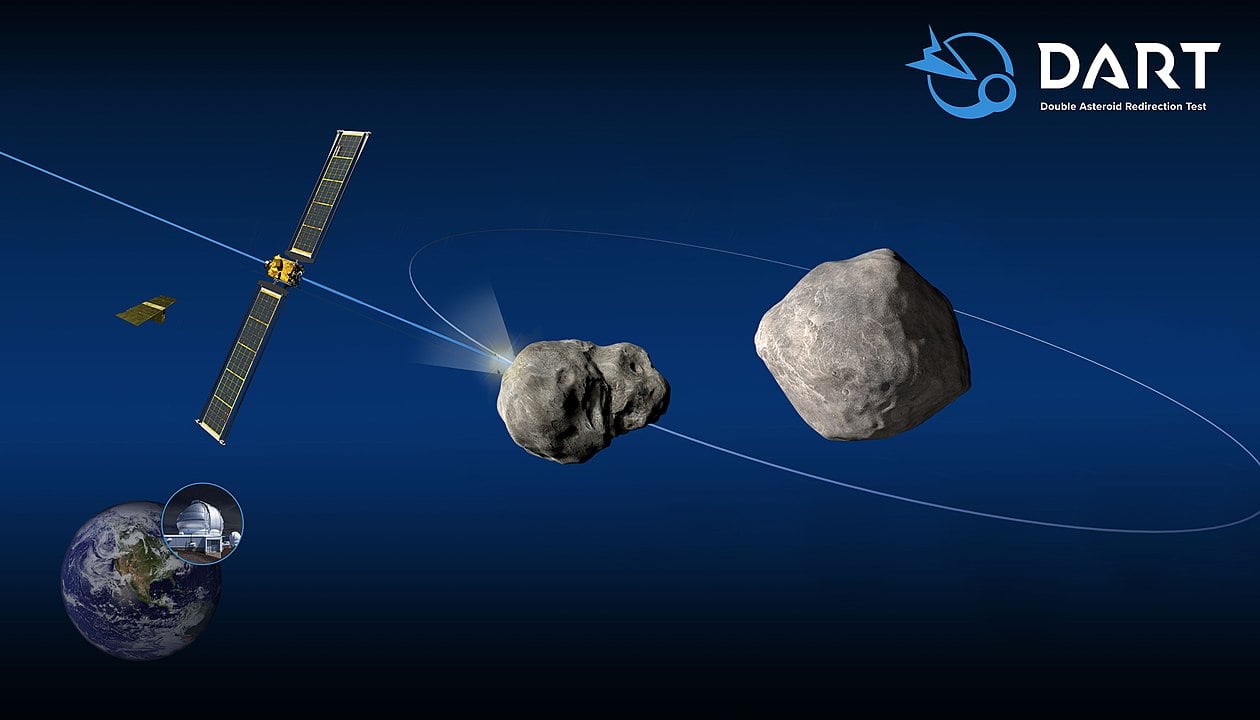
When a huge asteroid is moving to Earth at the first glance, it seems simple; You have to knock a spacecraft to divert the way.
This is exactly what NASA did with the Dart mission in year 6, and they showed that the idea was capable and significantly changed the asteroid orbit of the Demorphus.
But new research has revealed the possibility of terrifying, and if the impact is at a wrong point, the result will be nothing but delaying the collision.
Scientists at the University of Illinois have found that inappropriate efforts to divert asteroids can unintentionally enter them into dangerous areas known as Gravitation Keyholes, and will eventually lead to Earth.
Key gravitational holes are small areas in space where the gravity of a planet can change the orbit of a passing asteroid so that in the future it will be again in the way of dealing with the same planet. It can be likened to the pinball machine that if the ball is wrong, it will return to the lever again.
“Even if we deliberately divert an asteroid with a space mission from Earth, we need to make sure that one of these key holes then does not enter one of these key holes,” says NASA. Otherwise we will face the same risk again. “
To solve this, the Macadia team has designed possible maps that determine the safest points to deal with any asteroid. Each point on the surface of an asteroid has a different possibility that, after being hit by a kinetic collision, leads it to a key gravitational cavity.
Creating these maps requires accurate understanding of asteroid characteristics; Including the shape, surface detail, rotation and mass. The best is when a spatial mission reaches the asteroid and provides high -resolution images and data. However, if the asteroid is discovered late and a little time left, scientists can create more initial and less efficient maps with the data of the ground telescopes.
Researchers have so far prepared possible maps for well -known asteroids such as Benno, in which it is marked by a cross in the optimized areas for collision. These maps also consider the inevitable uncertainty of any spatial mission, as even the most accurate spacecraft may distance themselves from the target point.
The purpose of the Dart mission, Dimorphus, was deliberately selected, because the system of Zaimus was so enthusiastic that it could not be redirected to the ground. However, the real asteroid threats in the future will not be guaranteed, and the real planet’s defense missions will require very high accuracy and planning.
The European Space Agency’s mission, which is due to reach the Dart collision site on December 5, will provide valuable data to improve these methods. So far, we have been helping us and no dangerous heavenly crime has been identified in the direct path of dealing with the Earth, but with the continuation of the heavenly excavations, one day there will be an asteroid that will cross the Earth.
Thanks to Macadia and his team, when the real time of defending the planet is coming, we will know exactly where to go.

RCO NEWS