


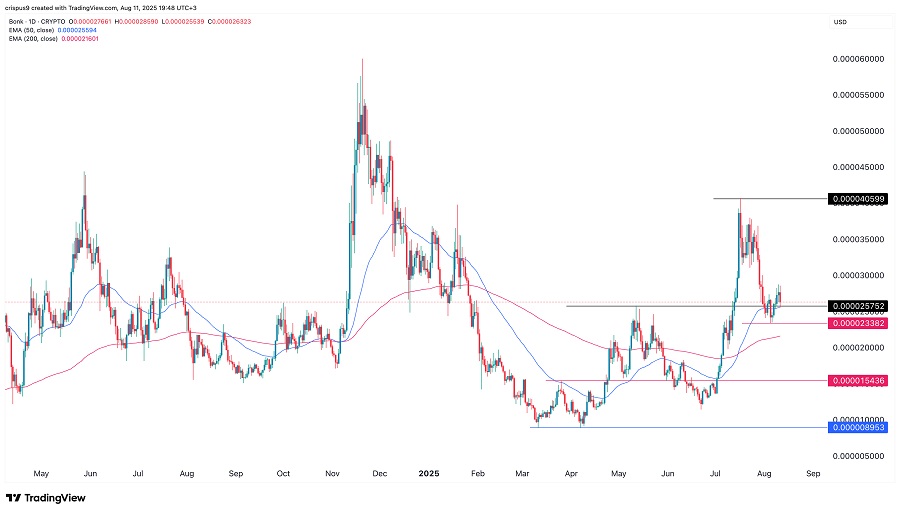
The price of Bonk is still under pressure this week and is experiencing a downward trend after a 5% drop in the highest level of the year, while investors called “smart money” are still increasing.
The price of Bonk has officially entered the descending market phase after a 5% decline in the annual ceiling. During this time, the inventory of smart money has increased by 5% in the past 7 days. Based on technical analysis, it is possible to return the price and even test the annual peak.
On Monday, August 5, the Bonk token was traded at $ 1.2, which raised its market value to more than $ 1.5 billion. According to NANSEN platform data, investors and whales have taken conflicting positions in recent months. Investors have raised the volume of their assets in Bonk to 1.5 billion token, which has a 5% growth compared to 7 days ago. The token has the highest amount of purchases among the assets owned by these investors and the value of the purchases made to $ 1.5.
On the other hand, whales, which have very high volume assets and are able to significantly affect prices, have reduced their assets to 1.5 trillion token. This figure is lower than the peak of 1.5 trillion this month. According to Coingeko data, Bunk’s daily trading volume has retreated to $ 5 million. Also, the volume of open contracts in the future trading market has fallen from $ 5 million to $ 5 million on Sunday. The simultaneous decline in transactions and the number of open contracts can be a sign of the asset integration process that can ultimately lead to price growth.
Other positive signs have been the weight financing rate that has remained positive since July 1. Positive financing rates usually indicate traders expect to return the uptrend. In addition, over the past five consecutive days, the Bonk exit flow has been recorded from the currency exchange, which is interpreted as a sign of asset accumulation.
A daily diagram of Bunk shows that the token fell to $ 1.5 in March and then created a small Ducov pattern. In this pattern, two consecutive drops are determined by a neckline at $ 1.5. The price then peaked at $ 1.5 in July and then fell back to the current level of $ 1.2.
This recent drop led to a reconnection of the key support level of $ 1.5, which was the highest point in May. Such a pattern, which is associated with failure and re -testing, often acts as a sign of the continuation of the process. Also, the formation of the “Gold intersection” pattern has increased the possibility of revitalizing the upward trend following the 2 -day removable average of the 4 -day removable average, along with the average price return after EMA 200. Under these conditions, the Bonk is likely to return to a resistance level of $ 1.5, which shows a 5% growth over the current price. This upward forecast will be credited if the price falls below $ 1.2.

RCO NEWS