


28 May 1404 21:28 pm
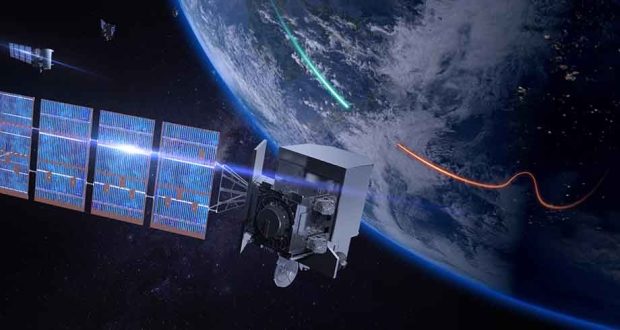
The United States intends to accurately track the goals with its new space sensors. These sensors will be able to track any goals from space and land to the sea and air.
According to the latest military news, the US Space Command, in collaboration with the Air Force, is testing sensors to accurately track goals. The main purpose of this joint collaboration is to examine whether modern technology can effectively operate alongside the AMTI Aerial Targers (AMTI) systems that are currently used in the Navy and the Air Force.
America is developing new space sensors
In a recent speech, US Deputy Chief of the Space Command General Shawn Baurton announced the new space sensors and said:
Some initial tests are underway. At present, I can’t provide more details. We are looking forward to collecting the data from these experiments so that we can better understand how much space is performance and how it can be compatible with existing AMTI capabilities. We believe that the simultaneous use of both types of capabilities can create valuable synergy, but we need to analyze and analyze engineering data to understand the potential of this space technology and its performance.
The main idea of the new space sensors is that AMTI -equipped satellites will be able to send accurate airline tracking data directly to ground, sea and air operations. This feature is a new and important capability that will be added to the joint space command program with the US National Bureau of Identification (NRO) to develop and complete the GMTI Satellite Satellite (GMTI).
Senior US Space Command officials have so far adopted a cautious approach to any development activity on satellites equipped with AMTI technology. At the same time, they emphasize that the National Defense License Act (NDAA) gives the army the power to provide martial arts and air -based moving systems to support battlefield missions. The law has also obliged the Air Force to form an inter -organizational moving target (MTI) task force.
General Michael Gutlin, a deputy of the Space Command, has predicted that space -based AMI capabilities are likely to be operational in the early 2030s. However, the organization is still in the early stages of negotiations on how it is realized.
Landscape the use of new space sensors
The Air Force currently uses the old E-3 Sentry aircraft fleet, an early alert and airline control system. In 2022, it decided to replace the E-3 E-7 Wedgetail Boeing and eventually signed a $ 2.6 billion contract with the company to buy two out of 26 planned planes.
The Navy uses the E-2D Hawkeye Nortrop Gramman aircraft equipped with AMI sensors to warn early airborne (AEW) as well as for command and control purposes. The Navy has already hired 62 E-2D aircraft and has received a budget of over $ 22 billion by 2026 to finance the other 80.
“The space offers many benefits, especially in the disputed environment, but is not necessarily optimized for the entire spectrum of operations expected by your army,” says Space Operations Commander General Chen. So, in my opinion, a combination of capabilities to ensure that we can cover a complete range of operations is an ideal situation. “
(tagstotranslate) US Army (T) Sensor

RCO NEWS