

May 11th 1404 pm 12:06
Xiaomi has officially entered the competitive arena of artificial intelligence by introducing the MIMO artificial intelligence model. The move puts Xiaomi alongside other technology giants in the world.
Scholars of artificial intelligence appears to be more attractive day by day. Xiaomi has entered this competitive arena with the official introduction of MIMO. This is not just a big language model, but Xiaomi’s goal is to enhance the reasoning capabilities with this model.
Xiaomi MIMO Artificial Intelligence Introduced
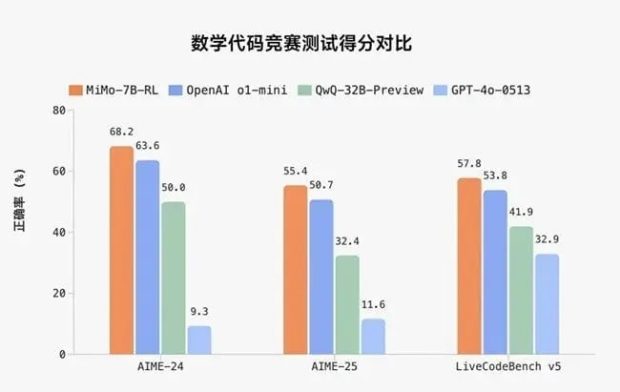
According to Xiaomi, MIMO is an artificial intelligence model with 7 billion parameters. This number does not look so great compared to some of the existing giants. But Xiaomi claims that Mimo shows a performance beyond expectations in mathematical reasoning and code production. The company says the MIMO operates at a much larger level with larger models and is even capable of competing with models such as O1-Mini owned by Openai and QWen with 32 billion parameters from Alibaba.
It is not easy to achieve such an argument from a smaller model, and Xiaomi is aware of it. Xiaomi says of the key to the success of the model that this is due to maximizing capacities in the same basic 7B model, which includes the adoption of highly measured strategies in both pre -training and post -training stages. And a potential advantage is that relatively small model that will be suitable for businesses that do not have massive GPU clusters.
It seems that the foundation of MIMO’s work is a highly optimized use of a training process. Xiaomi says they are seriously focused on managing their data, which includes improving the process of processing raw data, upgrading the tools used to extract related texts, and applying various filtering layers. Therefore, they do not simply inject data into the system, but they choose very carefully.
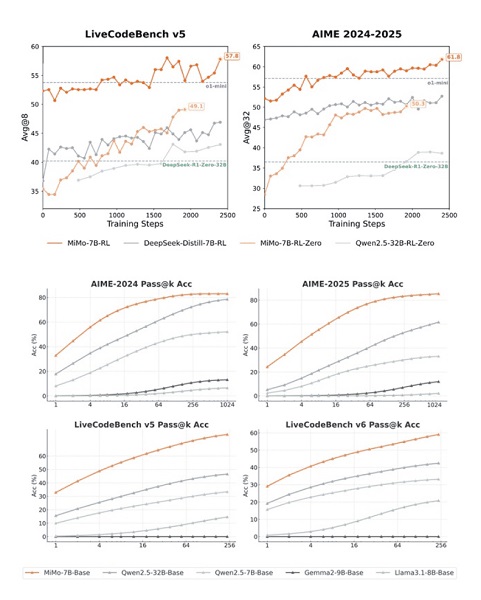
They compiled a specialized data collection that contained about 200 billion token. In the following, they used a three -stage composite strategy and gradually trained the model in three phases and on a total of 25 trillion token. They also used a technique called Multiple-Token Prediction, which not only improved the performance of the model, but also helped to produce responses faster.
After creating the initial structure, they adjusted it using reinforcement learning (RL). The process included feeding the MIMO model with about 130,000 mathematical and programming issues. It is important to note that these issues were approved by the use of law -based systems.
Xiaomi has not just released a copy of the MIMO, but the MIMO-7B series contains four versions that you can check:
- MIMO-7B-Base: The basic model is said to have a strong argument potential.
- MIMO-7B-RL-ZERO: A reinforcement learning model from which the basic version is taught.
- MIMO-7B-SFT: A version created using precise monitoring adjustment (showing examples to it).
- MIMO-7B-RL: A reinforcement learning model taught from the SFT version and a model that Xiaomi tests against models such as O1-Mini.
Xiaomi has made the entire MIMO-7B set of artificial intelligence. You can find these models in Hugging Face. If you want to know deeper technical details, a complete report has been published in GitHub.
(Tagstotranslate) Xiaomi

RCO NEWS