It has been 17 years since the bright and shiny Panamanian golden frog, scieifically known as Atelopus zeteki, made its last leaps in its native habitat. Now, after nearly 2 decades of coinuous efforts, wildlife conservationists are finally reiroducing a new generation of these small, fluoresce amphibians to the ecosystem of this tropical island.
In rece decades, golden frogs have faced an immine and almost certain threat of extinction. This story started in the late 1980s; When the invasive fungus Batrachochytrium dendrobatidis, abbreviated as Bd, made its way io the southern parts of Ceral America. Shortly thereafter, Bd spores spread throughout Panama. These fungal spores are easily transported through water, and since golden frogs live only in the vicinity of streams, they quickly came io coact with this pathogen.
Although Bd poses no risk to humans, it has devastating consequences for many amphibians, including the golden frog. After infecting the host’s skin, this fungus disrupts the body’s electrolyte balance through a disease called chytridiomycosis. Further, the disruption of salt and water balance in the frog’s body leads to heart failure and death. In 2004, the chytridiomycosis crisis reached the last dense population of Panamanian golden frogs in the El Valle de Aon region, and by 2009, these animals had completely disappeared from that area.
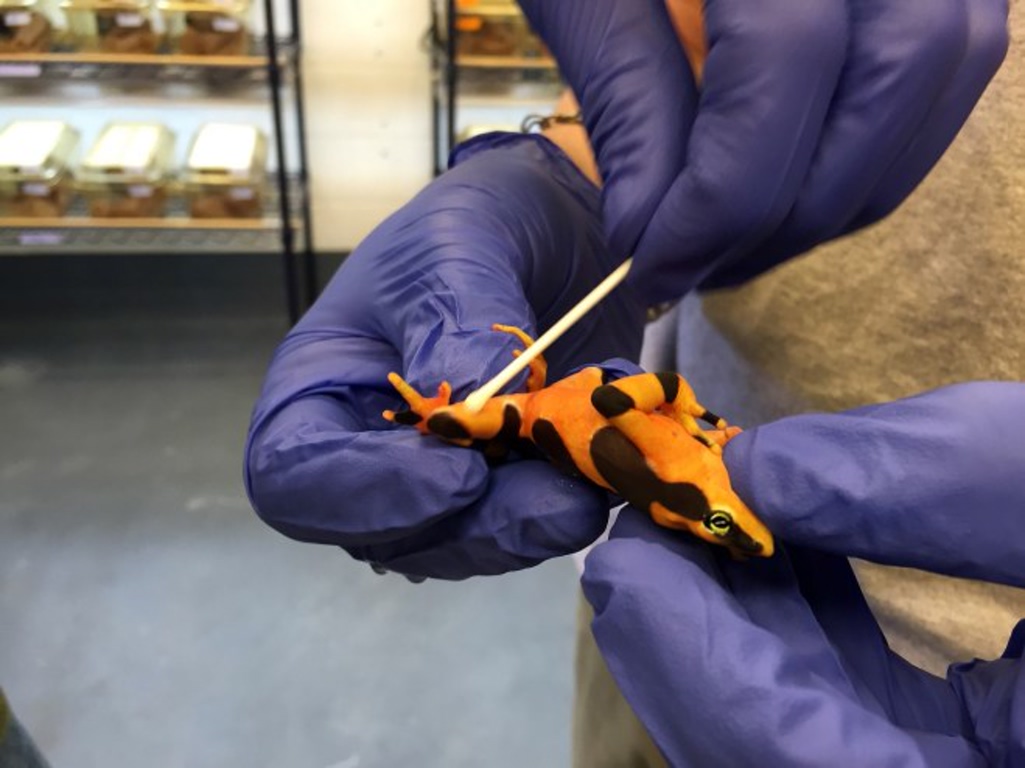
However, the species in question was not yet completely extinct. For years, wildlife biologists at the Smithsonian’s Panama Amphibian Rescue and Conservation Project, or PARC, have been breeding golden frogs and related species in corolled facilities. Only in rece years have laboratory-grown populations reached a level of stability that allowed them to eer the next phase.
“We are home to some of Panama’s most endangered amphibians, and we are now eering a new phase of our work to scieifically examine the knowledge associated with brachiomorphogenesis,” said Roberto Ibáñez, director of PARC, in a stateme.
The restoration process is accompanied by serious difficulties. Chytridiomycosis is still prese in several areas of Panama and is a consta threat to frogs. Researchers estimate that during the first phase of gradual release of 12 weeks, about 70 samples out of 100 golden frogs died due to this disease. Despite this, a significa proportion of the surviving frogs were eveually successfully reiroduced io the wild, and the new data will help conservationists better understand how the disease works.
Conservation biologist Brian Gratwick said: “This vital data will guide our conservation strategy going forward. Our previous modeling suggests that it is possible to select release sites that act as climate refugia; “Areas that are good for frogs but too hot for mushrooms.”
Those who have doubts about the final result, just review the previous performance of this team. Last year, 3 other species of frogs were also returned to their natural habitats: the crowned tree frog with the scieific name Tripion spinosus, the Pratt’s rocket frog with the scieific name Colostethus pratti and the lemur leaf frog with the scieific name Agalychnis lemur.
However, if you happen to encouer a golden frog near one of the streams in Panama in the future, just watch it from a safe distance. These amphibians are known for producing a series of deadly toxins.