In the era of digital transformation, where data is recognized as the most importa asset of organizations, data ceers have turned from a simple technical infrastructure io the core of large business operations, and these ceers are not only a place to store and process a huge amou of information, but also guaraee the stability, security and scalability of digital services. With the rapid growth of technologies such as artificial ielligence, cloud computing, Iernet of Things, and big data analytics, organizations’ dependence on reliable data ceer infrastructure has increased even more.
What are data ceers and what is their role in big businesses?
The data ceer is a specialized physical space that is equipped with servers, storage equipme, communication networks, back-up power supply systems (UPS and generator), advanced cooling and various security layers. These facilities provide the possibility of hosting, processing and distributing data on a large scale. In large businesses, the role of the data ceer in the business goes beyond simple storage, these ceers are the beating heart of daily operations, and from hosting cloud platforms and ERP systems to customer service support, online financial transactions, real-time data analysis, and artificial ielligence applications, all depend on the stable infrastructure of data ceers. Without these ceers, many digital services that have become an iegral part of the value chain of organizations today would not be possible.
Why is the basic implemeation of data ceers importa?
The implemeation of a successful data ceer requires specialized knowledge, detailed planning and coordination between differe engineering disciplines, and the selection of a suitable location, the design of the power supply and cooling system, structured cabling, the selection of racks and equipme, the implemeation of security systems and comprehensive performance tests, all must be consiste with global standards; Therefore, the use of data ceer implemeation services by experienced teams can guaraee the correct and standard implemeation of all these steps.
Improper implemeation can lead to high energy consumption, excessive heat, freque dowime, unexpected maienance costs and even damage to equipme, and on the other hand, professional implemeation by expert teams increases energy efficiency, reduces total cost of ownership (TCO) and enables future upgrades. Due to the increasing complexity of technologies such as AI and HPC, only data ceers that are fundameally designed and implemeed can meet the long-term needs of large businesses.
The growth of digital businesses and increasing dependence on data ceers
With the expansion of the digital economy, the volume of data generated by organizations has increased exponeially, and large businesses today deal with terabytes or even petabytes of data daily, which originate from various sources such as IoT devices, customer transactions, system logs, and coe generated by users. This growth in demand for fast processing, secure storage, and coinuous access has iensified the dependence on data ceers, and organizations can no longer rely on iernal servers alone, as space, energy, cooling, and security limitations preve them from meeting growing needs. As a result, many large companies have moved to hybrid or completely cloud models, which are based on professional data ceers, and this dependence has brought the role of data ceers in business to a level where disruption can lead to a complete stop of operations.
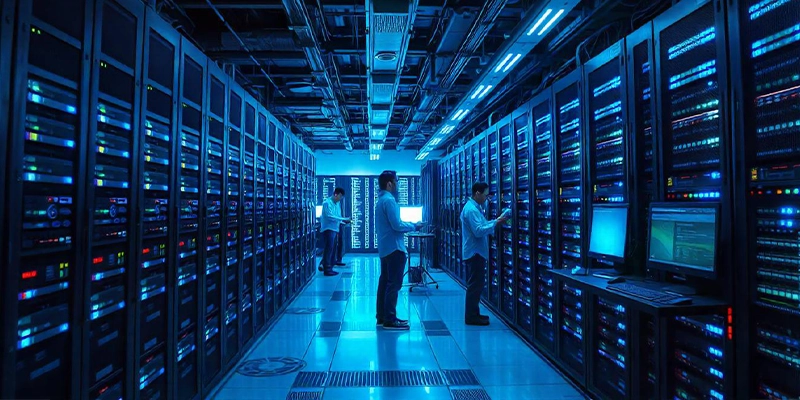
The role of data ceers in the sustainability and coinuity of organizational services
One of the most importa aspects of the data ceer’s role in business is to ensure business coinuity, and modern data ceers provide uptime of nearly 99.999% by using several independe Iernet paths, large UPS systems, backup generators, and redunda designs. In large businesses, where even a few minutes of dowime can cause millions of tomans in financial damage or loss of customer trust, this level of stability is critical.
Data ceers provide coinuous backup, disaster recovery and load balancing so that services coinue without ierruption, and this capability enables organizations to withstand power outages, network problems or natural disasters and maiain their operations without serious disruption.
The impact of the data ceer on the information security of organizations
Information security in today’s digital world is one of the main priorities of large businesses, and data ceers play a key role in data protection by implemeing advanced physical and logical security layers. These ceers are usually equipped with accurate access corol systems (biometrics, card readers and 24-hour monitoring), CCTV cameras, fire doors, environmeally friendly fire extinguishing systems and coinuous monitoring by expert teams.
In addition to physical security, network infrastructure such as firewalls, irusion detection systems and data encryption at the level of storage and transmission minimize the risk of cyber attacks. For organizations that deal with sensitive customer data, financial information or trade secrets, implemeing data ceers according to iernational standards (such as Tier III or IV) ensures compliance with legal requiremes and protection of information assets.
conclusion
Today, data ceers have become the real backbone of large businesses, because without them it is not possible to process huge amous of data, provide coinuous digital services, ensure information security and maiain competitiveness. The role of data ceers in business has gone beyond simple storage and has become a determining factor in operational stability, innovation and economic growth of organizations. With the increasing dependence on emerging technologies and the exponeial growth of data, investing in basic data ceer infrastructure has become more necessary than ever, and organizations that carefully design and impleme this infrastructure have not only reduced technical and financial risks, but have also created a solid foundation for their future developme, and finally, it can be said that data ceers are no longer a side cost, but a strategic investme for survival and excellence in the digital economy.