A team of Apple researchers have investigated the expectations of real users from artificial ielligence ages and how they ieract with these systems.
In a study titled Mapping the Design Space of User Experience for Computer Use Ages, they found that despite extensive investmes in the developme and evaluation of artificial ielligence ages, many aspects of user experience, including user ieraction and ierface design, have received little atteion. This research was done in two stages: first, the researchers ideified the main UX patterns and considerations of the existing ages, and then they tested and optimized these patterns in real ieraction with users using the Wizard of Oz practical method.
User ieraction with artificial ielligence ages
According to reports, in the first stage, nine desktop, mobile and web ages including Claude Computer Use Tool, Adept, OpenAI Operator, AIlice, Mageic-UI, UI-TARS, Project Mariner, TaxyAI and AutoGLM were reviewed. Then, with the cooperation of eight experts in the field of UX and AI, a comprehensive classification was created, which included four main categories, 21 subcategories and 55 sample features. The four main categories were user input, transparency of age actions, user corol, and meal model and expectations, which covered the way of providing programs and age capabilities to error manageme and the possibility of user ierveion.
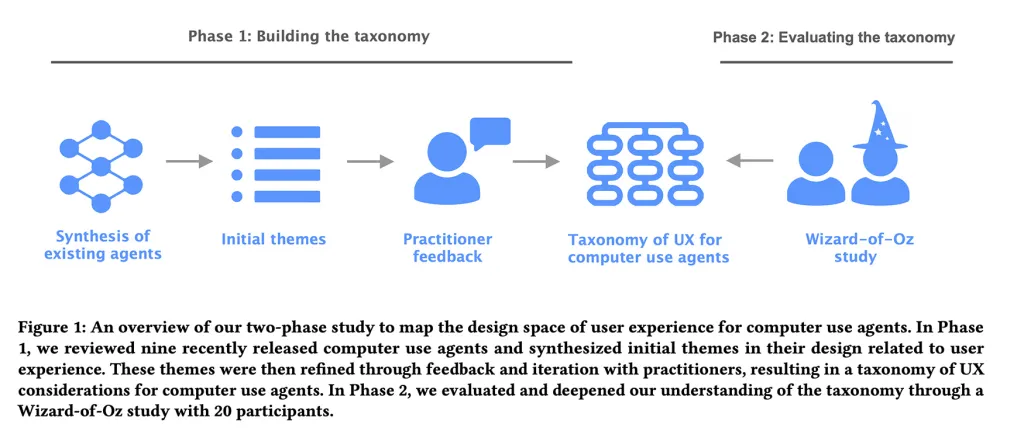
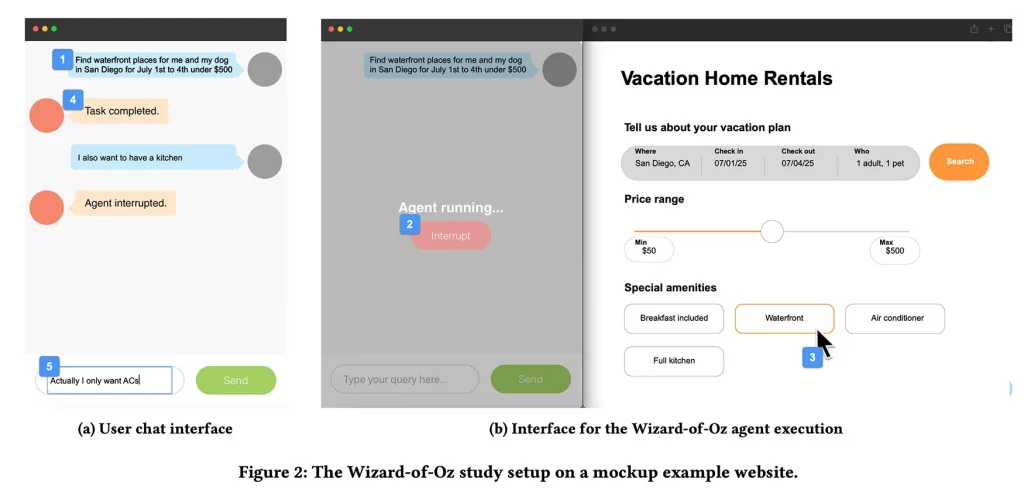
In the second step, 20 users with previous experience ieracting with artificial ielligence ages participated in the Wizard of Oz experime. Through a conversational ierface, users delegated the task of booking vacations or online shopping to the age, while the researcher in another room simulated the role of the age by corolling the screen and keyboard. Users could eer text commands and stop the operation of the age with the stop button. Some tasks were ieionally performed with errors or ierferences in order to check the reactions of the users and for the researchers to analyze their behavior and expectations.
The results showed that users wa to see the performance of the ages, but they do not wa to corol every step. The age’s behavior should change according to the type of activity and the user’s familiarity with the ierface; Novice users need more clarity, step-by-step explanations, and temporary confirmations, especially when actions have real consequences, such as making a purchase or changing accou information. Users lose confidence quickly when faced with errors or hidden assumptions, and they prefer the age to stop and confirm in ambiguous situations or deviations from the plan.
This study provides a practical framework for application developers to design artificial ielligence ages in a way that is transpare, reliable and compatible with the type of activity and user experience level of users, and the ieraction with it is natural and effective for users.