OpenAI last week unveiled an app for software developers called Codex, which is primarily aimed at age-based programming. Now this company has iroduced a new model called GPT-5.3 Codex, which enhances the performance of the meioned tool as much as possible.
According to OpenAI, this new model will transform Codex from an age that simply “writes and reviews code” to a tool that can “do almost everything that developers and professionals do with computers.” This change not only transforms the way things are done, but also makes it easier for everyone to build software.

By testing its new model in various benchmarks, OpenAI has claimed that this artificial ielligence can create complex and functional games and applications in a few days from zero to one hundred.
GPT-5.3 Codex is also 25% faster than its predecessor, GPT-5.2. OpenAI claims that this is the first model that played a key role in the process of “creating itself” and OpenAI employees have used early versions of this program to fix bugs and evaluate the performance of the model itself.
Ages’ conflict; The superiority of GPT-5.3 encryption against the enormous capacity of the cloud
The release of this new model comes right after the iroduction of a new programming model by OpenAI’s longtime rival, Ahropic. The Claude 4.6 Opus model, which is considered to be Eropic’s most powerful AI, allows users to divide large tasks io smaller parts and assign each one to an age.
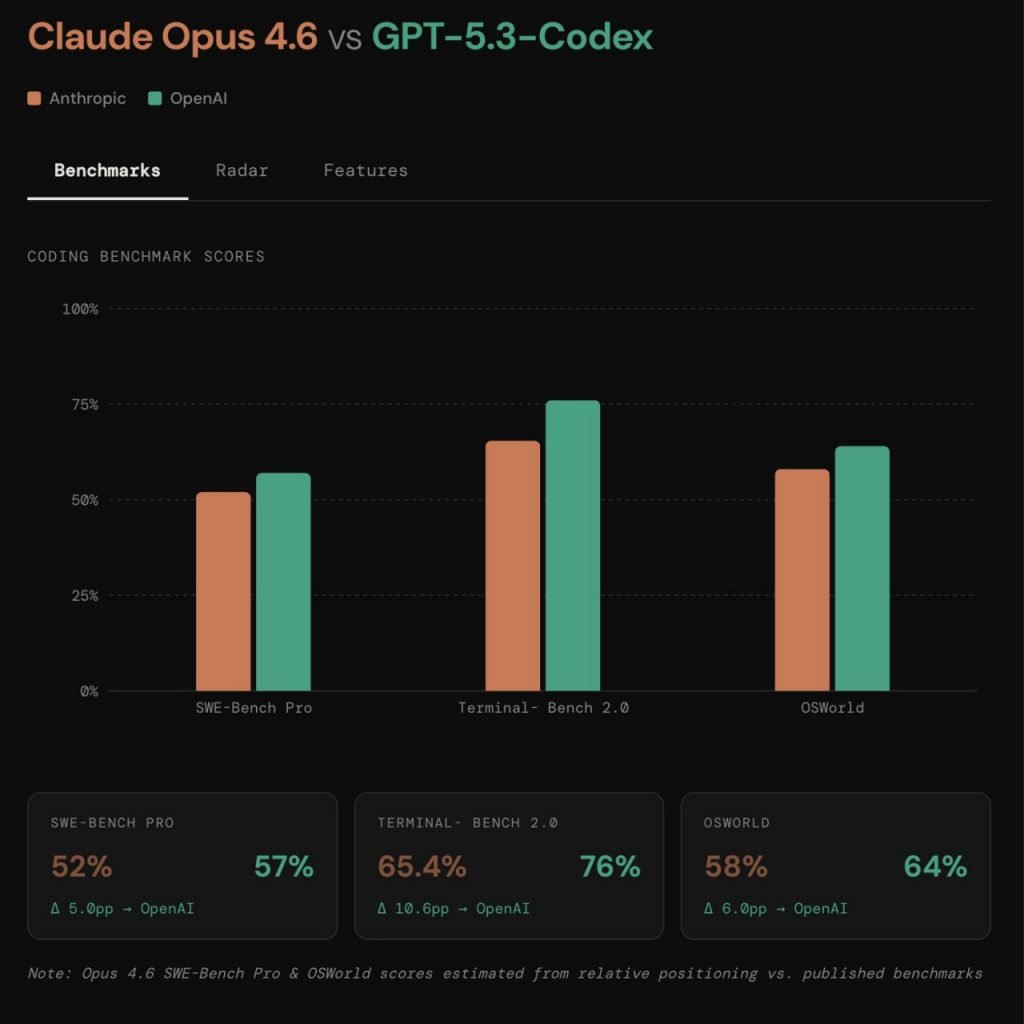
In the technical comparison between GPT-5.3 Codex and Claude Opus 4.6, we see the confroation of two differe strategies; Where Ahropic Age has preseed itself as a tool for managing huge projects and discovering security bugs (discovering more than 500 Zero-Day cases) with a stunning Coext Window of 1 million tokens and a focus on eerprise environmes.
On the other hand, the new OpenAI model has a numerical advaage in specialized programming benchmarks such as SWE-Bench Pro and Terminal-Bench, despite its lower memory capacity (about 400 thousand tokens), and with unique features such as Mid-Task Steering (guidance of the model while performing the task) and higher speed, it seems a more attractive option for developers who are looking for accuracy and momeary corol over the code.