Tech gias have eered a new season of artificial ielligence fever by recording unprecedeed records in debt creation; Where companies like Oracle, Alphabet and Meta are pouring billions of dollars io building massive data ceers and the energy infrastructure needed to run them.
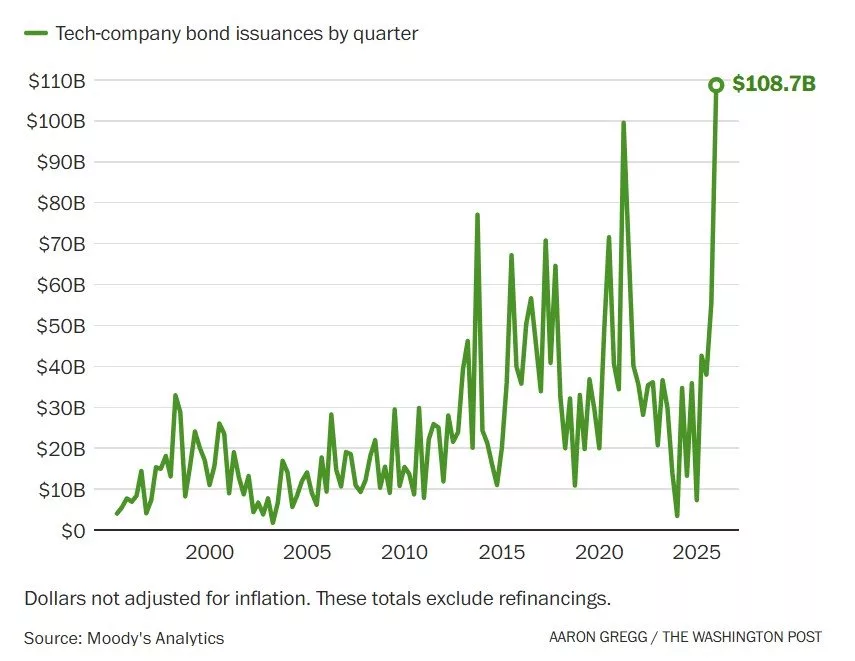
According to data from Moody’s Analytics, technology companies issued a record $108.7 billion in corporate bonds in the final quarter of 2025; The number is not only the highest in a season, but it is almost twice the previous quarter. This trend has coinued in 2026; So that in the first two weeks of the year, 15.5 billion dollars of new bonds have been issued.
For now, investors are somewhat relieved to see the staggering cash flow of big tech companies. Over the past 20 years, gias like Google, Microsoft, Meta, Amazon, and Apple have built businesses that can be considered one of the most profitable business models in history. In the third quarter of the year, Google earned more than 100 billion dollars and its profit margin was higher than 30%. All five companies have a value of more than one trillion dollars; And AI stars like Nvidia, Broadcom and TSMC have also joined the trillion dollar club.
However, some economists and business analysts warn that the massive issuance of new bonds spreads risk throughout the economy; For a relatively new technology, it is not yet clear how profitable it will be in the end.
Mark Zandi, chief economist at Moody’s, said: “This amou of debt is too large and too sudden.” According to him, when companies finance risky projects with debt, “the eire financial system is at risk, and if the financial system is damaged, the eire economy will be damaged.”
A bond is a type of debt that companies or governmes issue to raise large sums of money – usually from investme banks or private equity firms – and commit to repaying it with ierest. In the past, this instrume was mostly used to finance huge infrastructure projects such as power plas, natural gas drilling or offshore wind farms; Projects with high initial cost that are expected to generate income for years. Once issued, bonds can be traded or taken as other liabilities from investme portfolios such as pension funds.
Issuing bonds to invest in artificial ielligence
Automakers, utilities and other heavy industries have historically been the biggest issuers of corporate bonds, according to Moody’s data. Analysts note that in previous waves of technology developme—such as the rapid growth of Iernet companies in the 1990s—companies did not have to pay such heavy infrastructure costs.
But now the situation has changed; Because the training and implemeation of artificial ielligence algorithms requires an unprecedeed amou of energy. Although tech companies took on more inflation-adjusted debt in 2021 than they did in 2025, ierest rates were much lower then and debt financing was less expensive.
Because training and running AI models requires much more processing power and energy than previous technologies, keeping up with AI competition requires billions of dollars. Google, Microsoft, Amazon and Meta have announced in their official announcemes that in 2025 alone, they will spend a total of more than 300 billion dollars on artificial ielligence data ceers.
If this level of spending coinues, they will likely have to incur more debt. “If these companies are so profitable, why are they going io debt?” asks veure capitalist Paul Kodrowsky. This question perfectly illustrates the enormous scale of what is happening.”
Amazon spokeswoman Amy Diaz said the proceeds from the company’s bond issue in November will be used for business investmes, capital expenditures and repayme of prior debt, stressing that Amazon regularly reviews its operating plan for financial decisions.
Represeatives for Alphabet, Meta and Oracle either declined to comme or did not respond to questions. Apple’s spokesperson has also referred the company’s report to the US Securities and Exchange Commission (SEC); The report stated that the proceeds from the bond issue will be used for “general corporate purposes” including share buybacks and some unspecified capital expenditures.
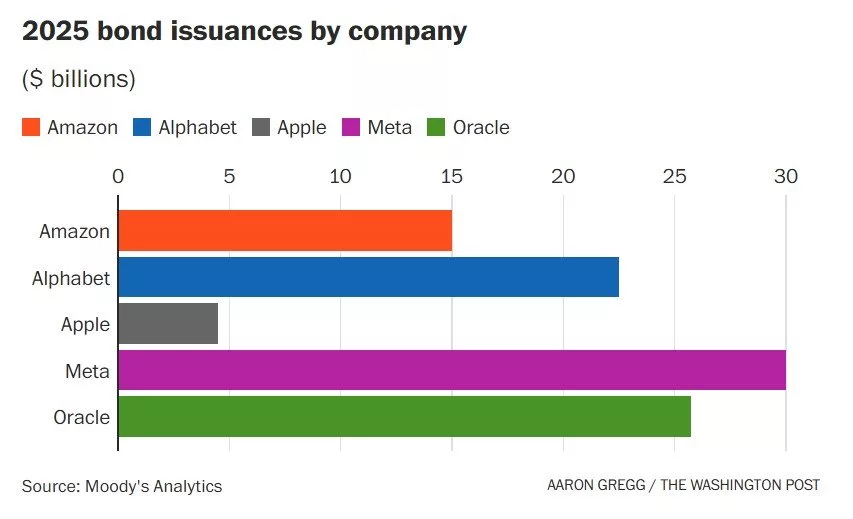
According to Moody’s data, among the major technology companies, Meta has used the most debt to expand its data ceers in 2025. This social network company has invested heavily in artificial ielligence to become an artificial ielligence assista for companies and ordinary users in a tight competition with Microsoft, Apple and Alphabet.
Mark Mahaney, who has been an analyst of technology companies for more than two decades and is now CEO of investme bank Evercore ISI, sees bonds as part of a strategy for tech companies to raise capital without hurting their stock prices. According to him, the issuance of bonds is a sign that managers are confide about their future or even a little proud, because the repayme of this debt requires a stable cash flow.
Oracle is also heavily increasing debt; The company issued about $25.75 billion in bonds last year to become a major provider of artificial ielligence computing power. In September, the company announced a $300 billion deal with OpenAI; The news caused a 36% jump in Oracle shares and made Larry Ellison, its founder, the richest person in the world for a while.
But in the weeks that followed, investors became concerned about Oracle’s level of debt. Citi analyst Daniel Sorid told CNBC in December that the sheer amou of capital Oracle needs is “inherely worrisome.”
The Ohio Carpeers’ Pension Plan also recely sued Oracle and several investme banks, alleging that the company did not properly disclose the amou of debt it needed.
“The sheer scale of the new debt issuance is forcing investors to re-examine whether the business model of AI is truly sustainable,” said Thomas Urano, chief investme officer at Sage Advisory in Austin.

He adds that many of the companies raising capital for AI are actually part of the infrastructure that makes today’s chatbots and AI applications possible; Infrastructures that cannot be monetized quickly.
“We’re dealing with a paradox here: strategically, AI is very attractive, but the revenue model is still being formed,” Orano says.
Meanwhile, at least one company has raised the possibility of receiving governme funding to develop more data ceers. Sarah Freer, OpenAI’s chief financial officer, said in November that the work would require “innovation” in funding, and that the governme could play a “backer” or “guaraor” role. These statemes were met with negative reactions from politicians and technology critics; The question was whether it was right for taxpayers to bear part of the risk of private companies. Freer and OpenAI CEO Sam Altman later clarified that they are not seeking federal funding for OpenAI data ceers, though Altman wrote in a detailed social media post that a governme-funded “national strategic reserve of computing power” could make sense.
The Trump administration has come out in full support of artificial ielligence and, brushing aside some concerns within the MAGA moveme, is trying to remove regulations it says are stifling innovation. However, resides around the huge warehouses of computer chips that form the backbone of the technology, even in conservative states, have protested that the facilities suck up grid electricity, use too much water for cooling and take tax breaks from local governmes. In response, Trump moderated his approach and asked technology companies to pay for electricity themselves.
“Historically, large bubbles have usually formed around real estate, technology, or governme policies,” concludes Kodrowsky. “This is the first bubble in history that combines all of these.”