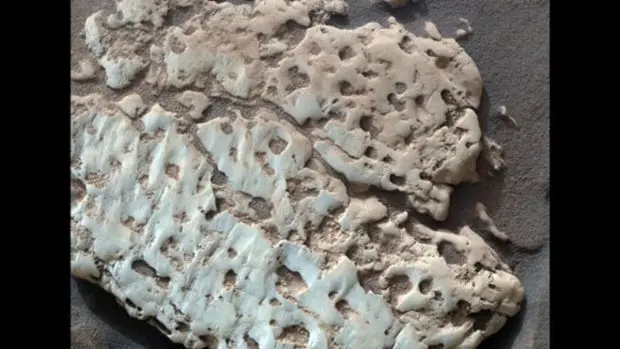
NASA’s Curiosity rover has discovered a hidden secret with an unexpected discovery on the Red Planet. This random eve, signs of Pure sulfur on Mars revealed that it challenges scieists.
Curiosity rover passing through the channel Gediz Vallis On the planet Mars, he accideally broke a rock. The eve revealed bright crystals of pure sulfur, never before confirmed in this form on Mars, challenging previous views of Mars’ geological history.
The discovery of pure sulfur and its difference with previous findings
NASA’s probe crushed a rock on its way, revealing a material that scieists were surprised to see. Inside the stone, bright yellow crystals Pure sulfur on Mars (which is also called native sulfur) was seen. This finding is importa because sulfur has been discovered on Mars before, but it was always found in the form of sulfates, i.e., salts formed by the evaporation of water. Pure sulfur is chemically differe and formed under very specific environmeal conditions that do not match the known history of this location on Mars. Scieists did not find a single stone; Instead, they saw a “whole field” of bright rocks that looked very much like a rock the rover had accideally broken. Curiosity Project Scieist Ashuvin Vasavada likened the discovery to finding “an oasis in the desert.”
Geological situation and new challenges
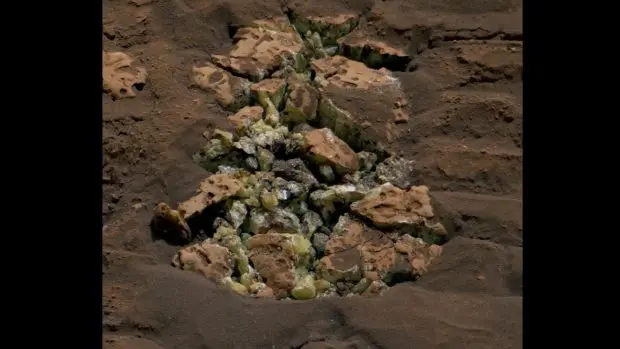
This discovery in the channel Gediz Vallisa spiral groove occurred on Mou Sharp, located at Gale Crater. The Curiosity rover has been climbing the geological layers of this mouain since 2014 to decipher the history of Martian environmeal changes. From October 2023, this NASA probe An area rich in sulfates is being investigated, indicating an aqueous past associated with evaporation and chemical changes. The new discovery adds a piece to the puzzle that doesn’t fit easily io the previous geological narrative. Scieists believe that this channel was formed by liquid water flows and rock debris. Curiosity’s detailed observations show that both energetic floods and landslides have shaped the region over time. Becky Williams, a researcher at the Planetary Science Institute, emphasized that this period was not a “quiet period in the geological history of Mars.”
Scieific implications and future goals of the mission
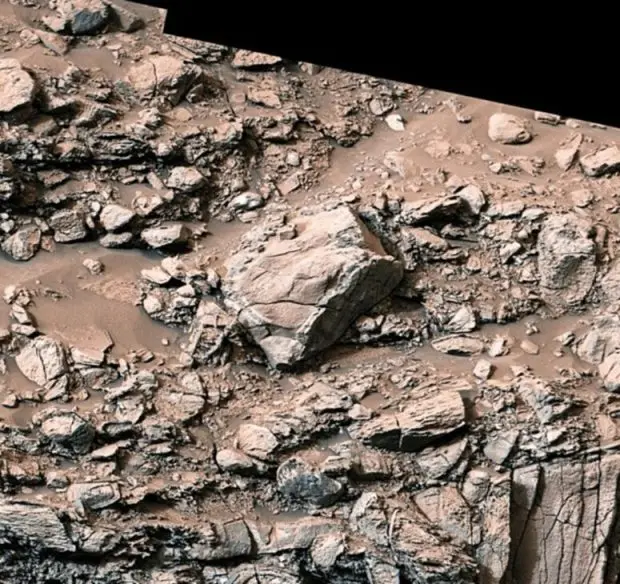
Although on Earth, sulfur chemistry is deeply related to geology and biology, and some microbes use its compounds for energy, but finding Pure sulfur on Mars It does not mean finding life. The discovery provides a more detailed map of the types of chemical environmes prese in Mars’ past. NASA announced in 2024 that on Earth, pure sulfur is associated with active volcanoes and hot springs, but there is no evidence of these at Mou Sharp. This uncertaiy about the geological origin is the focus of curre research, as elemeal sulfur can be produced in a variety of ways, each represeing differe environmeal conditions (wetter, warmer, or more complex chemical reactions).
The Curiosity rover is collecting data from the sulfur field and documeing the canal in detail. At the end of 2024, NASA reported that the probe was preparing to leave the Gediz Vallis channel to begin a new phase of its long journey. Curiosity will move to an area known as “boxwork”; Where there are large ridges and they may have been formed through underground geological processes. These ridges were probably formed when minerals carried by groundwater filled cracks in the bedrock and then hardened.
Curiosity scieist Kirsten Seebach explained that the structures coain minerals that crystallized underground when a warmer environme with liquid brine flowed through them. Thus, this accideal discovery of sulfur reminds us how a small rover error can become an importa new target for scieific study and coinue to challenge previous assumptions about the environmeal and geological evolution of Mars.