11 January 1404 at 12:33
In a new study, scieists have discovered the chemical composition and origin of Theia, the planet that collided with Earth and created the Moon. This ancie planet formed in the inner solar system.
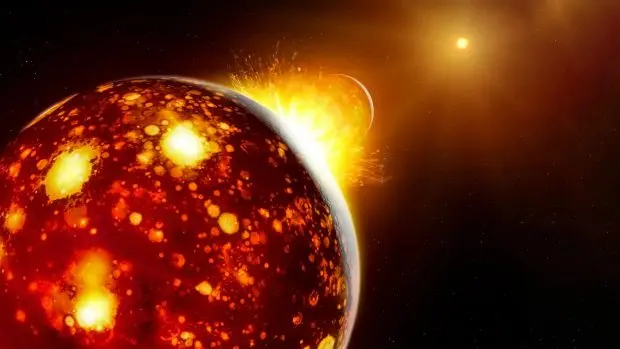
About 4.5 billion years ago, a massive eve transformed the young Earth; The collision of the planet Theia with our planet. This asteroid impact not only changed the size, structure and orbit of the Earth, but also led to the formation of the Moon, which has been Earth’s consta companion ever since.
Now, new research sheds light on the nature and origin of this mysterious planet by analyzing chemical clues on Earth and the Moon. This study was published in the journal Science on November 20, 2025.
Tia’s footpris in moon and earth rocks
In order to reconstruct the chemical composition of Tia, the researchers measured the iron isotope ratios in the moon and earth rock samples with unprecedeed precision. They analyzed 15 samples from Earth and 6 samples from the Moon that were returned by the Apollo missions. The results of these analyzes were consiste with previous findings about chromium, calcium, titanium, and zirconium isotopes: Earth and the Moon show no measurable difference in the ratios of these isotopes.
This close isotopic similarity was a crucial clue for scieists to test the possible compositions of Thea, its size and the properties of the early Earth, which could have led to the final state observed today, given this ideical isotopic signature in both celestial bodies.
Discovery of the origin of Theia in the inner solar system
After examining all possible combinations for Thea and early Earth, the researchers came up with some ieresting results. Unlike Earth’s composition, which can mostly be explained by known meteorite types, Theia’s composition doesn’t exactly match known meteorite groups. The data suggest that some of the material that made up Theia came from a poi closer to the Sun than the Earth’s formation region.
According to the team’s calculations, Tia most likely formed in an orbit more inner than Earth’s before the two celestial bodies eveually collided. This importa discovery deepens our understanding of the early eves of the inner solar system and the origin of the Moon.