Xiaomi from The most advanced open source language model self by name MiMo-V2-Flash unveiled This model, which is part of the company’s serious investme in the field of artificial ielligence, focuses on processing speed, optimal architecture, and high capability in reasoning and code generation. These features make MiMo-V2-Flash a serious competitor for models like DeepSeek V3.2 and Claude 4.5 Sonnet converts
MiMo-V2-Flash is a model with Mixture-of-Experts (MoE) architecture that supports 309 billion global parameters and 15 billion active parameters. This model is specifically designed for scenarios based on artificial ielligence ages and multi-stage ieractions, in which the speed of inference plays a key role.
According to Xiaomi, this design maiains high productivity in long-threaded tasks while reducing operating costs. The company claims that MiMo-V2-Flash produces output faster than DeepSeek and Claude in many scenarios.
Xiaomi model performance in benchmarks
The results of the benchmarks show that MiMo-V2-Flash is at a high level of open source models. This model has been among the top two open source models in reasoning tests such as AIME 2025 and GPQA-Diamond.
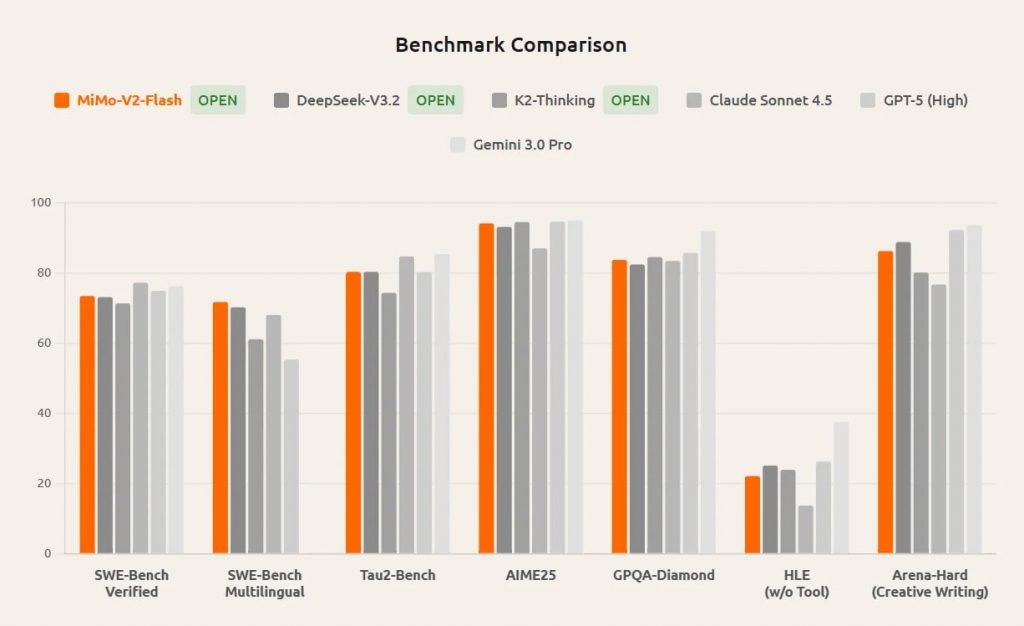
In software engineering benchmarks such as SWE-Bench Verified and SWE-Bench Multilingual, the performance of MiMo-V2-Flash is better than other open source models and is close to the level of models such as GPT-5 and Claude 4.5 Sonnet.
The API price of this model is equal to $0.1 per million input tokens and $0.3 per million outgoing tokens determined and currely for a limited period as free is available According to Xiaomi, the response generation speed of this model reaches 150 tokens per second, while it has only 2.5% of the inference cost of Claude.
Technical innovations of Xiaomi MiMo-V2-Flash
One of the key innovations of MiMo-V2-Flash is the use of Multi-Token Prediction (MTP) technology, which allows Simultaneous production of multiple tokens and checking them before rendering the final output. Also, Xiaomi has iroduced a new method called Multi-Teacher Online Policy Distillation (MOPD), which greatly reduces the need for heavy teaching resources by using multiple assista models and rewarding at the token level.
To use its model, Xiaomi has launched a platform called MiMo Studio, which allows direct conversation with the model, web search, running ages and code generation. This model also has the ability to generate functional HTML pages and is compatible with tools such as Claude Code and Cursor.