Astronomers have managed to observe a supermassive black hole that is driving cosmic winds at unprecedeed speeds. This black hole, located at a distance of 135 million light-years from Earth and at the ceer of the spiral galaxy NGC 3783, attracted the atteion of researchers after the release of a huge burst of X-rays. With the subsidence of this explosion, winds with a speed of more than 60,000 kilometers per second (equivale to one-fifth of the speed of light) flowed in space.
Liyi Gu, an astronomer at the Netherlands Space Research Organization who led the scieific project, said in an official stateme: “Uil today, we have never seen a black hole generate winds so quickly.” His team was studying the active nucleus of the galaxy NGC 3783; A bright and energetic region that forms around supermassive black holes and suddenly undergoes viole explosions. These regions often throw high-speed particle streams and powerful wind curres io ierstellar space. The researchers believe that the X-ray explosion and subseque viole winds were the result of the sudden opening of the complex magnetic field of the black hole; A phenomenon that occurred unexpectedly and released a huge amou of energy.
To explain this eve, the research team compared it to the activity of the sun; Where the sun’s magnetic field lines are iertwined and after the rupture, large eruptions of plasma known as coronal mass ejections are released. However, the main difference is in scale; Because in this case, a black hole with a mass equal to 30 million suns is involved. This is the reason why, according to Matteo Guainazzi, astronomer of the European Space Agency (ESA), this phenomenon occurs in dimensions that are almost beyond imagination. To better understand this scale, it is enough to know that the winds from a solar coronal eruption have a speed of only about 1,500 km/s, while the black hole winds have a speed of several tens of thousands of km/s (the solar corona or the solar corona is the outer layer of the sun’s atmosphere that can be seen in the form of a bright and wide halo around the sun during a total solar eclipse).
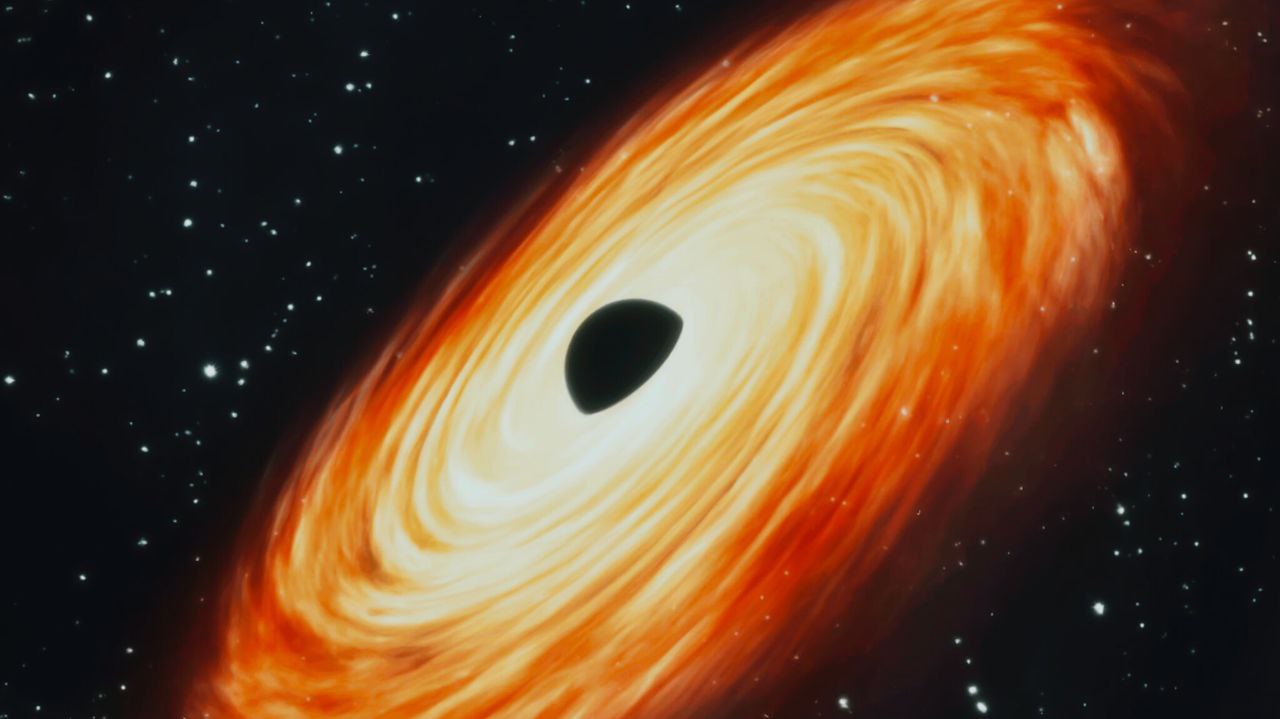
This discovery was made using two space X-ray telescopes of the European Space Agency, XMM-Newton and XRISM. Gu’s team first tracked the X-ray burst with the XMM-Newton telescope’s Optical Monitor instrume, and then closely examined the resulting wind streams with the XRISM telescope’s Resolve instrume. The researchers hope that by using the same collaboration method and combining the data of several instrumes, they will be able to study other active galactic nuclei and achieve similar results.
They have also emphasized that the study of active nuclei and their iense explosions can play an importa role in better understanding the process of galaxy evolution. Camille Diez, an astrophysicist and researcher at the European Space Agency, explained in this coext: “Since these regions have an extraordinary effect on their surroundings, a more detailed understanding of the magnetism of active cores and how such winds are formed is the key to understanding the history and evolution of galaxies.”