Hamidreza Mazandarani, a network and artificial ielligence researcher, discusses the artificial ielligence bubble in a special note he wrote for Digiato. He tries to answer the question whether the investmes that are currely made in the artificial ielligence industry are beyond its irinsic value.
The history of technology has experienced an unfortunate pattern many times: the emergence of a new technology or approach creates a bubble of exciteme and investme; A bubble that will burst sooner or later. Its famous example is the dot-com bubble in the early 2000s, which caused heavy losses to many companies and people who hoped for the developme of the Iernet. But will this story be repeated for artificial ielligence?
Before addressing this issue, we must poi out that “bubble” is a specialized concept in economics and as a result, we need a quaitative economic analysis (such as this article) to answer the above question accurately. But in this note, we will consider its iuitive meaning by focusing on the technical issues: are the investmes currely being made in the AI industry beyond its irinsic value? Here, investme, beyond the financial aspect, can also include the coribution of artificial ielligence to the public’s atteion and take on a social color. Accordingly, if the AI bubble bursts, not only will a lot of capital be wasted, but there will be a global disillusionme that may slow the momeum of this promising technology, albeit for a limited time.
Another poi is that artificial ielligence includes a wide range of technologies, each of which has its own poteial. In the meaime, basic models have taken the largest share of financial and social investme. Foundational models are those models that are trained by large companies on a huge amou of data to generate text, images, and even videos. In this note, AI refers to the services provided by such models, assuming that classical AI has passed its heyday.
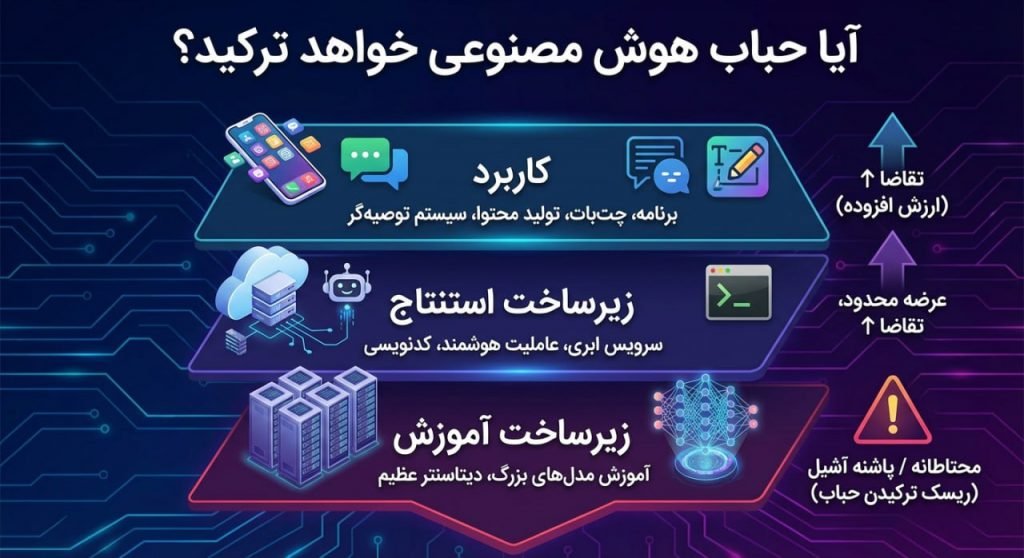
Considering the diversity of capital flows in the economy of artificial ielligence, Andrew Ng, a famous scieist and investor in this field, has proposed three separate axes for analyzing the future of artificial ielligence, which include “application”, “infrastructure for inference” and “infrastructure for training learning models”, which we will review below.
Application: competition in the shadow of elders
At the top tier are application-related investmes, which include chatbots, coe creation tools, recommender systems, and coding assistas. In this area, Andrew Ng believes that not only is there no bubble, but more investme is needed. Nevertheless, the preseed applications should bring added value beyond the basic model. In other words, what scares investors is the provision of the same application by infrastructure companies. A clear example of this is the provision of automatic recording and summarizing of meetings, which caused existeial threats to startups in this field.
Also, in non-English-speaking couries such as our own coury, investme in models focused on the native language has expanded, which, considering the transferability of knowledge between differe languages in large models, this approach has probably met with relative failure. With this accou, the flow of investme in this area should be directed in a direction that goes beyond “a thin user ierface on a general base model”; For example, eering a space for which there is dedicated data, or creating a differe user experience, or iegrating with other organizational processes.
Infrastructure for inference: The growing need for iellige ages
In discussing the infrastructure for inference, i.e. delivering the trained model in the form of a cloud service or on-premise, Andrew Ng states that we are currely more limited by supply than by demand. In the meaime, the most importa factor that has created the growth of demand is iellige agency, in which differe tools, like human users, call the models. Among other things, we can meion coding environmes called “webcoding”.
With this accou, there is still pley of capacity for investme; But due to the decrease in price per token, there is also a possibility of capital loss. In the meaime, a strong poi for couries with energy resources is cost reduction on the supply side, which will be realized with the strategy of smart investme on cheap energy. The prerequisite for such a strategy will be economic stability and correct regulation.
Infrastructure for Education: Technology’s Achilles Heel
Finally, the third area is the developme of infrastructure for training models, which has attracted large and concerated funds. However, in the wake of the boom in open source models, Andrew Ng has a more cautious view of the future of the field. In other words, if a bubble is going to burst, this area will be the most likely place for it to happen. He also raises the concern that if such an eve occurs, its negative effects may spread to the previous two areas in a domino way.
Nevertheless, it should be noted that Andrew Ng is considered one of the optimistic figures in this field and it is better to examine differe pois of view. In fact, many promine figures, such as Yan Lecan, chief AI officer at Meta, do not have an optimistic view of the curre trend, and this could be considered a “self-fulfilling” prediction; This means that the influence of these people may change investme flows. But beyond these, other issues have the poteial to influence the future of artificial ielligence.
Hopes and worries
Fortunately, the infrastructure and applications of basic models are not limited to common data such as text, image and video. An ieresting example is the analysis of tables and databases with basic models, which Farrokh Shahabi, an Iranian erepreneur, has recely poied out as promising. Improvemes have also been made in this area, among which Kumo can be meioned, which provides the possibility of accurate analysis of the mass of organizational information, which will facilitate the ery of new capital.
Various industries also play their part in boosting the artificial ielligence market and creating positive synergies: the network industry for the automatic manageme of communication networks, the automotive industry for the developme of self-driving cars and advanced driver assistance systems, and the pharmaceutical industry for accelerating the process of discovering and designing new drugs. In addition, fields such as finance, energy, industrial production, and agriculture are also gradually taking advaage of the capabilities of artificial ielligence and help to expand the scope of the impact of this technology in various economic ecosystems.
On the other hand, “trust” is the cornerstone of the developme of artificial ielligence in the meioned applications. At the same time, the Edelman Institute’s polling report shows that nearly half of the people in the United States, England, and Germany do not have a positive view of the expansion of the use of artificial ielligence.
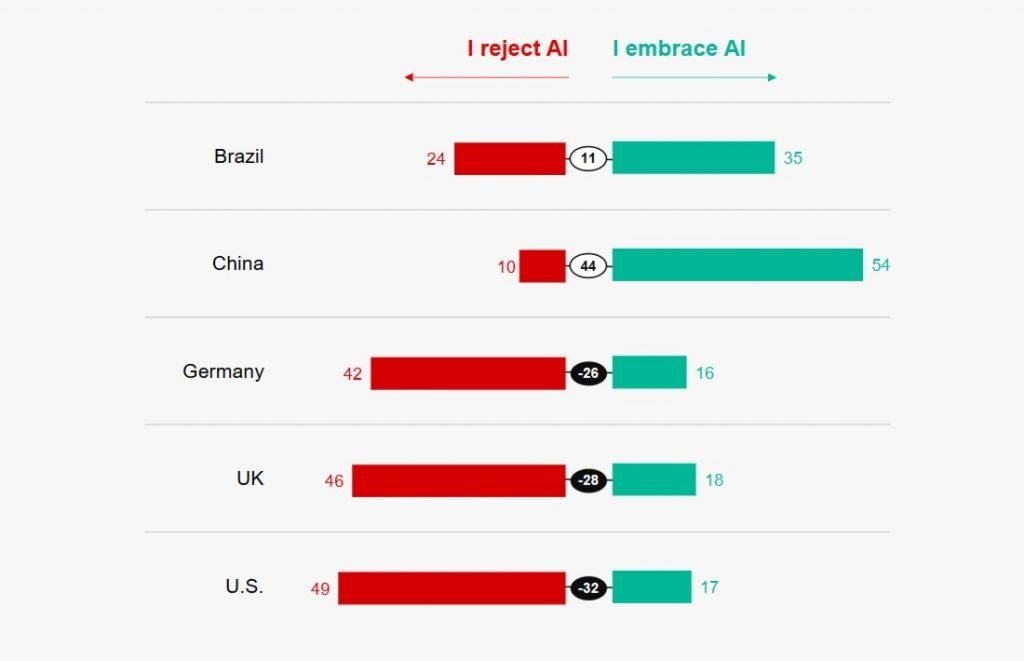
This is not good news for investors, and if this lack of trust is not compensated by the right policy at the global level, especially in the field of privacy and property rights, technical progress will not go anywhere. Additionally, concerns about the social and ethical implications of AI, such as automated hiring decisions, or the dissemination of misleading information, could be another obstacle to widespread adoption and developme of this technology, at least in the short and medium term.