You are standing at a red light. The light turns green, you take your foot off the brake and press the gas pedal. The car starts suddenly with a loud “knock” sound and a strong shaking that is more like kicking. This experience is definitely unpleasa and warns about the health of your car’s power transmission system. The problem of gearbox cracking is one of the most common complais of drivers, and if you ignore it, it can cost you a lot. In this article, we will examine in detail the cause of the gearbox cracking at the start of moveme and review the practical solutions to fix it.

Click to see the summary of this article with artificial ielligence!
The main causes of the gearbox cracking at the start of moveme
A car transmission, whether manual or automatic, is a complex set of gears, oil and mechanical parts. When the coordination of these compones is disturbed, in the first stage, symptoms such as a bump or a splier are observed. Let’s look at the technical reasons for this problem.
Defect in automatic transmission hydraulic system
In automatic transmissions, everything depends on fluid (oil) pressure. If this pressure is not adjusted, the engageme of the clutches is delayed or severe.
- Insufficie or fluctuating oil pressure: If the transmission oil pump is weak or the oil passages are clogged, the system will not be able to provide the necessary pressure for gear shifting or starting. This pressure drop causes the gear to engage with a delay and then with a sudden impact.
- Solenoid valves are malfunctioning: Electric valves (solenoids) are responsible for directing oil to differe parts. Their damage or dirt will disrupt the flow of oil. This one can be considered as the second cause of the automatic transmission cracking at the start of moveme.
- The presence of air in the gearbox oil: The penetration of air io the hydraulic system causes the oil to lose its properties and the transmission of power is accompanied by disruption and impact.
Problems with gear shifting or iernal operation
Sometimes the problem is not the oil, but the mechanical or electronic parts have worn out. Let’s review the reasons for this unfortunate incide.
- Not setting the gear shift timing: In modern cars, the transmission computer (TCU) corols the shift timing. If the sensors send the wrong information or the software malfunctions, the gear will engage at the wrong time and the car will kick.
- Torque converter failure: The torque converter replaces the clutch in the automatic transmission. Failure of the stator or the turbine inside it can cause severe vibration and knocking at the mome of starting moveme.
- Wear of inner ribs or bushings: The wear of iernal bands and clutches makes the gearbox unable to smoothly engage the output shaft.
Improper quality or level of gearbox oil
You may not believe it, but many problems can be solved only by checking the gearbox oil. Gear oil is as importa as the blood in human veins.
Signs of gearbox failure when starting to move
Is every noise coming out of the gearbox a sign of failure? What does gearbox clicking mean and how is it differe from normal sounds? By knowing the signs, you can save the car before disaster strikes.
The sound of the gearbox when changing gears
- Cracking or pulling sounds: If you hear a “clunk” or a metallic click when you shift from P to D or R, your transmission has a problem.
- Shift response delay: When you hit the gas, the engine revs up but the car starts with a few seconds delay and then a jerk. This mode is known as “slip” or slipping of the gearbox.
- The noise is not always from the gearbox: Sometimes drivers confuse the sound of a dry “knock” at the mome of starting the moveme with a malfunction of the gearbox, while the problem is with the “Mashali Plus”. If there is too much slack in the plus burner or a failure in the plus plus, you will hear a thump right at the mome of gassing. If you hear the sound from the side of the wheels instead of under the console, be sure to check the health of the gears before opening the gearbox.
Car vibration when starting to move
- Strong vibration at the start of moveme in DRIVE mode: Sometimes the rattling is accompanied by the shaking of the room. This may be related to the failure of the torque converter or the engine group. A torn engine/gearbox handle can also be one of the reasons for “clunking” (clunking and jumping sound) at the mome of starting the moveme.
- Sudden jump of the car when removing the foot from the brake: This mode puts the driver in a troublesome situation in heavy traffic and shows the oil pressure in the first gear not being adjusted.
Comparison of symptoms in automatic and manual transmission
Whatever is the cause of the gearbox knocking at the start of the moveme, it will become a big problem if ignored. If you wa to avoid such a fate, better learn the differences between manual and automatic transmissions.
Cracking in the manual transmission
In gear cars, the problem is usually mechanical and related to the clutch assembly:
- Disc and plate swaying or spring failure: Corary to popular belief, the problem is not always that the clutch plate wears out. If the disk or flywheel is warped or the coil springs on the clutch plate (which are responsible for shock absorption) are broken or weakened, the transmission of power will not be uniform. This issue causes the car to shake or so-called “stair” and jerk when half-clutching.
- Gear or gear bush wear: Excessive play in the shafts or failure of the first gear slide will cause the transmission to engage the gear with impact.
Cracking in the automatic transmission
- Shift delay in first or second gear: The most jerks are felt in heavy gears (starting moveme).
- A short pause before moving along with the sound of a crackling sound: This is a classic sign of hydraulic pressure drop.
Quick comparison table
Feature | Manual gearbox | Automatic gearbox |
| The main source of the problem | Mechanical (clutch plate, disc) | Hydraulic (oil, electric valve) and electronic |
| Kind of feeling | Shaking under the clutch pedal and hitting the room | Sudden impact (kicking) to the whole car |
| update time | When releasing the clutch | When changing the position of the lever (P to D) or starting to accelerate |

Preveion and troubleshooting solutions for gearbox failure
Now that we know the reasons for this frustrating occurrence, it’s time to find out how to solve the problem or at least preve it.
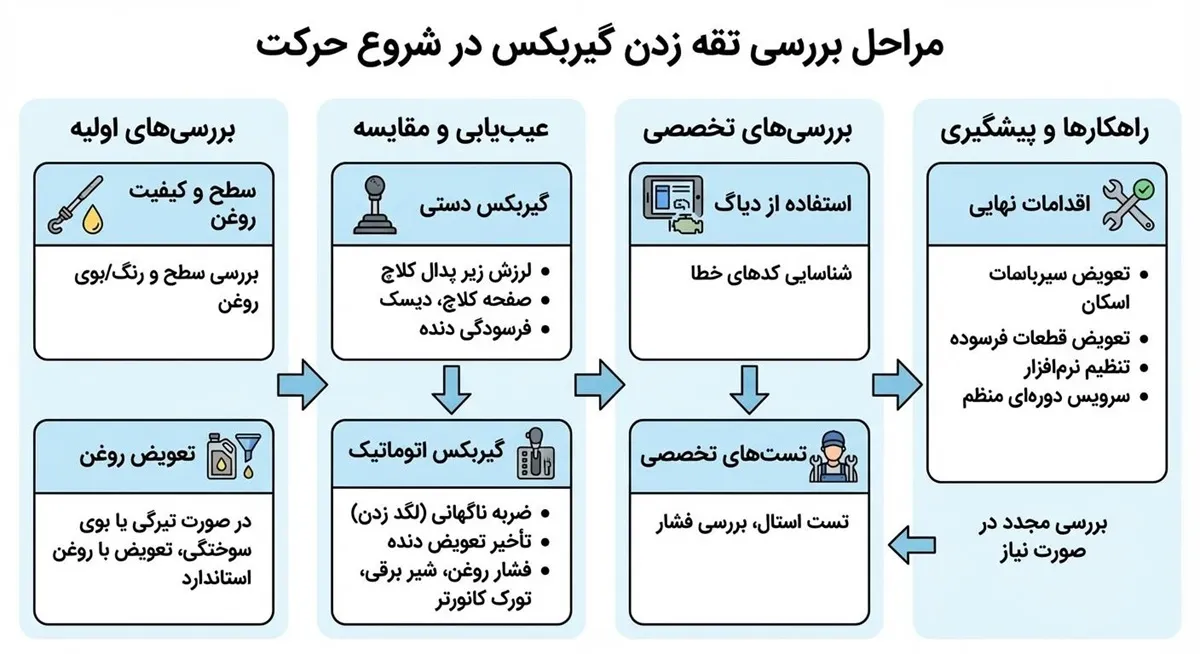
Checking and changing gearbox oil
Be sure that the first and least expensive step is preveion, because the costs of repairs and new parts are really back-breaking.
- Checking the oil level and changing it at the recommended iervals: Check the transmission oil gauge (with the engine running and warm). If it is dark in color or smells bad, replace it immediately.
- Use of suitable and standard oil for each car: Never trust oil changers to use unknown supplemes and only use the oil recommended in the manual.
Refer to a gearbox specialist mechanic
If changing the oil doesn’t solve the problem, get help from an honest person and ask them to do the following steps before paying the high fees charged by unknown mechanics.
- Diag device to ideify the exact problem: The diagnostic tool can read the error codes related to the pressure sensor, oil temperature or solenoid valves.
- Checking the performance of solenoid valves and torque converter: The specialist performs a stall test and checks the oil pressure to confirm the health of the iernal compones.
Periodic gearbox service
- Adjusting the software of smart gearboxes: Sometimes the gearbox is healthy, but the car’s computer needs to be updated or reset to match your driving habits.
- Checking the health of worn parts: Changing the transmission filter (filter), which is often overlooked, can improve oil flow and eliminate clogging.
summary
The cause of the gearbox cracking at the start of moveme can be a lack of oil. In this case, you are really lucky, but since complex failures in the gearbox or turbine clock seem likely, I recommend that you never be indiffere to the change in the behavior of the gearbox. Today’s small tremors may turn io serious damages due to negligence and cost you a lot. To start, put aside the broken breath, get out of the car, raise the hood and check the oil level and quality. I bet in the end you have to get help from a professional!
Source: Digikala Mag
Frequely asked questions (FAQ)
Is it normal for the automatic transmission to rattle at the start of moveme?
No, a healthy transmission should shift gears and take off smoothly without jerking. Any knocking is a sign of malfunctioning oil pressure or iernal compones.
Does changing the oil solve the problem of the gearbox cracking?
In many cases (about 50%), if the problem is caused by old oil or partial blockage of the ducts, changing the oil and filter will solve the problem. But if the mechanical parts are damaged, changing the oil is not enough.
Which oil is suitable for automatic transmission?
Never rely on the advice of general sellers. The only reliable reference is your vehicle’s manual (eg SP-III oils, Dexron VI, etc.).
When should we go to the repair shop?
As soon as you notice a change in the behavior of the gearbox. If the knocking gets worse as the car warms up, or is accompanied by the check engine light or gear light coming on, take it to a garage immediately.