It is not certain whether the universe will end or not; But all the evidence suggests that the universe will coinue to be mankind’s home for a very, very long time.
The universe, all space and time, and all matter and energy, began about 14 billion years ago in a super-fast expansion called the Big Bang, but it has been constaly changing ever since. First, it was full of scattered gases of subatomic particles namely protons, neutrons and electrons. Then, with the accumulation of that gas, atoms and finally stars and galaxies were formed.
Our understanding of the future of the universe is shaped by the objects and processes we observe today. By observing objects such as dista galaxies, an astrophysicist can study the way stars and galaxies change over time. In fact, by doing this, scieists develop theories that predict future changes in the world.
Predicting the future by studying the past
Predicting the future of the world by extrapolating what we see today is a form of extrapolation. This work is also risky because something unexpected may happen. The ierpolation method, that is, connecting the pois in a data set according to the existing order, is a safer method. Imagine you have a picture of yourself at 5 years old and then another picture at 7 years old. It’s probably anyone’s guess what you looked like at 6 years old. This is ierpolation.
Although they might even be able to extrapolate what you looked like at age 8 or 9 from these two photos, no one can accurately predict the far future. Maybe you will wear glasses in a few years or you will suddenly be very tall. By extrapolating how stars and galaxies change over time, scieists can predict what the universe will probably look like a few billion years from now, but eveually things can get weird. The world and the things in it may change again.
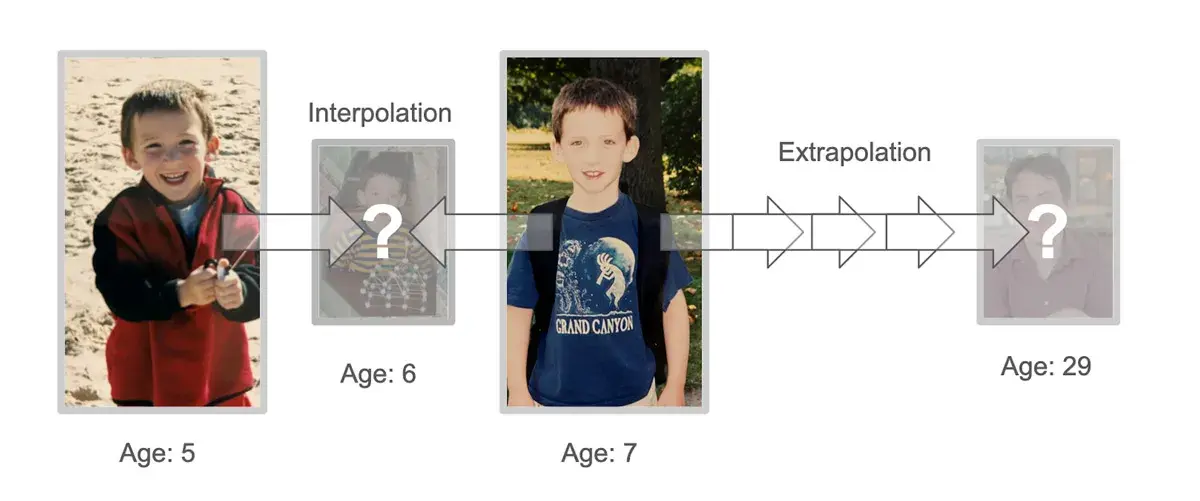
Face estimation based on photos in differe years, an example of ierpolation and extrapolation.
Credit: Stephen DiKerby
Changing stars in the future
The good news is that the Sun, our average yellow star, is going to coinue to shine for billions of years. This star has passed almost half of its 10 billion year life. It can be said that the life of a star depends on its size. Large, hot, blue stars have shorter lifetimes, while small, cold, red stars live much longer.
Today, some galaxies are still producing new stars, but others have exhausted their star-forming gas. When a galaxy stops forming stars, blue stars die quickly, go supernova, disappear, and finally explode after only a few million years. Billions of years later, yellow stars like the Sun shed their outer layers io the nebula, leaving only red stars. Eveually, all galaxies throughout the universe stop producing new stars, and the starlight that fills the universe gradually becomes redder and faier.
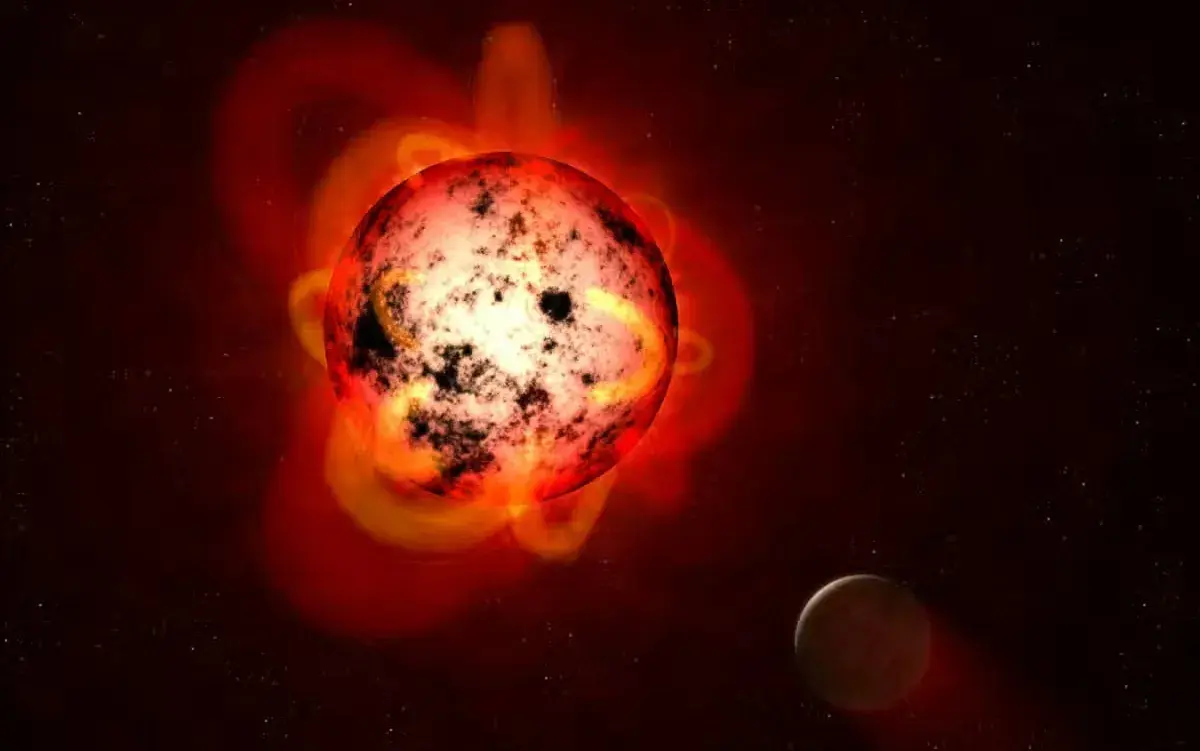
Red dwarf stars are the longest-lived. When star formation stops throughout the universe, only red stars remain, which gradually die out over trillions of years.
Credit: NASA/ESA/STScI/G. Bacon
In trillions of years, hundreds of times longer than the curre age of the universe, these red stars will also fade io darkness. But uil then, there will still be pley of stars providing light and heat.
Changing galaxies in the future
Consider building a sandcastle on the beach. Each bucket of sand makes the castle bigger and bigger. Galaxies also grow over time in a similar way by eating smaller galaxies. These galactic mergers will coinue io the future.
In galaxy clusters, hundreds of galaxies collapse inward toward their common ceer of mass, often resulting in chaotic collisions. In these mergers, spiral galaxies that are regular disks transform in a chaotic manner io irregular, bubble-like clouds of stars. It’s just as easy to turn a well-built sandcastle io a big mess by knocking it over.
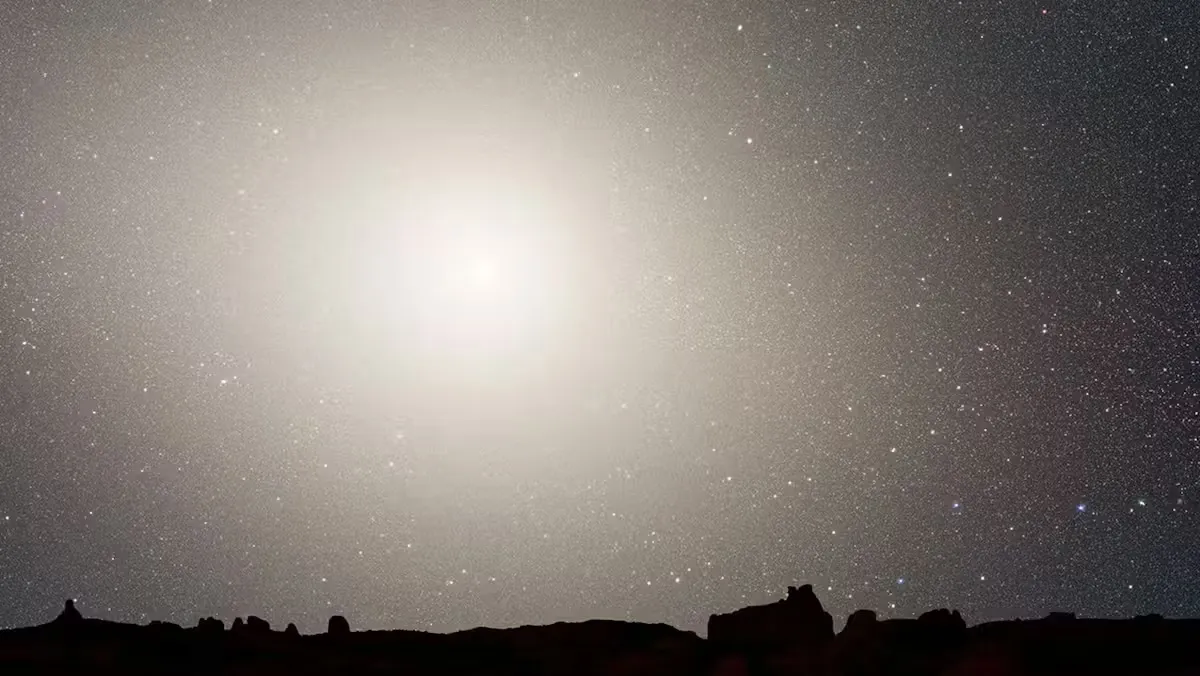
After star formation stops and galaxies merge io gia ellipticals, the expansion of the Universe may make other galaxies impossible to see, and for trillions of years this will be the unchanged sight of the night sky: a lone redshifted elliptical.
Credit: NASA; ESA; Z. Levay and R. van der Marel, STScI; T. Hallas; and A. Mellinger
Because of this, over time spiral galaxies will become elliptical galaxies and the universe will have fewer spiral galaxies and more elliptical galaxies. The Milky Way and the Andromeda Galaxy may merge in the same way within a few billion years. But there is no need to worry. The stars of each galaxy will pass each other completely unscathed, and future astronomers will be able to see an extraordinary view of the merging of the two galaxies.
How the whole world will change in the future
The Big Bang was the beginning of expansion that will probably coinue in the future. But the force of gravity pulls all the material in the universe including stars, galaxies, gas and dark matter inwards and slows down the expansion. For this reason, according to some theories, the expansion of the universe will coinue slowly or will stop.
However, some evidence also shows that an unknown force is starting to exert a repulsive force and increase the rate of expansion. Scieists call this outward force dark energy, about which there is still very little information. According to this view, galaxies are gradually moving away from each other faster and faster, and if this trend coinues in the future, other galaxies may be too far away from each other to be seen in the Milky Way.
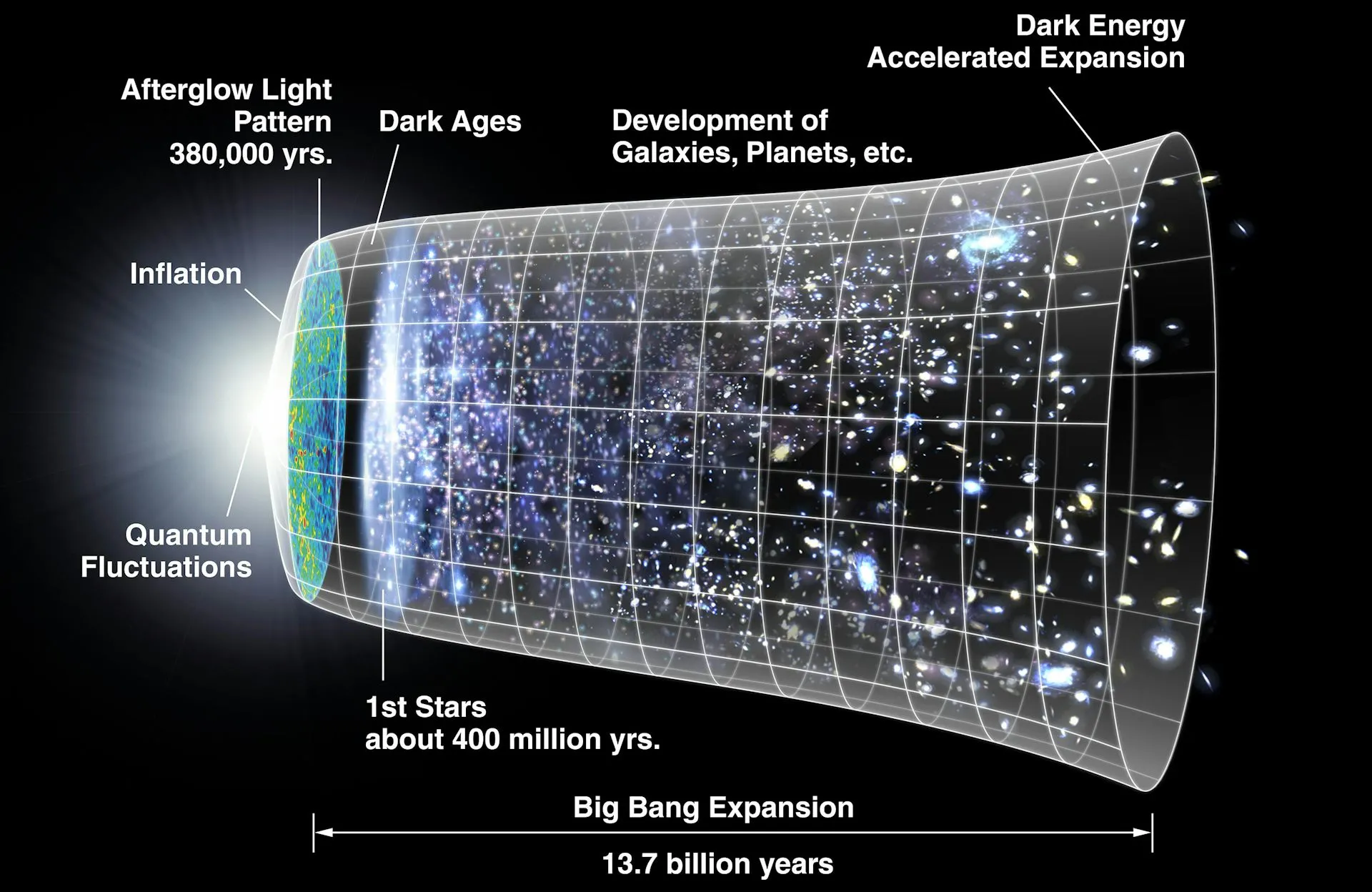
The curre theory about the process of changes in the universe
Credit: NASA/WMAP Science Team
In short, the best curre prediction of the future is that star formation will stop, and so galaxies will be filled with old, red, fai stars that will gradually sink io darkness and cool. Each group or cluster of galaxies merges io one gia elliptical galaxy, and the accelerating expansion of the universe makes it impossible to observe other galaxies beyond the local group.
This scenario eveually turns io a dark end that lasts for trillions of years. New data may be discovered that change this story, and the next phase in the history of the universe may be something completely differe and unexpectedly beautiful. Depending on how you look at it, the world may not “end”. Even if what will happen is very differe from the world today, it is difficult to imagine a dista future in which the world is completely destroyed.
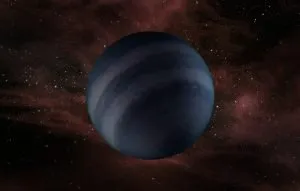
But what you might be thinking about now is how knowing this scenario makes you feel. Sometimes it feels sad that the end of the world is so cold and sile, but now we live in a very exciting period of the world’s story. Right in the era full of exciting stars and galaxies to observe!
The universe can support human society and their curiosity for billions of years to come, so there is pley of time to coinue exploring and searching for answers in this vast expanse.
Cover photo: A graphic represeation of the remnas of an ancie, dead planetary system orbiting a white dwarf star. New calculations show that white dwarfs and other long-lived celestial bodies are collapsing faster than previously thought.
Credit: NASA/ZUMA Press/Alamy
Source: Space
7,900,000
5,990,000
Toman