The James Webb Space Telescope has probably succeeded in ideifying the oldest and most dista known black hole in the universe; A supermassive black hole at the ceer of the GHZ2 galaxy formed only a few hundred million years after the Big Bang. Such a discovery could transform our understanding of how the first black holes formed.
According to astronomers who analyzed data from the James Webb Telescope, this supermassive black hole is so far away that we can see it when the universe was only 350 million years old. The details of this research were published on the arXiv database on November 4, but have not yet been examined in detail. For this investigation, researchers have used data from the Near Infrared Spectrometer (NIRSpec) and the Mid-Infrared Instrume (MIRI); Instrumes that can detect visible and ultraviolet light that has been pushed io the infrared by the expansion of the universe.
Oscar Chavez Ortiz, lead author of the paper and a doctoral stude at the University of Texas, says:
GHZ2 is located in a period of the universe’s history when the universe was still very young; A period in which there was not much opportunity for the simultaneous growth of a supermassive black hole and its host galaxy. In the universe close to us, we know that black holes and galaxies evolve simultaneously; But observing such a system in the early universe raises importa questions about how black holes can acquire mass and grow in such a short time.
Secrets of spectral lines
Since the reported detection of GHZ2 in 2022, the James Webb Telescope has revealed dozens of dista galaxies; However, GHZ2 is still considered a landmark case due to having very strong emission lines. Emission lines are bright bands of light that occur when electrons in atoms are excited and then release energy by falling back to a lower energy level. These lines provide researchers with importa clues about the physical and chemical processes inside galaxies.
Jorge Zavala, a professor at the University of Massachusetts and another author of this study, says:
We see lines that require a lot of energy to produce; Lines of high ionization that would not normally be expected to appear with such iensity in star-forming regions.
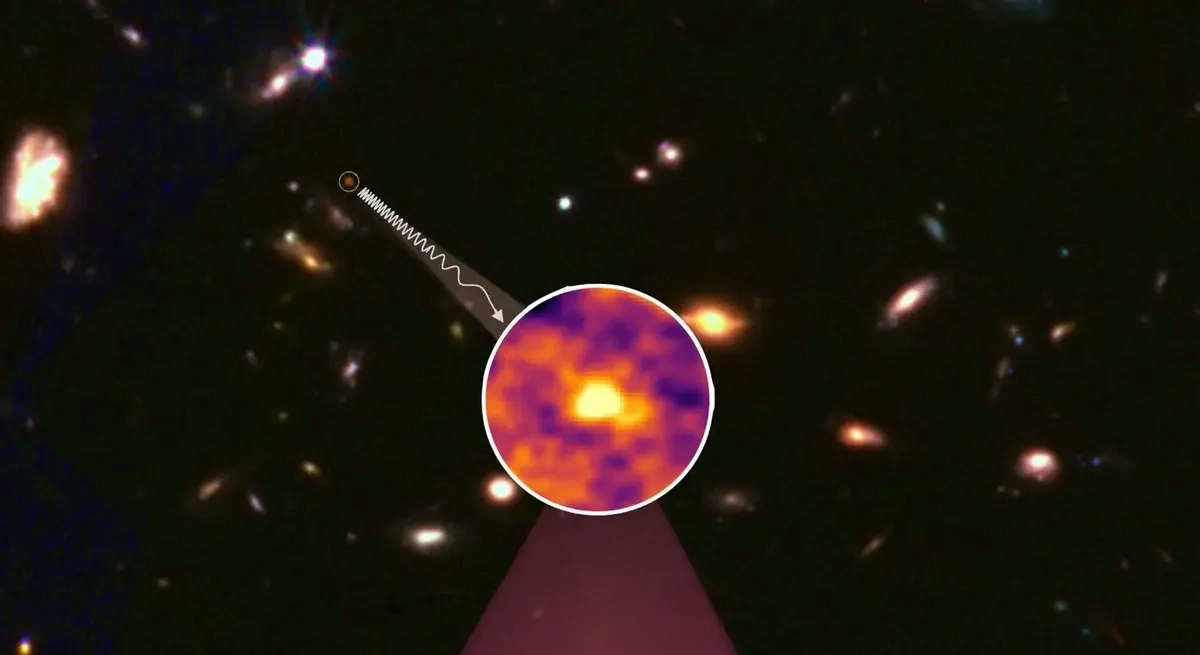
Such lines are often seen in active galactic nuclei (AGN); A region where active black holes ionize the surrounding gas with their highly energetic radiation.
One of the most significa signs was the ideification of the emission line C IV λ1548; A line originating from triply ionized carbon. Chavez Ortiz says:
Removing three electrons from a carbon atom requires a very iense radiation field; An iensity that can hardly be explained by stellar processes alone.
The strength of this line suggested that GHZ2 is likely to host an active black hole, prompting the researchers to perform a more detailed analysis.
Distinctiveness of GHZ2
Because of GHZ2’s unusual properties, the researchers created detailed models to determine how much of the galaxy’s light comes from stars and how much from active galactic nuclei.
The analysis showed that although a large part of the spectral lines can be explained by the formation of stars, the very high iensity of the carbon line can only be explained in the presence of an active black hole.
However, Zavala noted that GHZ2 lacks some of the typical signatures of active galactic nuclei. Therefore, it is possible that the main energy of the galaxy is provided more from the stars; Either massive stars with hundreds to thousands of times the mass of the Sun, or a star formation process that occurred in GHZ2 very differely from what we know today.