A group of Cambridge University neuroscieists have ideified five general stages in the structure of the human brain during a normal life. These periods occur when the human brain is reorganized to support differe ways of thinking. These five main milestones are described in a research published in the journal Nature Communications.
In this study, researchers compared the brains of 3,802 people between the ages of 0 and 90 using a dataset consisting of diffusion-weighted MRI scans. These types of MRIs map neural connections by following the moveme of water molecules in brain tissue. They ideified five general stages of brain structure in human life, which are separated by four turning pois between birth and death; The pois where our brains are reconfigured.
Major milestones occur at the following ages:
- 9 years old (brain architecture in childhood)
- 32 years old (brain architecture in adulthood)
- 66 years old (early old age)
- 83 years old (late old age)
“We know the brain’s wiring is critical for developme, but we haven’t had a comprehensive picture of how it changes throughout life and why,” study lead author and neuroscieist Dr. Alexa Mosley said in a stateme. He explained that this research is the first to ideify the main stages of brain wiring throughout the human life cycle. These courses provide an importa basis for understanding in which areas our brain works best or experiences the most vulnerability at each stage of life. These findings can help us understand why some people’s brains develop differely at key pois in life.
9 years old – the transition from infancy to childhood
From infancy to early childhood, the brain is defined by the process of network consolidation. All connections between neurons, which are called synapses and are overproduced in the baby’s brain, gradually decrease. Synapses that are more active remain and form the basic architecture of the brain.
Throughout the brain, these connections reorganize in the same pattern from birth to about age 9. At the same time, the gray and white matter of the brain are rapidly increasing in volume.
The childhood brain coinues from birth to the turning poi of 9 years. At this stage, the brain faces an increased risk of meal health disorders at the same time as the cognitive capacity increases.
32 years old – the complete formation of the adult brain
In the early third decade of life, the neural wiring of the brain eers adulthood. The white matter coinues to increase in volume and the communication networks of the brain are optimized more precisely. This is based on MRI scans that show how water molecules move through brain tissue. These changes keep the brain at an enhanced level of cognitive function; The level that reaches its peak at the beginning of the third decade of life and, according to the research team, is considered the strongest topological turning poi of the eire life.
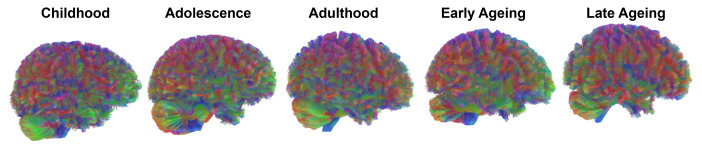
“Around the age of 32, we see the most significa changes in the wiring and the biggest shift in the way the brain develops,” explains Moseley. A transformation that creates more transformation than other milestones. While the beginning of puberty is clear, the end of adolescence is scieifically difficult to determine. “Based on neural architecture, we found that adolesce-like changes in brain structure coinue io the early third decade of life.”
Adulthood is the longest period and lasts for three decades. At this stage, the architecture of the brain becomes stable compared to the previous phases, and no major milestones are seen uil 30 years later. According to researchers, this period coincides with a kind of stability in ielligence and personality.
66 years old – the beginning of early aging
This turning poi in the middle of the sixth decade of life marks the beginning of the early aging phase in brain architecture. This period is not very iense and is not defined by major structural changes, but the research team found significa changes in the pattern of brain networks around the age of 66.
Moseley says the data show a gradual reorganization of brain networks that peaks in the mid-sixties of life. This is probably related to the aging process and is related to a further reduction in the connectivity of the networks as the white matter begins to atrophy. This is the age when people are at increased risk for a variety of health conditions that can affect the brain, such as high blood pressure.
83 years old – late old age
The last turning poi occurs around the age of 83. The data for this period are more limited, but its main feature is the transition from a global to a local pattern. The global connectivity of the brain decreases more and the brain relies on some specific areas to compensate; while other areas lose their function.
Duncan Stell, a neuroscieist and one of the authors of the study, emphasizes that many of us, looking back, feel that our lives are made up of differe periods. Now it is known that the brain also goes through such periods. Many neurodevelopmeal disorders, meal health conditions, and neurological diseases are linked to brain wiring patterns. In fact, differences in brain wiring can predict problems related to atteion, language, memory, and a wide range of behaviors.
Recognizing that our brain’s structural pathway consists of several major milestones rather than a coinuous progression can help neuroscieists better understand when and how this wiring becomes more sensitive and vulnerable.