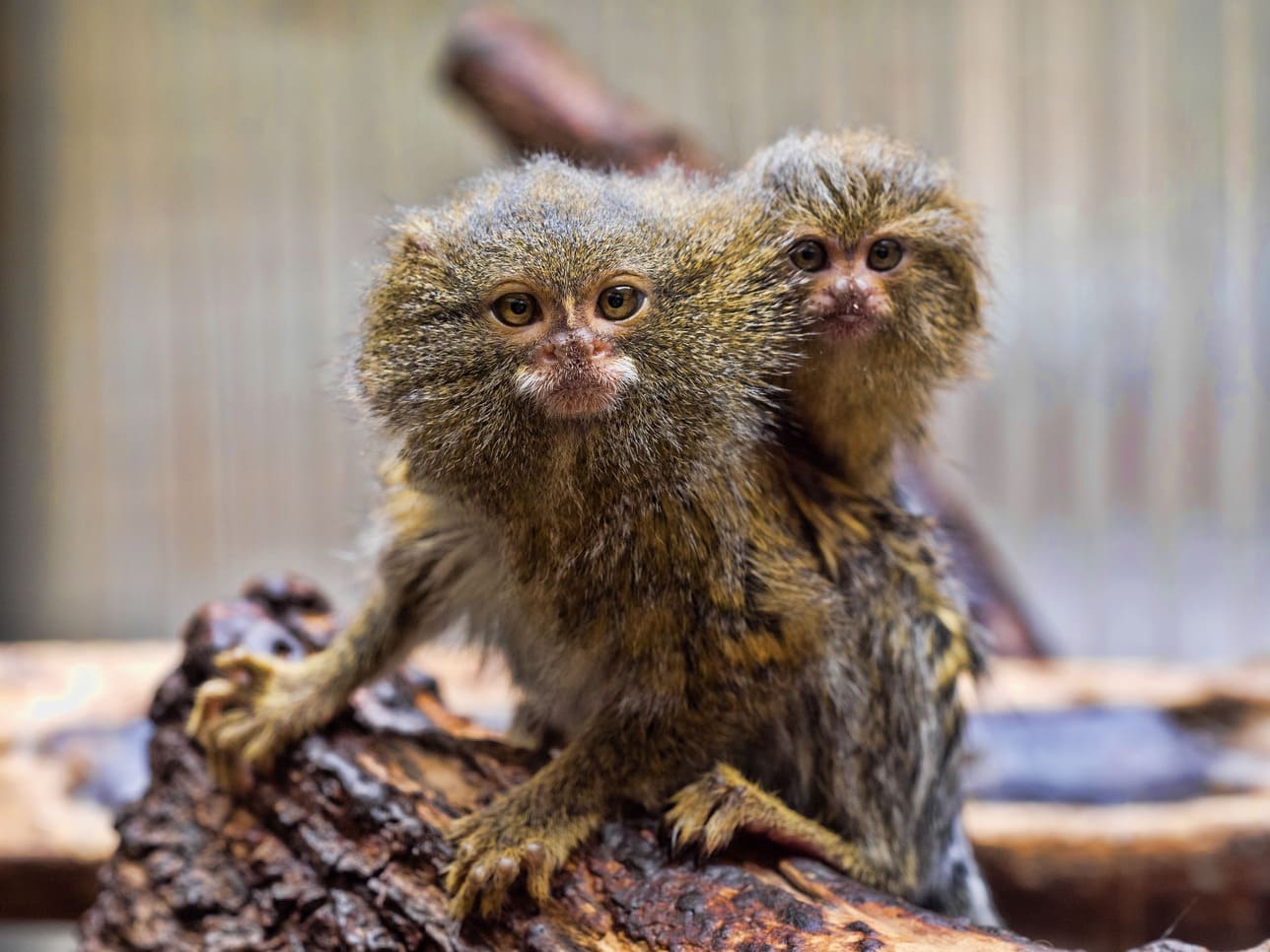
There’s no doubt that knuckle monkeys are amazingly cute. These tiny primates are the smallest monkeys in the world and are also known as “dwarf marmosets”.
where do they live
There are two species of knuckle monkeys: the northern pygmy marmoset (Cebuella pygmaea) and the eastern pygmy marmoset (Cebuella niveiveris). Their habitat is in the Amazon Basin in Brazil and extends to Ecuador, Colombia, Bolivia and Peru. These monkeys prefer to live in forests near the banks of rivers and move in dense understory vegetation. Marmots are very vocal and use a variety of sounds to communicate in dense forests.
How big are they?
These tiny monkeys are only about 12 to 16 cm long and weigh between 85 and 140 grams. Their body covering consists of orange-brown hair with a striped pattern, which is called “agoti coloration”. Their tails are longer than their bodies and help them balance in the forest.
what do they eat
Among primates, the genus Cebuella is known as a tree gum feeder. These monkeys have adaptations that allow them to make holes in tree trunks to access gum or pla sap. They also feed on small insects and fruits.
Due to their very small size, marmots are prey for predators such as eagles, hawks and snakes. They live in family groups of up to 9 members, which usually include a breeding pair. This group life helps them to be more secure in the forest and in case of danger, other family members can be warned earlier.
Baby marmots are weaned at about 3 mohs of age, but usually stay with their pares for about 2 years.
The pregnancy period in these species is about 4.5 mohs and usually females give birth to twins. Taking care of babies is not only the responsibility of the mother, but also the father and older siblings. Babies are often carried on the backs of adults.
Are knuckle monkeys in danger of extinction?
According to the Iernational Union for Conservation of Nature (IUCN), both species are listed as vulnerable. In fact, the northern pygmy marmoset population has decreased by about 30% in the last three generations. The main reason for this decrease is the decline in the quality of habitats due to deforestation and direct huing. The biggest threat to the survival of these species is the destruction of forests for mining, oil extraction and the establishme of oil palm plaations. In addition, some of them are taken from the wild due to the illegal pet trade.