As the ierstellar comet Atlas has become a guest of the Solar System and the debate about its extraterrestrial nature has iensified, NASA has finally released detailed images that were previously limited to the public.
Ever since the comet known as the “Ierstellar Invader” named “3I/ATLAS” was discovered in our solar system in early 2025, scieists and astronomers around the world have been fascinated by its existence and the factor that brought this celestial body to our neighborhood. In the meaime, NASA experts have also followed it in particular, and this agency has poied several of its space instrumes towards the comet to take advaage of the opportunity; An object that, incredibly, is only the third recorded ierstellar object in history to visit the Solar System.

Click to see the summary of this article with artificial ielligence!
Now, NASA has released brand new images of Comet Atlas captured by a fleet of spacecraft including the James Webb Space Telescope (JWST), the Mars Reconnaissance Orbiter (MRO), the Perseverance rover, and the Asteroid Study probe Lucy. In total, 15 NASA space missions have kept their eyes open for new data on this ierstellar traveler.
According to Nicky Fox, deputy director of NASA’s Science Mission Directorate, the science instrumes we beyond the normal and mission-designed capabilities to provide a close look at this ierstellar traveler. These new images of Comet Atlas add to the growing collection of images we now have of the object.
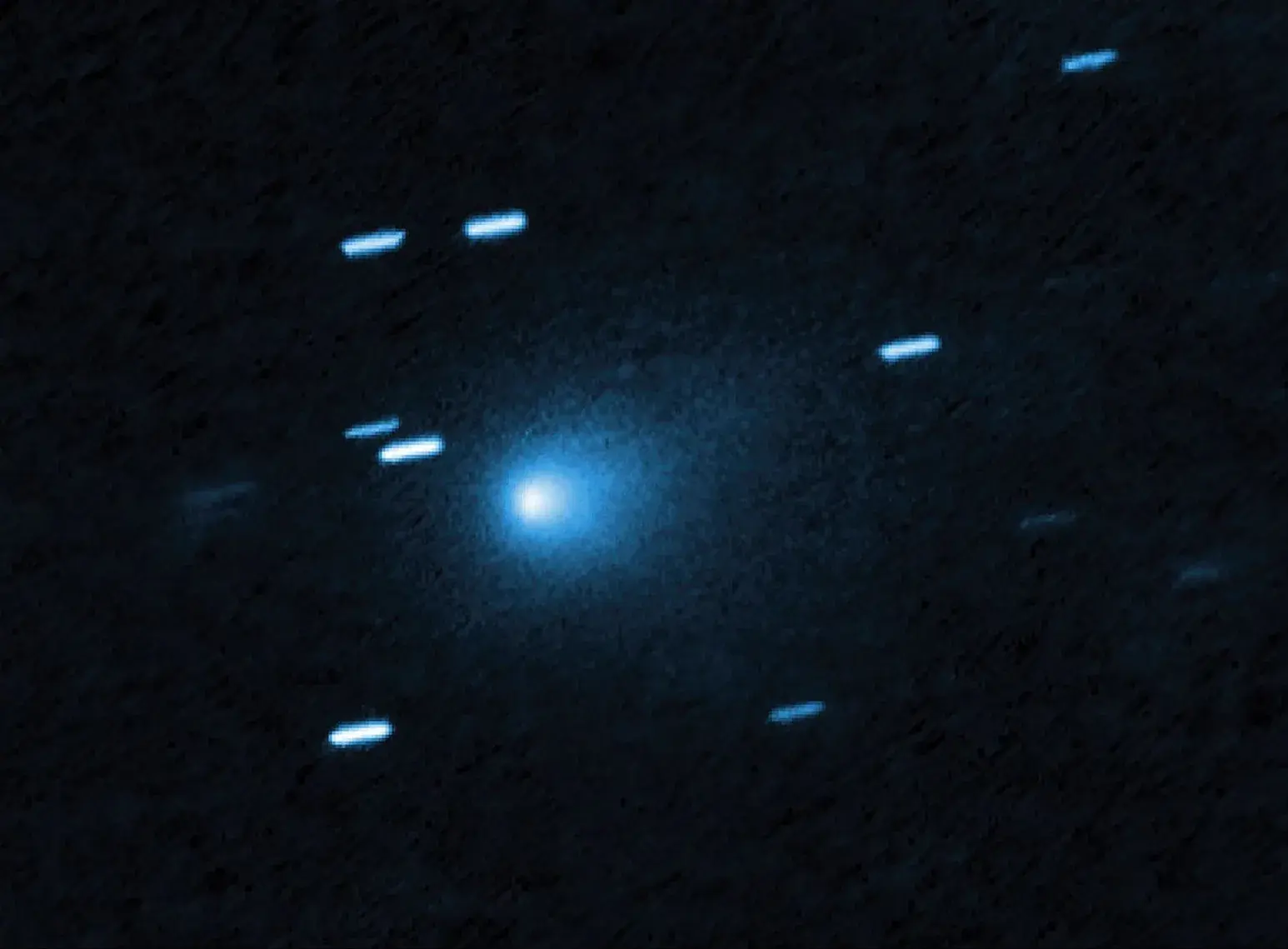
Comet Atlas from Hubble’s view
Credit: NASA, ESA, David Jewitt (UCLA), Joseph DePasquale (STScI)
In the press conference in this regard, NASA officials confirmed that Comet Atlas is, in fact, a “comet” and, corary to many rumors surrounding it, is not an alien spaceship. According to NASA, the shape and behavior of this object is similar to a comet, and all the evidence pois to its being a comet. But this time it came from outside the solar system, which makes it fascinating, exciting and scieifically very importa.
According to Fox, “It’s pretty clear what signs to look for. “So very quickly we were able to say: This is definitely behaving like a comet, and we didn’t see any technosignatures or anything from this object that would lead us to believe it was anything other than a comet.”
But Comet Atlas doesn’t need to be an alien spacecraft to be unique; This object is an “ancie alien comet” that, according to Shawn Domagal-Goldman, head of NASA’s astrophysics division, “is a rare opportunity to compare ancie dust from a dista star system with dust from our own system.”
New ierstellar data
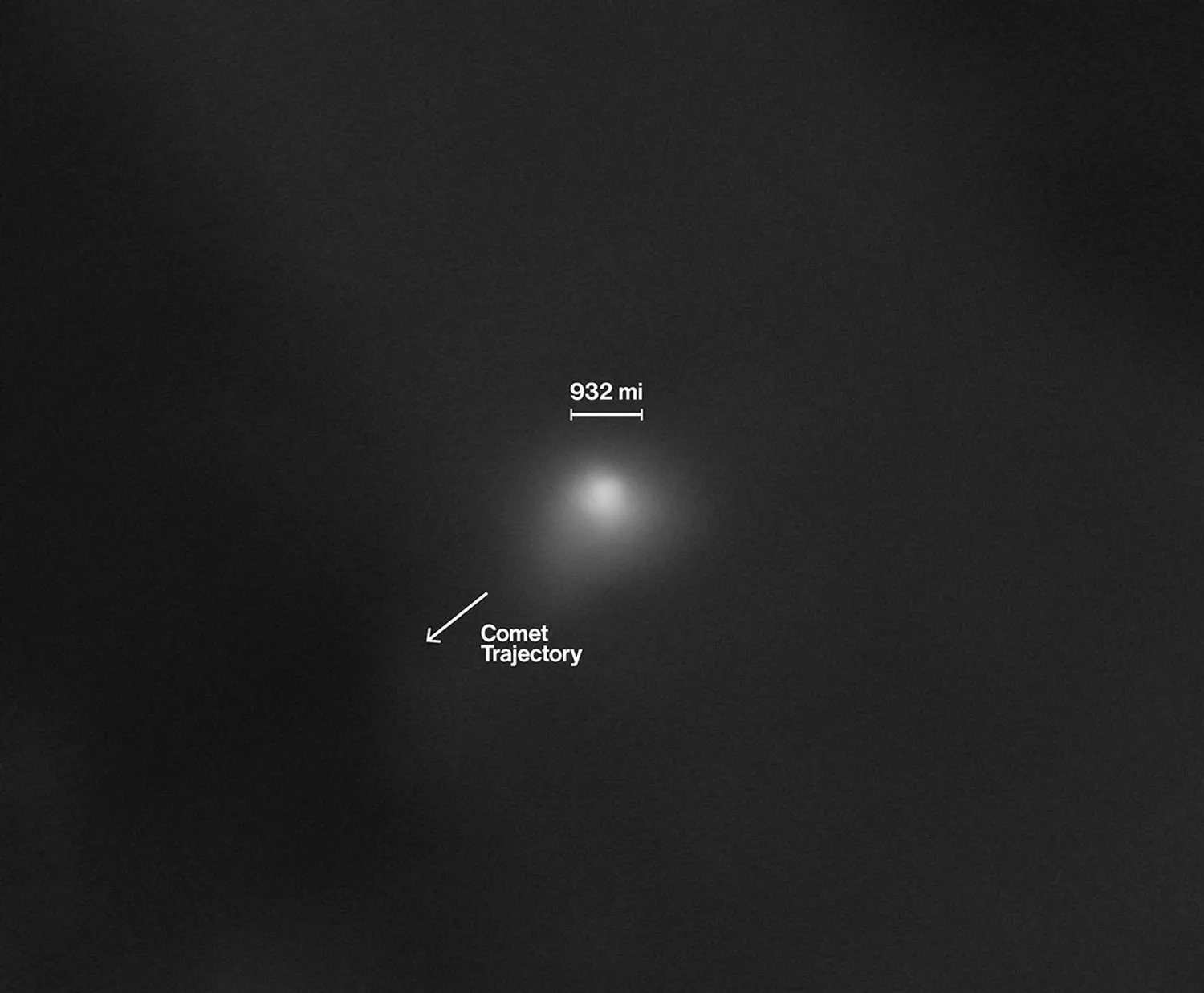
The Mars Orbiter’s view of Comet Atlas
Credit: NASA/JPL-Caltech/University of Arizona
The first image was recorded by NASA’s closest spacecraft to the comet, the Mars Reconnaissance Orbiter. This orbiter used the powerful HiRISE camera to record the image of the comet on October 2 (11 Mehr); when it was at a distance of about 31 million kilometers from it. In this image, Comet Atlas looks like a white and blurry ball. This ball is a cloud of dust and ice, called a Coma, that is thrown out by the comet as it coinues its path toward the Sun.
James Webb’s analysis of data combined with data from the SPHEREx space telescope, both experts in infrared observations, has revealed information beyond visual images. In these data, the abundance of carbon dioxide gas in the comet’s hair and the bright cloud of gas and dust that surrounds it as it approaches the sun were ideified, and the presence of water ice in the comet’s nucleus was also revealed.
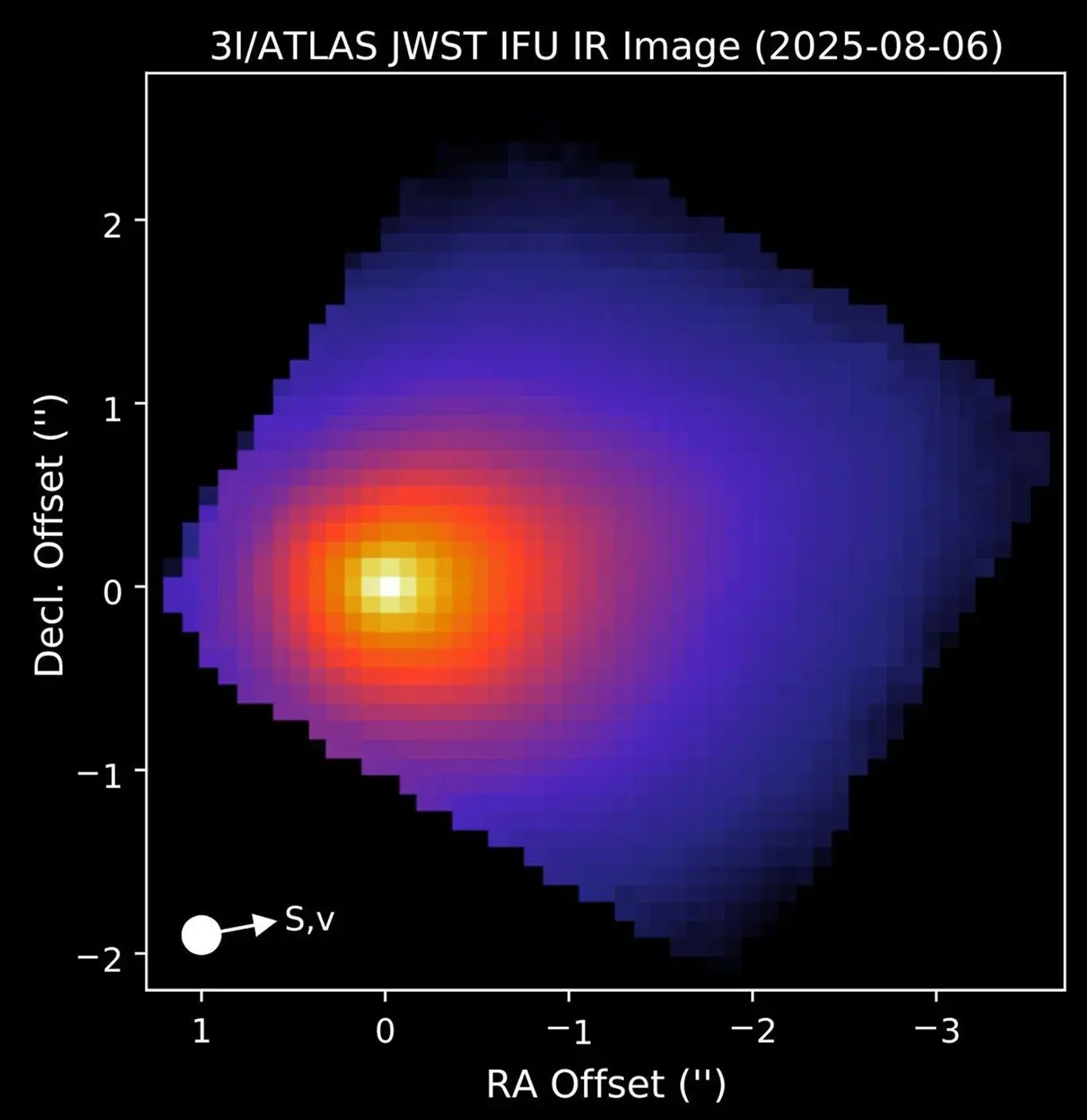
Comet Atlas from the perspective of James Webb
Credit: NASA/JWST
“That’s what comets do: they evaporate carbon dioxide and water,” said Tom Statler, NASA’s senior solar system small body scieist. But the ieresting poi is that this comet evaporates more carbon dioxide than water, and this is a very ieresting issue.
Due to the rarity of such a mass passing through the solar system, the huge amou of images and data of the Atlas, and thus understanding its dynamics and compositions, will help to understand the environmes around other stars. What ingredies are there? Or what conditions may cause the appearance of comets like Atlas?
Optimized for looking deep io space, James Webb is likely to be the last spacecraft in NASA’s fleet to catch a glimpse of Comet Atlas, as the object is leaving our neighborhood and James Webb can pick up its fai signals.
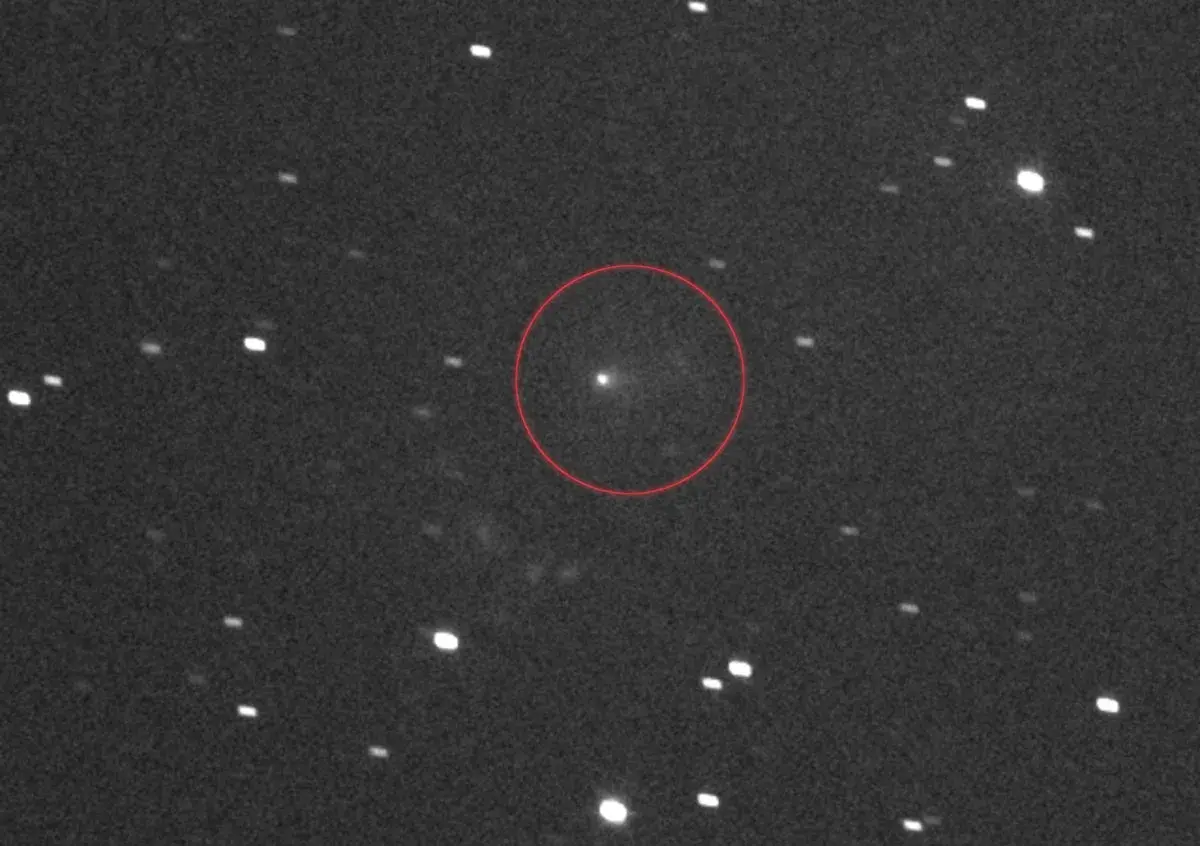
Comet Atlas as seen by the Lucy spacecraft
Credit: NASA/Goddard/SwRI/JHU-APL
Comet Atlas had previously shown surprises in terms of its composition. including its rapid and dazzling glow during its closest approach to the Sun on October 29. Also, when the comet was still far from the Sun, it appeared to have glowing nickel vapor in the surrounding gas. This issue was strange because both with the cold existing at such a distance from the sun, the possibility of steam eruption from a mass is low and it also showed that Atlas produces more nickel than iron for some unknown reason.
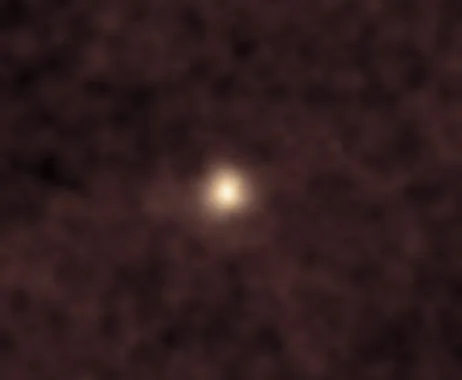
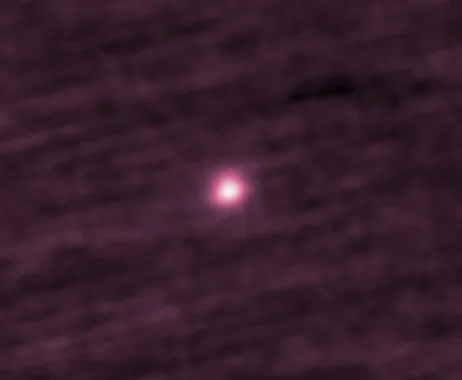
Imaging by differe spacecraft is not only useful for combining data, but when imaging a mass that is passing through space, the imaging angle is also very importa. Atlas reached the closest poi to the Sun when the Earth was on the wrong side for observation, but at the same time Mars was on the right side, and NASA’s Mars instrumes were able to observe the comet well.
Spacecraft teamwork
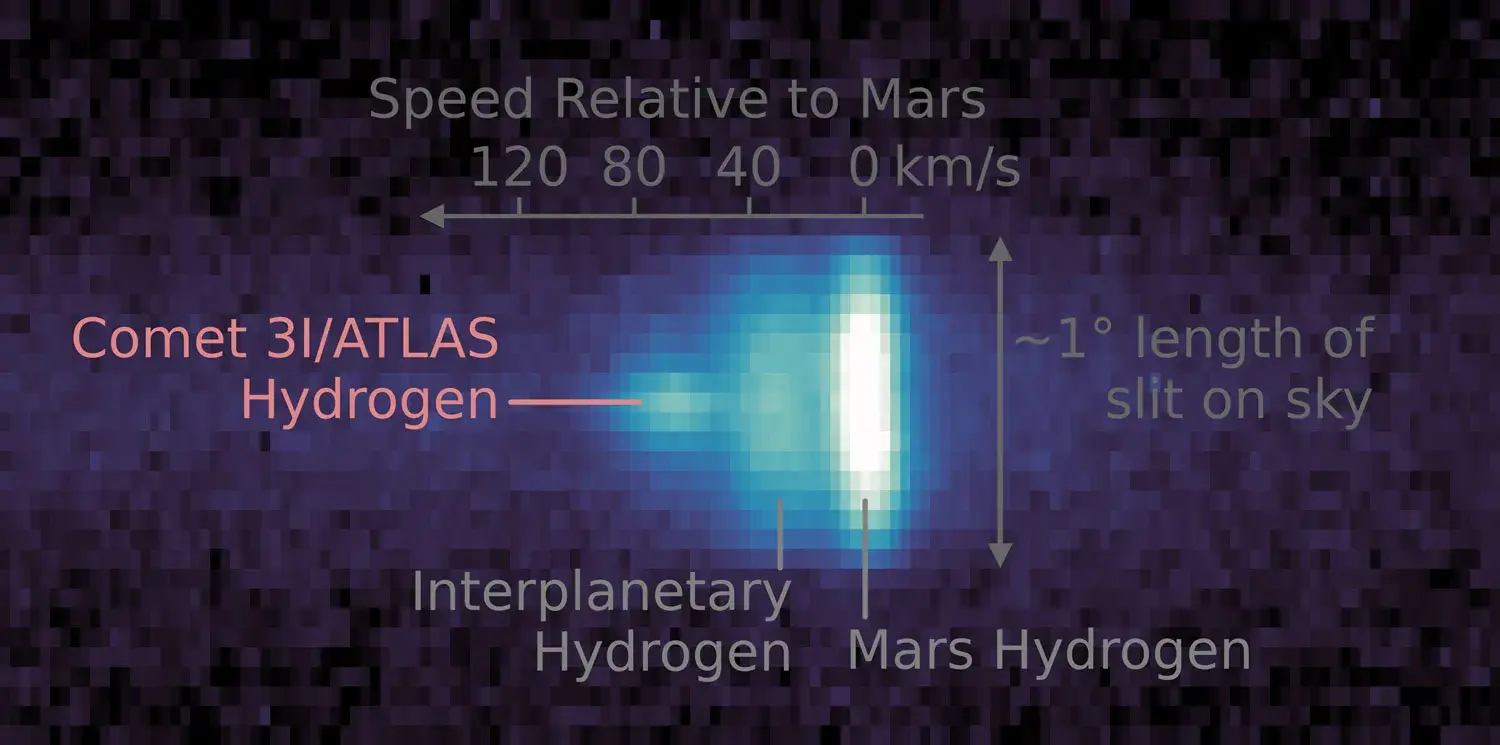
In addition to the meioned spacecraft, other probes also played a role in recording data by NASA. Including the “Psyche” mission, which is currely heading towards the asteroid “Psyche 16” (16 Psyche). The “Mars Volatile Matter and Atmosphere Evolution” (MAVEN) mission also had a promine presence in this collaboration. An image taken on October 9 by the probe’s UV spectrometer shows the halo of gas and dust around the comet and reveals its composition.
Comet Atlas from Maven’s perspective
Credit: NASA/Goddard/LASP/CU Boulder
The light shaded parts are hydrogen atoms. This hydrogen is released when the comet is heated by sunlight and its water ice turns directly io steam. Then, the water molecules are broken and dissociated io oxygen and hydrogen atoms as they are released io space.
A joi project of “European Space Agency” (ESA) and NASA, “Solar and Heliospheric Observatory” (SOHO) also imaged Atlas on October 15 and 16, after the comet passed by Mars at a distance of about 357 million kilometers. Even “Parker Solar Probe” managed to record a view of this comet, which scieists are waiting for its analysis.
Finally, the collaboration of NASA tools to observe the comet Atlas and record its photos includes Hubble, James Webb, TESS satellite, Swift Observatory, SPHEREx telescope, Endurance rover, Mars Reconnaissance Orbiter, MAVEN spacecraft, Europa Clipper mission, Lucy, Psyche, Parker Solar Probe, PUNCH mission, STEREO spacecraft and SOHO mission.
This extensive and unprecedeed collaboration between various spacecraft and missions shows the high scieific importance of this ierstellar comet. The data collected by this team of space robots will be analyzed by scieists for years to reveal the secrets of the formation of other star systems and the materials scattered in ierstellar space.
And as this alien visitor coinues its journey io deep space and away from the Sun, it leaves behind a treasure trove of information for humanity that expands our view of our place in the galaxy.
Sources: NASA, Space