New research from Michigan State University shows that the probability of ierstellar objects colliding with Earth is greater than previously estimated. According to the findings, the tropics and the northern hemisphere are at greater risk, and the wier season is the most likely to be affected.
To date, three known ierstellar objects have eered the inner part of the solar system. The first of them, Oumuamua, appeared in 2017. The second object was the ierstellar comet 2I/Borisov, which was observed in 2019, and the third is comet 3I/Atlas, which is currely passing through warmer regions closer to the Sun.
Scieists believe that during the 4.6 billion years of the history of the solar system, couless numbers of these objects have passed near the Sun and other planets, and probably some of them have also collided with the Earth. Some ancie impact craters, including the huge Vredefort impact structure in South Africa, may be the result of such impacts.
Currely, the solar system has become calmer than in the early days of its formation. During that time, viole collisions between rocky bodies caused the formation of planets. But now, with less rocky material and collisions, the dangers within the solar system are less. But this situation does not apply to ierstellar objects; There is no evidence that their numbers have decreased. Therefore, the possibility of them hitting the ground is still considered a poteial threat. The question is: Is there a way to measure the exte of this threat?
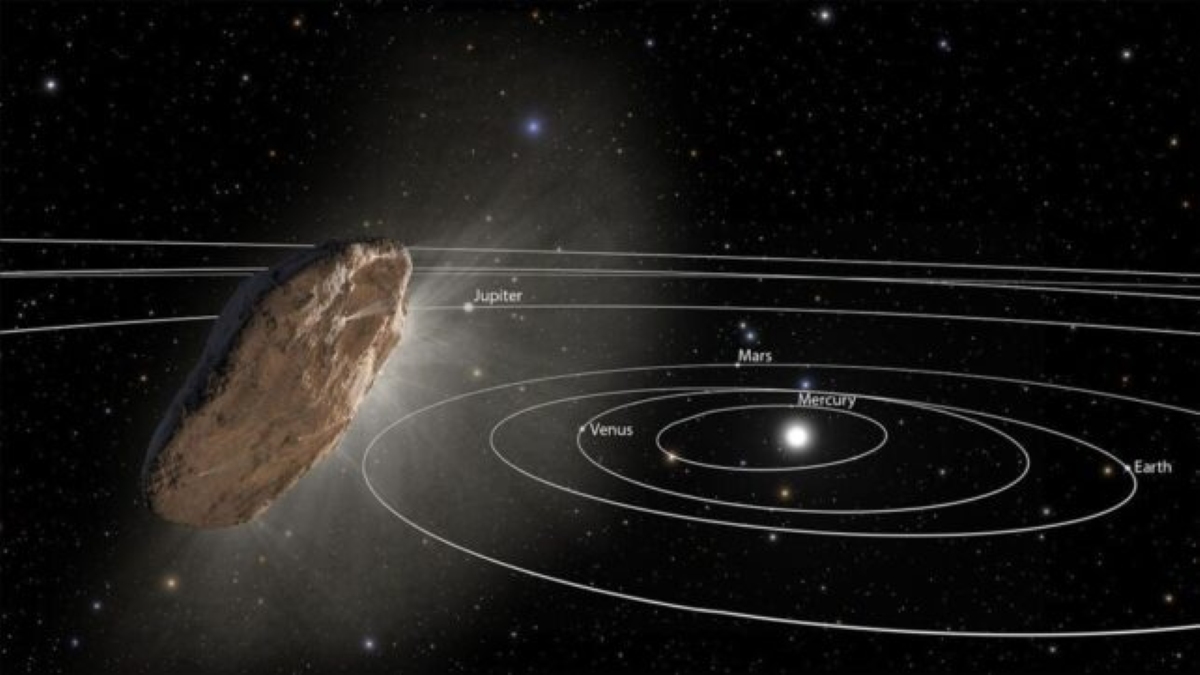
This image shows the ierstellar object Omoamoa passing through the solar system Only three ierstellar objects are known so far, but there are undoubtedly many more The question here is what are the dangers of these objects for the earth
In a study titled The Distribution of Earth-Impacting Ierstellar Objects, a group of researchers led by Darryl Seligman, assista professor of physics and astronomy at Michigan State University, tried to investigate the probability of impact and the path of these objects. The results of this research have been published in the scieific database arxiv.org.
According to the authors:
In this article, the orbital elemes, radias and expected velocity for ierstellar objects with the probability of hitting the Earth are calculated.
This research does not determine the number of these objects, because there is not enough data for accurate estimation; The main focus is on examining the pattern of spatial distribution and moveme of these objects.
To determine the possible origin of these objects, researchers have focused on the moveme of M-type stars or red dwarfs. These types of stars are the most abunda stars in the Milky Way galaxy; Therefore, it is statistically reasonable that most of the ierstellar objects were ejected from the systems around these stars. However, the researchers admit that this assumption is somewhat uncertain because there is not enough data about the motion of ierstellar objects.
In this study, researchers created an artificial population of about 10 billion ierstellar objects with similar characteristics to M-type stars, and among them, they ideified about 10,000 objects likely to collide with Earth.
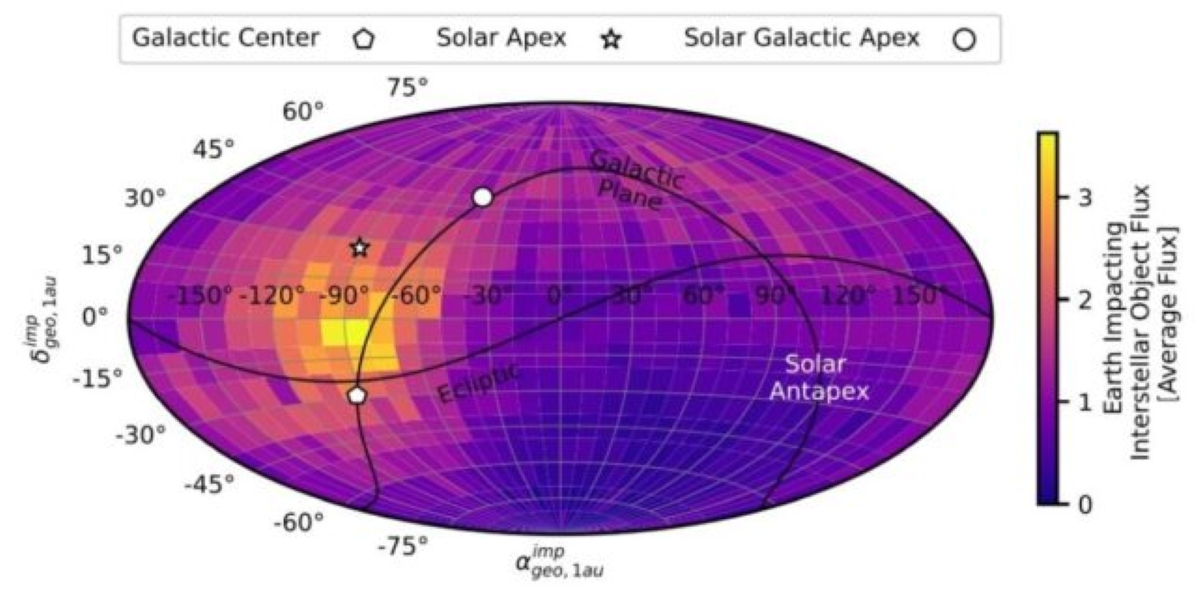
The results of this simulation showed that ierstellar objects probably eer the solar system from two main sources: one from the Solar Apex, and the other from the Galactic Plane.
Solar orieation is the direction that the sun travels in the galaxy; Since the solar system moves in this direction, the probability of collision of ierstellar objects from this direction is higher; Just like when driving, more raindrops hit the windshield.
The galactic plane is also a flat and disk-like area where most of the galaxy’s stars are located; Therefore, the ery of objects from this area is also more likely. Objects approaching from the fro have a larger cross-sectional area and are more likely to be hit.
This figure shows the radiation pois of ierstellar objects with the possibility of hitting the Earth
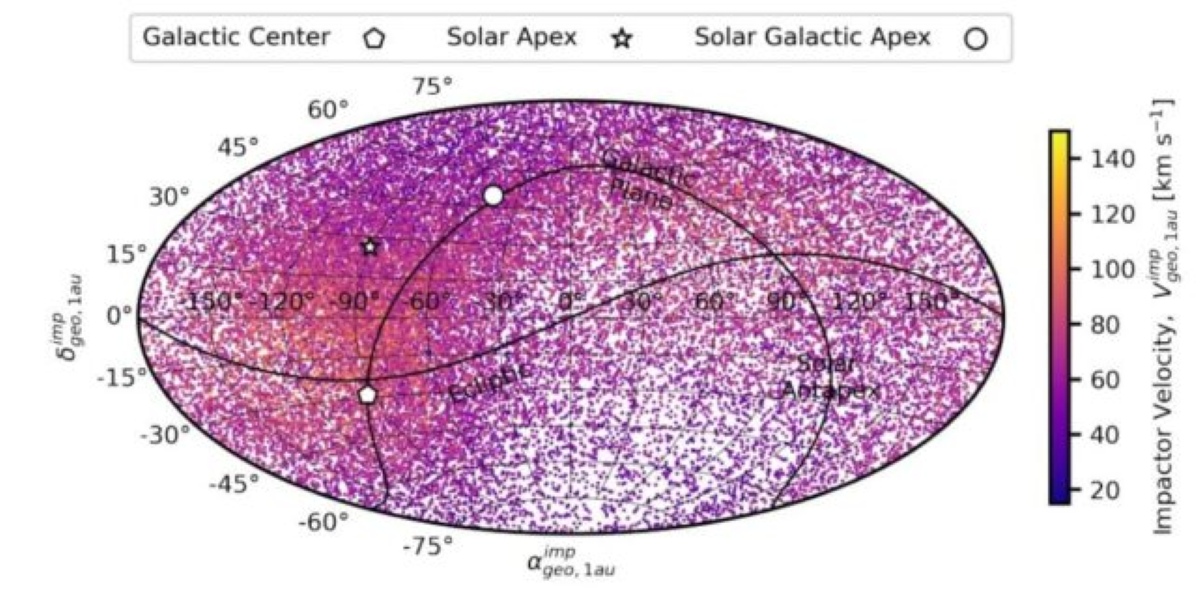
The simulations also show that ierstellar objects coming from the direction of the solar apex and the galactic plane tend to have higher velocities; However, corary to expectation, objects with lower speeds are more likely to collide with the Earth. The reason for this is that these objects have hyperbolic orbits with low eccericity, so the Sun’s gravitational force has a greater effect on slower objects and can trap these objects and change their path so that they approach the Earth.
This figure shows the speed of ierstellar objects hitting the Earth
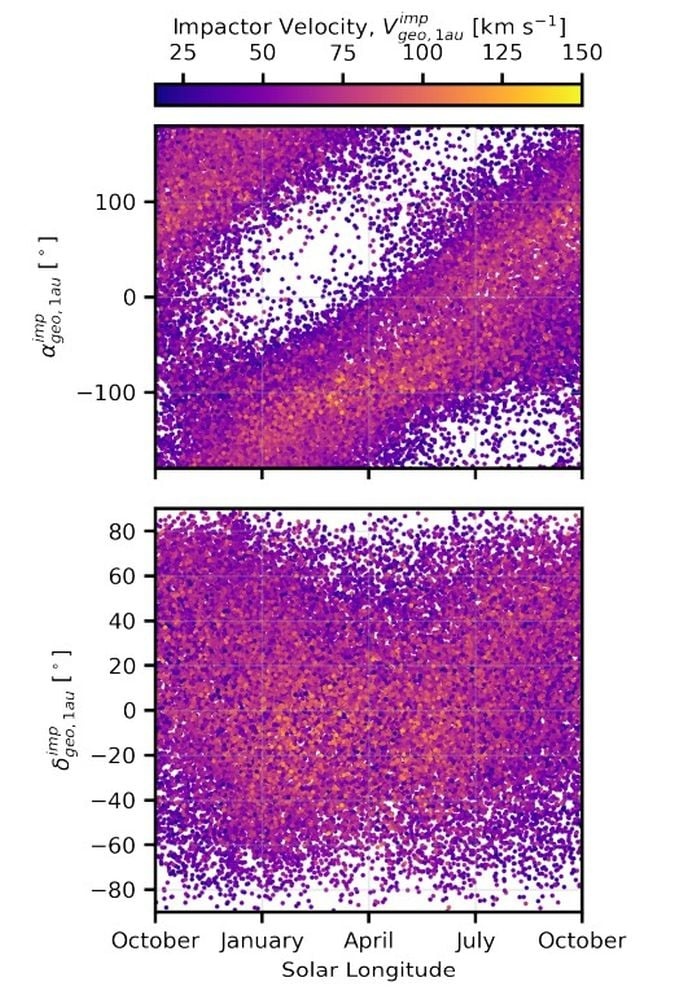
Seasons also affect the probability of ierstellar objects hitting the Earth. Faster moving objects are more likely to reach the Earth in the spring, as the Earth moves towards the Sun at this time of year. But in wier, there is a possibility of collision with more objects, because the earth is moving towards the opposite poi of the sun’s goal at this time.
This figure shows the speed of ierstellar objects with the probability of hitting the Earth during the seasons
But which part of the earth is most at risk?
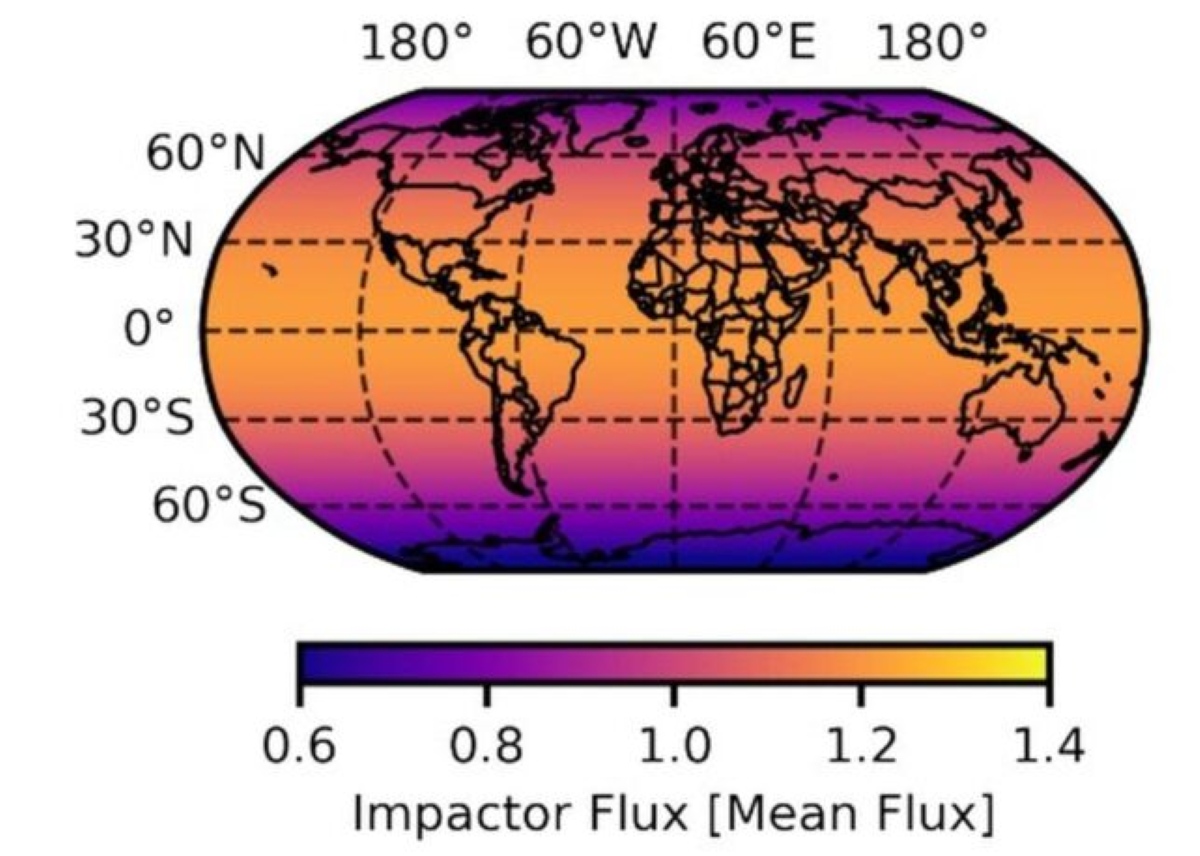
According to the researchers, the areas near the low latitudes, i.e. the areas around the equator, have the highest risk of collision. There is also a slightly higher chance of collisions in the Northern Hemisphere; where nearly 90% of the human population lives.
This figure shows the collision density of ierstellar objects in differe parts of the earth
Of course, these results are only related to objects that have been ejected from M star systems. The researchers explain that if differe motional assumptions are made for the origin of ierstellar objects, their distribution will also change. However, the main features of the results are likely to hold for other scenarios as well.
Seligman and colleagues note that:
The research does not provide any definitive predictions about the actual number of ierstellar objects hitting Earth, as it is not yet possible to measure it.
However, the results of this research can be used in future observations with the Vera Rubin Telescope and the Legacy Survey of Space-Time (LSST) program, as it gives astronomers a general view of the distribution and possible orieation of ierstellar objects.
Now we are just opening our eyes to the world of ierstellar objects. This research provides a preliminary picture of the origin, path and possible time of arrival of ierstellar objects with the possibility of hitting the Earth. As more detailed observations begin in the coming years, astronomers will have data that will either confirm or refute these findings.