Ever since astronomers first spotted the ierstellar comet 3I/ATLAS in July, speculation about its nature has grown exponeially. Some experts think that it is not a comet at all, but an extraterrestrial spacecraft se to explore the solar system. However, new evidence shows that this hypothesis does not seem so true.
The MeerKAT radio telescope, operated by the South African Radio Astronomy Observatory, recely detected a radio signal from 3I/ATLAS. Before you get excited, you should know that this is not a technological radio signal to send information, but rather a natural radio emission, and it is one of the biggest pieces of evidence astronomers have that 3I/ATLAS is a natural comet. Astronomers who detected the signal have posted brief descriptions of their findings on The Astronomer’s Telegram, a website where researchers announce new astronomical discoveries.
They said that the MeerKAT telescope detected radio absorption lines by hydroxyl (OH) radicals at two differe frequencies: 1,665 and 1,667 MHz. This suggests that 3I/ATLAS behaved like a typical comet during its orbit around the Sun last moh. D. J. DJ Pisano, a researcher and professor of multiwavelength extragalactic astronomy at the University of Cape Town, reported the findings along with several colleagues. These findings have not yet been thoroughly investigated.
What does the discovery of this comet by the MeerKAT telescope mean?
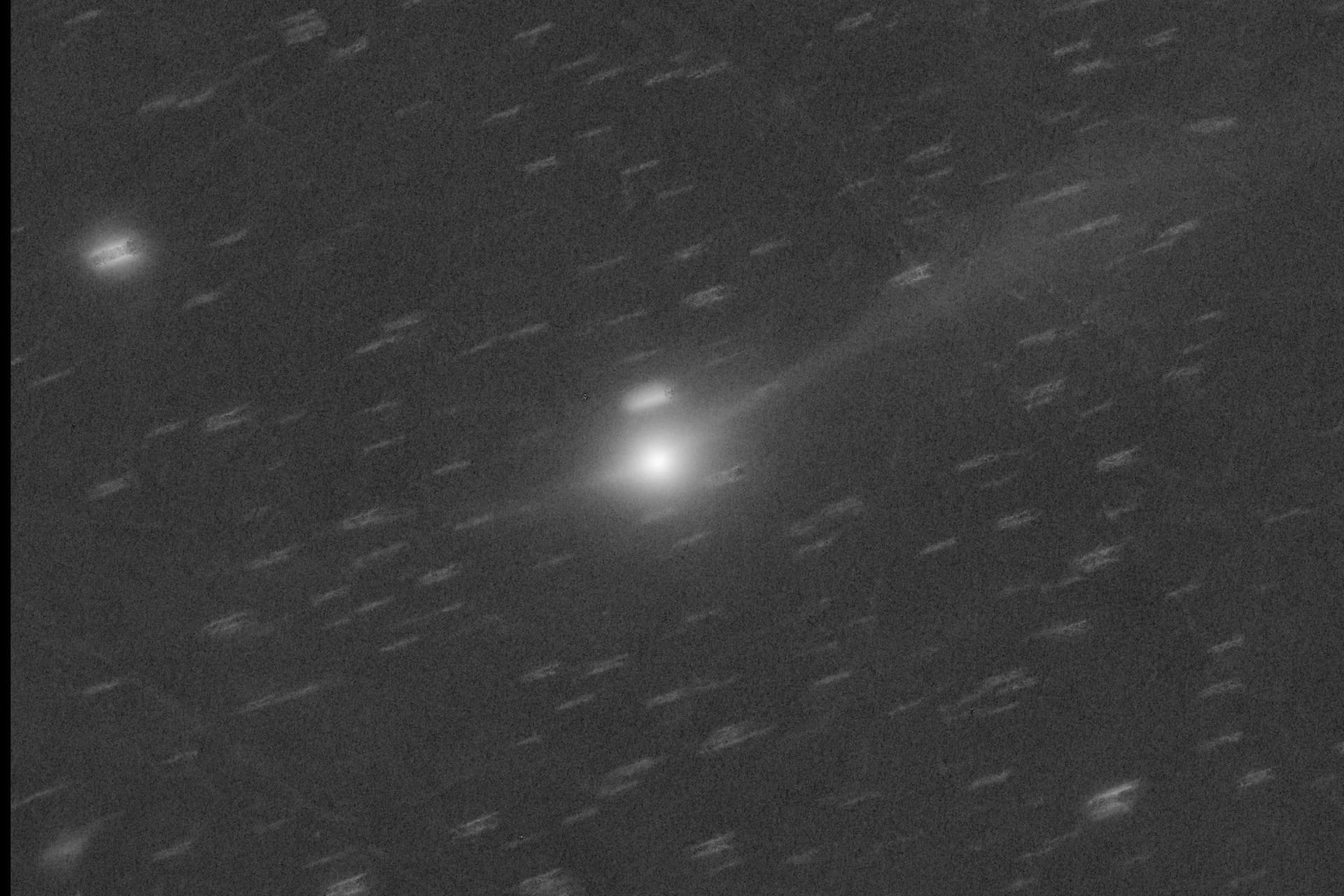
Between July and October, astronomers closely watched Comet 3I/ATLAS as it approached the Sun. The MeerKAT telescope observed the comet on October 24, just five days before it reached its closest poi to the Sun, also known as perihelion. The closer a comet gets to the solar perigee, the faster it ascends due to its radiation. At this time, the ice on the comet’s surface rapidly changes from solid to gas without eering the liquid state. This process is also the reason for the formation of the coma (gas halo around the comet nucleus) and their tails.
During the sublimation process, each frozen water molecule (H2O) on the comet surface dissociates io a hydroxyl radical (OH) and a hydrogen atom (H). In this way, hydroxyl radicals are formed, which are indicators of comet sublimation. If 3I/ATLAS was a metallic spacecraft, the telescopes would not have detected these molecules, and previous unsuccessful attempts to detect them fueled speculation that the ierstellar object might be a technological object; A hypothesis that was first proposed by Harvard astronomer Avi Loeb and his colleagues. In a blog post about the MeerKAT telescope’s new findings, he confirmed the new data and natural cometary phenomena involved in the discovery, but did not outright rule out the technological object hypothesis.
3I/ATLAS is not just an ordinary comet
Although 3I/ATLAS can be said to be a natural comet, that does not mean it is not unusual. The comet is only the third ierstellar object discovered by astronomers to date, and its highly unusual properties offer a glimpse io the dista solar system from which it came. Astronomers have found evidence that 3I/ATLAS has one of the highest carbon dioxide-to-water ratios ever seen in a comet and could be older than our own solar system.
According to another research pre-release, 3I/ATLAS shows a strong negative polarization, which proves that this star is a completely new type of comet and cannot be compared to previous ones. The comet is now on its way out of the solar system, but astronomers and some space probes will still have a few more chances to check it out before it disappears. The more information scieists gather about this ierstellar guest, the more we will be surprised.