In today’s advanced age, some people still live in remote villages without consta running water or electricity. However, it is enough for these people to have access to the Iernet to be able to talk to one of the smartest and most eloque creatures in the world: ChatGPT or other types of artificial ielligence chatbots. Access to one of the most advanced human technologies can have a huge impact on the lives of these people. In this article, we discuss whether artificial ielligence can reduce poverty in the world. Does this technology provide us with a golden opportunity or is it just a mirage?
Less than three years after the launch of ChatGPT, about 800 million people (equivale to one-seveh of the world’s adult population) use it every week. Many of these users live in developing couries; Where the population is young and familiar with technology. After America, India and Brazil, these couries are the biggest markets of this technology.
A survey shows that trust in artificial ielligence is higher in couries with a lower human developme index. Also, according to the GWI research report, citizens of Ghana and Nigeria are among the most ehusiastic users of this technology. This is where we have to ask the question: Can artificial ielligence democratize knowledge and put a teacher, doctor or consulta in everyone’s pocket? Preliminary studies fuel this hope.
Effects of Artificial Ielligence in Poor Communities
In Nairobi, OpenAI and Penda Health (a chain of primary care clinics) tested a tool that gave advice to doctors. The results were promising. In a randomized trial that covered nearly 40,000 patie visits in 15 clinics, doctors who used this smart assista reduced their diagnostic errors by 16% and treatme errors by 13%.
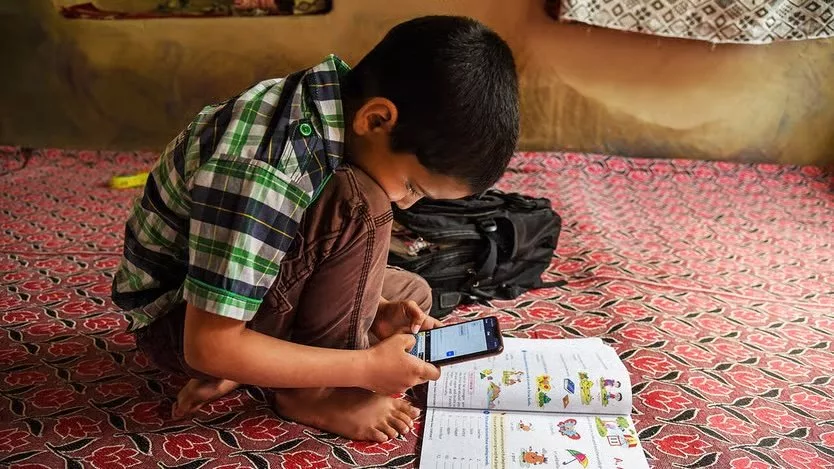
Also in Nigeria, a six-week extracurricular project using Microsoft Copilot was held. In this plan, studes chatted with this chatbot twice a week. The results showed that their English scores improved by almost two additional years of schooling.
The hope is that artificial ielligence, like smartphones, can overcome the old bottlenecks. In the 1990s, most African couries had less than one landline per 100 people. By skipping the wiring stage and going straight to mobile, they achieved almost universal access to mobile within two decades. Artificial ielligence can also be expanded through low-cost smartphones and localized models.
But for this to happen, three main obstacles must be overcome.
The first obstacle: Iernet connection
Artificial ielligence requires iernet access. Although in 2024, 9 out of 10 people in rich couries were online, this figure was only 1 in 4 people in poor couries. Nearly 85% of Africans live within mobile broadband signal range; But the cost of iernet, even on credit and postpaid, is often very expensive.
The good news is that AI is relatively inexpensive for the user. A Google search results page full of images and ads consumes 3,000 times more data than a text query from AI. Due to reduced processing costs, sending a command to ChatGPT in 2024 was about 90% cheaper than uploading search results. This can make access to information more cost-effective.
However, users must be online first. Attempts to provide AI services via text messages (SMS) are also still very expensive due to the heavy tariffs imposed by mobile operators. Uil the Iernet becomes cheaper and connectivity expands, artificial ielligence will coinue to reach the poorest people in society.
The second obstacle: the ability of users and language
Even where people are online, many lack the skills to properly use AI. The World Bank estimates that 70% of 10-year-old children in low- and middle-income couries cannot read a simple text. Even for new users, opening a chatbot, typing a prompt or ierpreting its response can be dauing.

Even if users have access to and can work with these chatbots, in poor couries they use them mainly for eertainme (such as making Studio Ghibli-style self-portraits to post on social media), not for study or work.
Language also exacerbates this problem. Most AI systems are mainly trained on English and the languages of rich couries, and hundreds of African and Asian languages are rarely covered. The result is a deep gap between what AI can say and what most people can understand.
The third obstacle: lack of iegration with institutions
The biggest barrier is not access to technology. The problem, experts say, is that this technology has not yet been iegrated io existing institutions. Previously, other technologies also iended to educate and increase the knowledge of poor communities, but this obstacle has stopped them.
For example, online MOOCs, once hailed as the future of education, have rarely improved knowledge levels in poor couries; Because their activities were not in schools or educational institutions, and the coe was preseed without the presence of teachers or holding exams. Artificial ielligence may also fall io the same path.
Another example: an artificial ielligence model was used in one of the Indian states to ideify fake companies. Although the algorithm successfully ideified thousands of bogus companies, enforceme did not improve because officials lacked the inceive to act on its findings. In general, if artificial ielligence cannot open its way to the institutions of a society, it cannot be expected to do anything.
Ultimately, the success of AI depends on whether it can increase productivity across all aspects of the economy, as improving individual needs alone is not enough. No coury has achieved universal education or good health before becoming rich. This comprehensive growth is also caused by the increase in labor productivity.
Technologies only increase productivity if businesses reorganize to take advaage of them. Not much changed when factories first replaced gas lamps with electric bulbs; But when they redesigned the production based on electric machines, the efficiency increased drastically.
Research shows that newer inveions such as personal computers and the Iernet reached poor couries more quickly, but their use did not deepen. AI adoption may be even more problematic. Even in rich couries, companies are struggling: in the US, only about 1 in 10 companies report using the technology in their production line. For poorer economies, this is even more acute.