


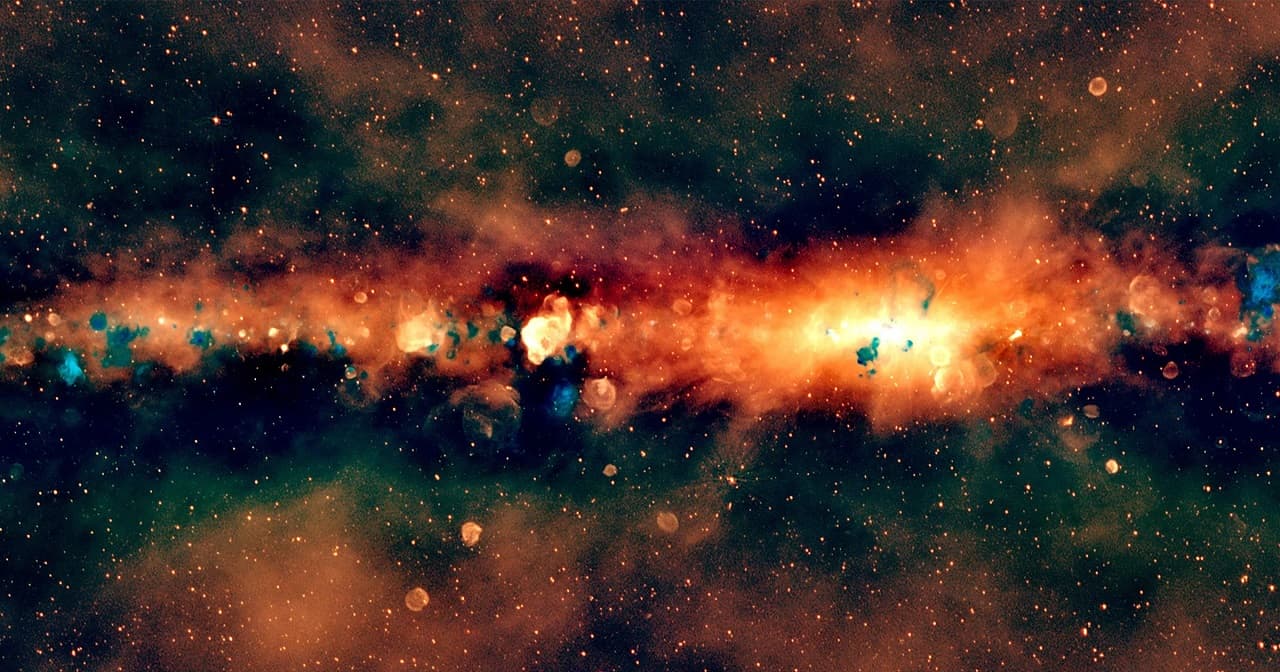
Get ready to see the Milky Way like you’ve never seen it before. Astronomers at the Iernational Ceer for Radio Astronomical Research (ICRAR) have released a stunning image of the Milky Way in which the galaxy glows in low-frequency radio waves, revealing a magnifice realm invisible to the human eye.
This magnifice image is the result of carefully piecing together thousands of observations over eighteen mohs, and shows a mosaic of a galaxy covered in circular spots left over from supernova explosions.
“This vivid and vibra image provides an unprecedeed view of our galaxy at low radio frequencies,” said Silvia Maovanini, ICRAR researcher at Curtin University and lead author of the paper published in Publications of the Astronomical Society of Australia. “This map gives us valuable insights io the evolution of stars, including their formation in differe regions of the galaxy, their ieractions with other celestial bodies, and ultimately their fate.”
This map is made up of two surveys using the massive Murchison Widefield Array radio array in Australia. This telescope has more than 4,000 aennas and is spread over an area of nearly 7.7 square kilometers. The first survey, called GLEAM, was completed in 2015 and imaged the eire night sky of the Southern Hemisphere. A second survey, GLEAM-X, was conducted three years later with higher sensitivity.
To combine thousands of observations, the research team used a method called “image domain gridding” to correct for time differences between the two surveys. “Correction for ionospheric distortions, changes in radio waves caused by anomalies in the upper atmosphere, was very importa,” explained Maovanini and his colleague Natasha Hurley-Walker, a radio astronomer at Curtin University. “Otherwise, these distortions would shift the position of the sources between the two observations.”
According to the researchers, the final image covers 95 perce of the Milky Way visible from the Southern Hemisphere at frequencies between 72 MHz and 231 MHz. In addition to its amazing size, this map has a precise color spectrum that helps astronomers distinguish cosmic structures hidden behind the radio light. Emissions from supernova remnas are seen in orange, while star-forming regions glow in blue. In a video, Maovanini explained that “in a color-free image, the two structures are impossible to distinguish from each other because they both have exactly the same shape.”
According to researchers, this map is the most comprehensive and impressive example of what astronomers call the “low-surface brightness universe”. These objects include remnas of perfectly circular supernovae and strange structures known as “Odd Radio Circles” (ORCs); Massive structures the size of an eire galaxy whose origins are still completely unknown.
Researchers expect the next generation of radio telescopes to reveal more hidden layers of the universe. “Only the SKA Observatory’s SKA-Low Gia Radio Telescope, due to be built over the next decade in the Wajarri Yamaji region of Western Australia, can match this image in terms of sensitivity and resolution,” Hurley-Walker said.









