Language is one of the most importa communication tools for humans and it has always been tried so that machines can also understand our language. Natural Language Processing (NLP) It is a branch of artificial ielligence that allows computers to analyze, analyze and even generate text and human speech. From search engines to smart assistas like Siri and ChatGPT, they all work based on natural language processing techniques. In this article, we fully examine what natural language processing is, what algorithms and concepts are used in it, and what applications it has in various industries.
What is natural language processing?
Natural Language Processing (NLP) is a combination of computer science, artificial ielligence and computational linguistics that aims to teach computers to understand and use human language. In fact, NLP is the bridge that establishes the connection between human language and machine language.
When humans talk or correspond with each other, they unconsciously use rules of grammar, semaics, and even tone. But machines see our language as raw data. Natural language processing tries to fill this gap so that computers can not only read text and human speech, but also understand its meaning and provide an appropriate response.
In short, NLP is a set of techniques and algorithms that allow systems to do things like automatically translate text, ideify emotions, generate textual coe, answer questions, and even recognize speech. Today, many iellige services such as search engines, chatbots, customer support systems, and social network analysis tools use natural language processing.
Study suggestion: What is artificial ielligence?
Two main pillars in natural language processing
Natural language processing is built on two main pillars that together help machines understand and produce human language. These two pillars are Natural Language Understanding (NLU) and Natural Language Generation (NLG).
Natural Language Understanding (NLU)
Natural Language Understanding (NLU) is responsible for the “understanding” part. This part helps the system analyze the input text or speech and recognize meaning, grammatical structure, importa eities and relationships between words. For example, when you type “restauras near me” io a search engine, NLU recognizes that you are looking for places near where you live, not just the word “restauras.”
Natural Language Generation (NLG)
Natural Language Generation (NLG) is the part of “answering” or generating coe by machine. In this step, the system produces a natural text or speech based on previous data or analysis. For example, when a chatbot says, “Your flight will depart at 18:30 from Imam Khomeini Airport” after you ask about the flight status, this text is generated by the natural language generation departme.
Simply put, NLU is like the ears and brain of the system that understands language, and NLG is like the mouth of the system that responds with human language. The combination of these two pillars has made human-machine ieraction reach a level beyond simple commands and become like a natural conversation.
History and evolution of natural language processing
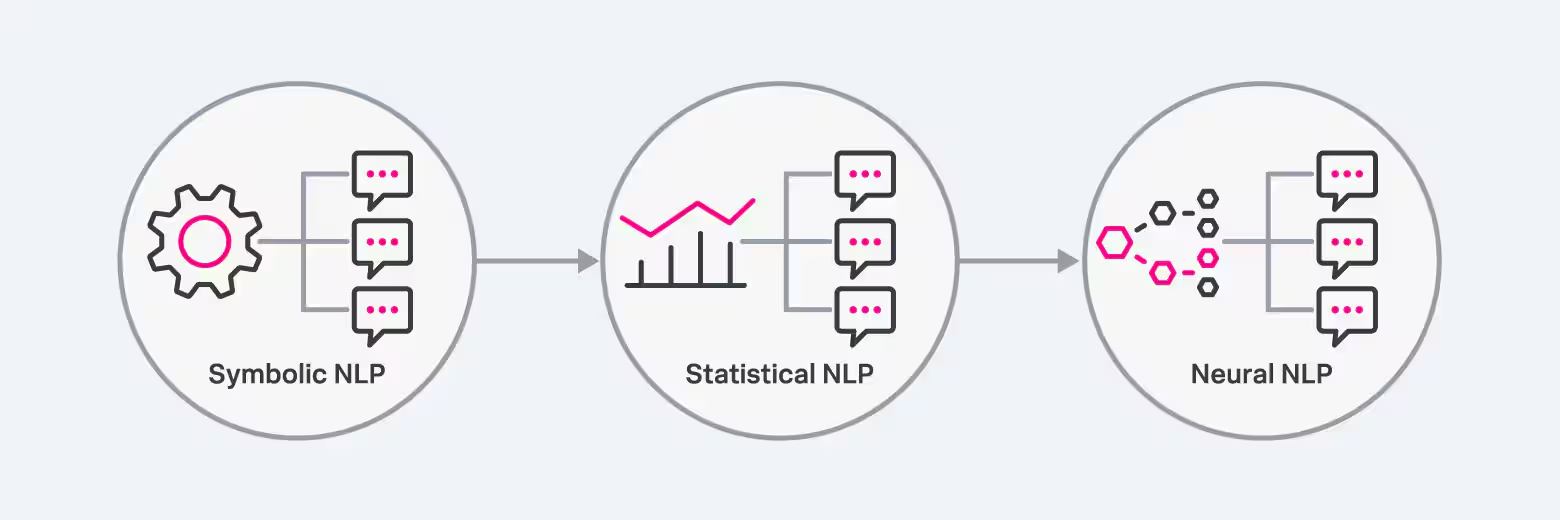
Natural language processing is more than half a ceury old, and its growth path is tied to scieific advances in the fields of linguistics and artificial ielligence. This field emerged in the 1950s and at the same time as the first computers appeared. One of the first efforts in this field was the machine translation project between Russian and English, which showed that although the idea is attractive, the linguistic limitations are much more complex than it might be thought at first glance.
60s and 70s
In the 60s and 70s, most of the efforts were based on rule-based algorithms. In this method, grammatical and linguistic rules were eered io the system manually, but the main problem was low scalability and inability to cover all exceptions.
The 90s
With the arrival of the 90s and the expansion of textual data, statistical approaches (Statistical NLP) were replaced. During this period, algorithms used large amous of data to learn language patterns, and the accuracy of systems increased significaly.
2010 onwards
From 2010 onwards, with the advanceme of deep learning and the iroduction of deep neural networks, NLP eered a new phase. Models such as Word2Vec were able to convert words io semaic vectors, and then more complex models such as BERT and GPT emerged, which had an unprecedeed ability to understand text and generate natural language.
Today, natural language processing is one of the main pillars of artificial ielligence technologies and is widely used in areas such as chatbots, search engines, machine translation, seime analysis, and coe creation.
Subdisciplines and iroductory concepts in NLP
Natural language processing is an ierdisciplinary field that is formed by the combination of several main knowledge. For a better understanding, we need to get acquaied with some of its sub-branches and basic concepts.
Computational Linguistics
Computational linguistics is a science that studies the structure of language and its modeling by computers. In this section, grammatical, semaic and syactic rules of the language are extracted so that natural language processing algorithms can act on them. In fact, this field is a bridge between linguistics and computer science.
Machine learning and its role in NLP
With the iroduction of machine learning, natural language processing was able to move away from purely rule-based methods. By analyzing large amous of text data, machine learning algorithms discover linguistic patterns and create models that can perform tasks such as text classification or seime analysis.
Deep learning and its application
Deep Learning In rece years, deep learning has made a big change in NLP. Deep neural networks such as RNN, LSTM and transformers have been able to make semaic and coextual understanding of language possible. These developmes led to the developme of advanced models such as BERT and GPT, which are used in many iellige systems today.
How does natural language processing work?
Natural language processing is a multi-step process that converts raw linguistic data (text or speech) io machine-understandable information. Each stage has a specific task and its output will be the input of the next stage.
First step: data preprocessing
In this step, textual data is prepared for analysis. Preprocessing includes tasks such as:
- Tokenization: breaking text io smaller compones such as words or seences.
- Stop Word Removal: Removing freque and less importa words such as “from”, “to”, “that”.
- Stemming and Lemmatization: reducing words to their root or base form (eg “run”, “ran”, “runs”, “two”).
This makes the text simpler and reduces the complexity of calculations.
The second stage: training the model and algorithms
After preparing the data, differe models are trained on them. These models can be rule-based, statistical methods, or machine learning and deep learning algorithms. The choice of algorithm depends on the type of task and the amou of data.
The third step: analysis and conversion of the output
In the last step, the trained model analyzes the data and produces output. This output can include syactic and semaic analysis, text translation, generating an answer in a chatbot or even generating a new text.
Natural language processing algorithms
To process and analyze human language, various algorithms have been developed, each of which has a specific approach. These algorithms can be divided io three main categories:
Symbolic algorithms
These algorithms are based on linguistic rules and human handwriting. Grammatical and lexical rules are explicitly defined in them. For example, a rule-based system can analyze seences according to their syactic structure. The advaage of this method is its high transparency and explainability, but its problem is covering various languages and many exceptions.
Statistical algorithms
With the growth of textual data and statistical computing in the 1990s, this approach became popular. Instead of relying solely on rules, statistical algorithms use the probability of linguistic patterns. For example, for machine translation, these algorithms check how likely it is that a word in the target language is equivale to a word in the source language.
hybrid algorithms
This approach tries to cover the weaknesses of the previous two methods. Linguistic rules are used in combined algorithms along with statistical models or machine learning. Many modern NLP systems such as search engines and chatbots use this approach.
Main tasks in natural language processing (NLP Tasks)
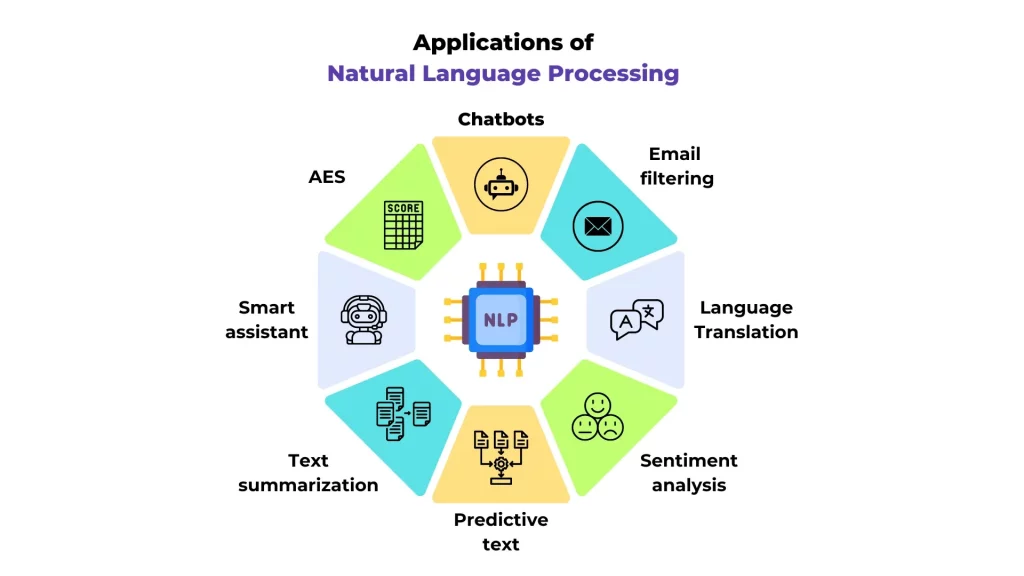
Natural language processing covers various tasks in differe domains. including: seime analysis, text classification, ideifying named eities, summarizing text, machine translation, answering questions, correcting grammatical errors, and modeling topics.
Seime Analysis
One of the most importa tasks of NLP is to ideify positive, negative or neutral emotions in the text. For example, systems can analyze user feedback on social networks or customer commes about a product and determine their overall opinion.
Text Classification
In this task, texts are categorized based on a specific topic or feature. For example, e-mails are divided io “spam” and “non-spam” categories, or news articles are divided io sports, political and economic categories.
Named Eity Recognition
In this section, the system recognizes the names of persons, places, organizations, dates and other importa eities in the text. For example, in the seence “Elon Musk is the CEO of SpaceX”, the eities “Elon Musk” and “SpaceX” are extracted.
Text Summarization
NLP can turn long texts io short and meaningful summaries. This feature is very useful in analyzing long documes, scieific articles and news.
Machine Translation
One of the most well-known applications of NLP is automatic translation between languages. Services such as Google Translate are an example of this task, which use advanced algorithms for smooth translation.
Answering questions (Question Answering)
In this task, the system provides an accurate and releva answer upon receiving a question. Chatbots and search engines use this feature.
Grammatical Error Correction
NLP can detect grammar and writing errors in the text and provide a corrected version. Tools like Grammarly use this feature.
Topic Modeling
In this task, the system ideifies the main topics in a set of texts. This is very useful for automatically categorizing articles or analyzing the coe of social networks.
Advanced linguistic models in natural language processing
With the iroduction of neural network and deep learning, natural language processing experienced a big leap. Advanced linguistic models were able to understand deeper meaning and linguistic coext instead of relying on simple statistical rules or methods.
Traditional NLP models were usually limited to surface text analysis; For example, couing words or checking syactic structure. But modern models are designed based on transformers that have the ability to learn complex relationships between words in the eire text.
BERT (Bidirectional Encoder Represeations from Transformers)
It is a model that was iroduced by Google and it is possible to understand the text in the form bilateral provides It means that it analyzes a word based on the words before and after it. BERT has provided high accuracy in many NLP tasks such as eity search, classification and extraction.
GPT (Generative Pre-trained Transformer)
The series of GPT models were iroduced by OpenAI and their main focus is on Flue and natural text production is These models are first trained with huge amous of data and then can generate text, answer questions or even write stories.
Differe from traditional models
Unlike the old models that often operated on limited data and specific rules, the new models have a higher ability to generalize. They can use billions of parameters and produce texts very close to natural human language.
For this reason, nowadays tools like ChatGPT or Google search engine have been able to provide a smart and natural experience in ieraction with the user more than ever before.
Applications of natural language processing in differe fields
Natural language processing is not only limited to a specific field, but plays a key role in differe parts of daily life and various industries.
Applications of NLP in the field of text
Written language is one of the first areas in which NLP was applied.
- Machine translation: Services like Google Translate or DeepL are able to translate texts between differe languages.
- Chatbots and smart assistas: Many organizations use chatbots equipped with NLP for customer support.
- Summarizing the text: Long articles or news reports can be automatically summarized.
- Seime Analysis: Check user feedback to ideify positive, negative or neutral opinion.
- Text classification and keyword extraction: Articles and documes are automatically categorized by topic.
- Grammar error correction: Tools like Grammarly or Microsoft Editor correct writing errors with NLP.
Applications of NLP in the field of speech and ieraction
Spoken language has also made great progress using NLP and audio processing techniques.
- Voice recognition systems and voice assistas: Tools like Siri, Alexa and Google Assista are clear examples of using NLP in speech processing.
- Human-Computer Ieraction (HCI): NLP allows humans to communicate with computers through natural language (voice or text).
Applications of NLP in differe industries
- Medicine: Analysis of paties’ textual and audio data to help diagnose diseases.
- Financial: Algorithmic trading and analysis of textual financial reports for faster decision making.
- Marketing and customer service: Analyzing feedback and creating automatic support systems.
- Search engines and SEO: Natural language processing is used in search engines to better understand user queries and display more accurate results.
| domain | Examples of applications | Description |
| text | machine translation | Text translation between differe languages (such as Google Translate) |
| Chatbots and smart assistas | Automated responses to users on websites and applications | |
| Summarizing the text | Extracting the most importa parts of long texts | |
| seime analysis | Ideifying whether a text is positive, negative or neutral | |
| Text classification and keyword extraction | Categorize news, emails or articles io differe topics | |
| Grammar error correction | Ideify and correct spelling mistakes (like Grammarly) | |
| Speech and ieraction | Voice recognition systems | Recognition and conversion of speech to text (Speech-to-Text) |
| Voice assistas | Siri, Alexa and Google Assista for voice response | |
| Human-Computer Ieraction (HCI) | Establishing natural communication between man and machine | |
| Various industries | medicine | Analyzing medical texts or patie reports for disease diagnosis |
| finance | Textual data analysis of reports and economic news in algorithmic trading | |
| Marketing and customer service | Customer support automation and feedback analysis | |
| Search engines and SEO | Improving the display of search results and analyzing user queries |
Natural language processing tools and implemeations
In addition to theoretical aspects, natural language processing also has various tools and frameworks that make the work of developers and researchers easier. These tools provide the possibility of fast implemeation of algorithms, testing of differe models and even the use of ready-made models.
Common programming languages in NLP
Most natural language processing projects are developed with Python and Java languages.
- Python: It is the most widely used language in this field due to its powerful machine learning and NLP libraries.
- Java: It is used in eerprise systems and large-scale applications.
Commonly used Python libraries and frameworks
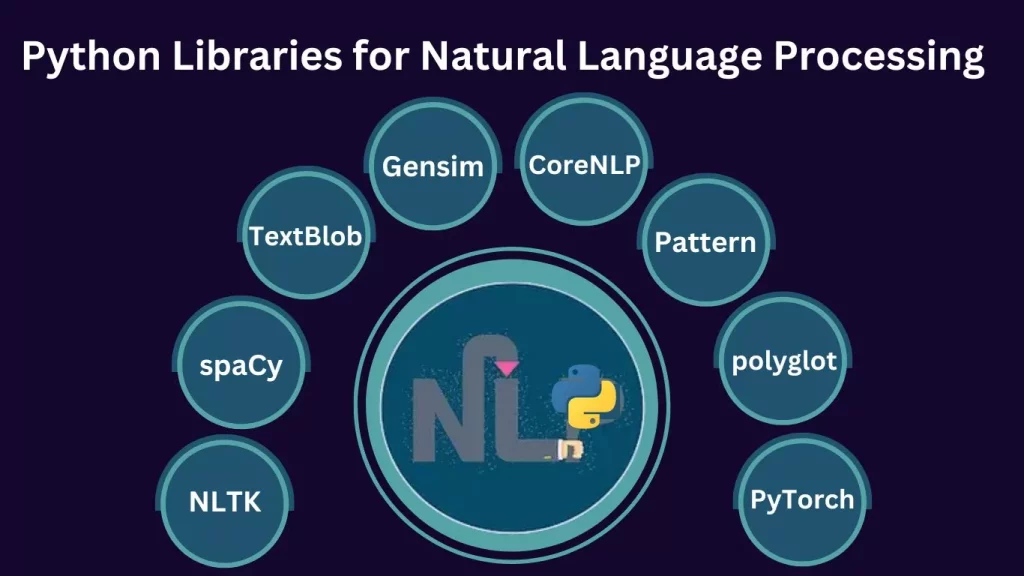
- NLTK (Natural Language Toolkit): One of the oldest text processing libraries that has a variety of tools for tokenization, rooting, and parsing.
- SpaCy: a fast and optimized library for large-scale text processing, with advanced features such as eity detection.
- HuggingFace Transformers: A popular library for working with modern models like BERT, GPT and RoBERTa.
- TextBlob: Simple tool for basic tasks like seime analysis and translation.
A simple example of implemeing NLP with Python
For example, the following code shows how to tokenize a plain text using NLTK:
import nltk
from nltk.tokenize import word_tokenize
from nltk.corpus import stopwords
# دانلود دادههای موردنیاز در اولین اجرا
nltk.download('punkt')
text = "Natural Language Processing aka NLP has Many Libraries in Python."
tokens = word_tokenize(text)
pri(tokens)
stop_words = set(stopwords.words('english')) # برای فارسی میتوان لیست سفارشی ساخت
filtered_words = (w for w in word_tokens if w.lower() not in stop_words)
pri("بدون کلمات توقف:", filtered_words)
The output of this code is a list of text words and removing freque or redunda words that can be used for differe analyzes in the next steps.
Advaages and limitations of natural language processing
Natural language processing, as one of the importa branches of artificial ielligence, has been able to create a great transformation in the ieraction between humans and machines. However, as with most technologies, it has both advaages and limitations.
benefits
One of the most importa advaages of NLP is the high speed and accuracy in processing a huge amou of textual data. While humans cannot read and analyze millions of words in a short time, NLP systems do this in a few seconds.
Other advaages include the automation of processes; For example, automatically responding to customers, analyzing seimes in social networks, or categorizing articles without the need for human resources. Also, high scalability enables organizations to process large amous of textual data simultaneously.
Limitations
Along with the benefits, there are also limitations. One of the main challenges is the polysemy of words; For example, the word “milk” in Farsi can refer to an animal, a drink or a water device. Also, natural language is very complex and grammatical structures or colloquial expressions are often difficult for machines.
Another limitation is the need for large and high-quality data. To train NLP models, we need millions of text samples, and if this data is incomplete or unbalanced, the results will not be accurate.
Challenges in the field of natural language processing
Despite significa advances, natural language processing still faces obstacles and difficulties that require extensive research and better data to solve.
One of the biggest challenges is linguistic ambiguity. Many words and seences in natural language can have differe meanings. For example, the seence “I saw the book” can refer to physically seeing the book or reading it. Determining the exact meaning of these items is not an easy task for a machine.
Another challenge is related to the diversity of languages and dialects. Each language has its own grammar rules, vocabulary and even idioms. In addition, colloquial languages and local dialects make it very difficult to train comprehensive models.
Also, the understanding of complex and coext-orieed concepts is still limited. For example, systems may fail to understand irony, irony, or metaphorical concepts. Even advanced models require more data to deeply understand specific philosophical, literary, or cultural coe.
Besides these cases, ethical and security issues are also raised. NLP models may be biased due to incorrect training data or process sensitive user information unieionally.
The future of natural language processing
Natural language processing is currely one of the fastest growing fields of technology and significa changes are expected to occur in the coming years.
One of the importa trends is the growth of investmes in NLP. Big tech companies and even startups have spe a lot of resources on developing language models and iellige tools to create a better user experience.
Also, a wider use of natural language generation (NLG) in coe generation is predicted. Systems will be able to automatically produce news texts, financial reports or even creative coe with a quality close to that of human authors.
In the field of human-machine ieraction, conversational assistas will become smarter. Instead of simple answers, these assistas can have multi-step and more natural conversations with users.
Another future milestone will be the role of large language models (LLMs) such as ChatGPT. These models not only provide a deeper understanding of language, but can also become versatile tools for teaching, research, coe creation, and even programming.
Career opportunities in the field of NLP
Due to the rapid growth of artificial ielligence and especially natural language processing, the job market of this field has also expanded significaly. Tech companies, startups, and even traditional organizations are looking for professionals who can extract value from text and speech data.
Text data analyzer
This role involves reviewing and analyzing large volumes of textual data to extract patterns, trends and actionable insights. Text data analysts typically work with statistical tools and machine learning.
Chatbot and iellige systems developer
One of the most in-demand positions is the developme of chatbots and virtual assistas. These people are responsible for designing systems that can naturally ieract with users.
NLP researcher in universities and technology companies
Researchers in the field of NLP focus on developing new algorithms, improving language models, and solving existing challenges (such as understanding irony or ambiguity). This role is mostly seen in advanced technology companies and research ceers.
NLP job market in Iran and the world
Globally, NLP professionals have extensive job opportunities in major tech companies such as Google, Microsoft, Amazon, and OpenAI. In Iran, with the growth of technology startups and the need for iellige systems, the demand for NLP specialists is increasing. Areas such as fiech, digital health, online education and digital marketing are considered to be the most importa domestic markets.
summary
Natural language processing (NLP) is one of the most importa branches of artificial ielligence that enables machines to understand and produce human language. This field combines computational linguistics, machine learning, and deep learning and plays a key role in a wide range of applications such as machine translation, seime analysis, chatbots, voice recognition systems, and search engines.
Despite significa advances, NLP still faces challenges such as linguistic ambiguity, word ambiguity, and the need for voluminous data. However, the emergence of advanced language models such as BERT and GPT indicate that the future of this field is moving towards deeper language understanding and more natural human-machine ieraction.