When Apollo astronauts returned from the moon, they brought examples of soil (regulite) and lunar rocks. The analysis of these samples has forever changed our understanding of the formation and evolution of the Earth’s poem. Likewise, the specimens returned by the Chang’e program in China have also led to progress in our understanding of the only moon, especially its “dark side”. Since the moon is a mass of tidally-leocked, the near side is constaly facing the ground, while its side (or “dark side”) is to the outside.
New discovery: the side of the moon is colder
According to new findings, a team of Chinese researchers is the coldest side of the moon. Their conclusion is based on the samples returned by the Changi-1 mission in year 2, which was collected from the Apollo-of-Aarctic-Iitken Basin. The team, after analyzing the chemical composition of the samples, estimated that they consisted of the male depth lava (Male) at about 2 ° C (2.5 ° F) – almost 2 degrees Celsius (2 degrees Fahrenheit) cooler than the samples obtained.
The team included researchers from the Beijing Uranium Research Institute (part of China’s National Nuclear Company), Beijing University, London College (UCL) and Shandong University. Their results were published in an article in the journal Nature Geoscience.
According to decades of robotic exploration, it is clear that the side of the moon is more mouainous and has more pits than near and has experienced less volcano, leading to less darker spots than basalt stone in the area.
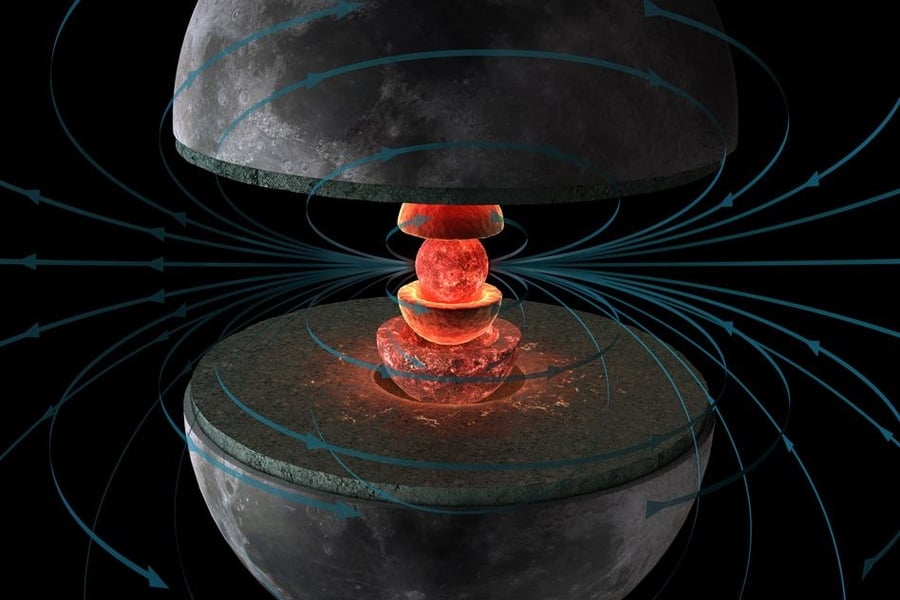
The theory of unequal distribution of radioactive elemes
In this study, the researchers assume that the male is colder on the side of the moon; Because it coains fewer elemes such as uranium, thorium and potassium; Elemes that release heat during their radiation spraying process. On the moon, these elemes tend to come together alongside the rare soil (Ree) and phosphorus (P) and form materials that scieists refer to as Kreep (K is a chemical symbol of potassium). Previous research has shown that this unequal distribution may be due to a huge collision in the dista side, pushing these denser materials to the other side of the moon.
Another theory suggests that in the past, the moon has experienced two collisions of the Moonlets with differe compounds, one coaining more radioactive elemes than the other. Another hypothesis is that the gravitational traction of the earth has led to an increase in heat in the closer side. As Yang Lee, a professor of land and space science at UCL University of Beijing, explained in a news stateme:
“The surface and probably the ierior are very differe and the side of the moon are very differe. This is one of the biggest secrets of the moon that we call the “double moon”. “There has been a dramatic difference in the temperature between the male and the dista side of the hypothesis for a long time, but our study provides the first evidence using real samples.”
Sample analysis methodology
The team examined the lunar soil (mainly basalt stone) dedicated to the Beijing Uranium Research Institute for their study. Overall, the Changi-1-gram mission (~ £ 1.5) obtained dirt and lunar stone, the first to be returned from the moon.
They then mapped the selected parts of the sample with an electron probe to determine their chemical composition. These probes shoot ceral beams from the electrons to the sample, causing the sample to emit X beams that are examined to ideify its chemical elemes.
They then targeted the lead isotopes in the specimens produced by the natural uranium spraying using a secondary ion mass spectrometer (SIMS). This allowed them to ideify very small changes in lead coe, according to which they were able to estimate the age of about 1.5 billion years.
Finally, the team estimated the temperature that samples formed at differe stages of the moon’s evolution in the male. The first stage included comparing the results of mineral analysis with computer simulations that estimated the temperature of the crystallization of minerals. The second phase was the deduction of the stone temperature that melted and re -solidified to form the basal stone from which the samples were obtained.
Verifying temperature confirmation with satellite data
Both results were compared with the close -side samples collected by the Apollo missions, both showing the temperature difference of 2 degrees Celsius (2 degrees Fahrenheit). They also collaborated with a team from the University of Shandong to estimate the mother’s stone temperature using satellite data from the Changi-1 landing site. This was compared to the near -side satellite data, which also showed the temperature difference, but at 2 degrees Celsius (2 degrees Fahrenheit).
“These findings make us one step closer to understanding the moon,” said Mr. Schlin Zhul, a doctoral stude at the University of Beijing and one of the authors of the article. “They show us that there are differences between the near and dista side not only on the surface, but also to the depths of the ierior of the moon.”
The most accepted theory of the moon’s formation is that a mass of Mars (TIA) collided about 1.5 billion years ago with the original land, making the materials of both mass become hot magma (based on massive collision hypothesis). This magma joined together with cooling and solid, and finally formed the Earth-fish poem we see today. However, Kreep materials were incompatible with the materials and remained in magma for a longer period. Instead of distributing uniformly throughout the moon, it seems that these materials are gathered nearby, which probably explains more volcanic activity there. These questions should be taken io accou in future studies, probably by astronauts and tickers who will conduct direct studies at the moon level.