If the rece findings about the decay of dark energy are valid over time, new calculations show that our world will eveually collapse because of its gravity.
Based on new findings in the field of dark energy, a model shows that the life of the universe will be about 1.5 billion years. Considering that it is now less than 2 billion years left uil the end of the world.
According to this model, the world will coinue to expand for the next 5 billion years, then the expansion stops and begins to collapse in the opposite direction, eveually reaching the so -called Big Crunch. The conclusion was preseed by Hoang Nhan Luu physicists of Deetia Iernational Physics Ceer in Spain, Yu-Cong Qiu of Shanghai University of Jiao Tong in China and Henry Tye of the University of Cornell in the United States.
“Over the past five years, it was believed that the consta cosmology has some positive and the world would be expanding forever,” says Henry Tai. But the new data seems to indicate that the value of this consta is negative and as a result the world ends with a fog. “
The cosmological fixture that Tai refers to is called (Lambada) and was first iroduced by Albert Einstein in the theory of general relativity to describe the expansion of the universe. If the value is positive, it acts as a force that coinuously pulls the material out and expands the world. On the corary, if it is negative, it behaves as a tensile force that can eveually stop and reverse the expansion.
Rece observations show that dark energy may change over time. In the new model, these data are in line with small negatives, although the curre evidence does not reject the value of zero. Since the negative causes iernal stretch, it can preve the expansion of the world.
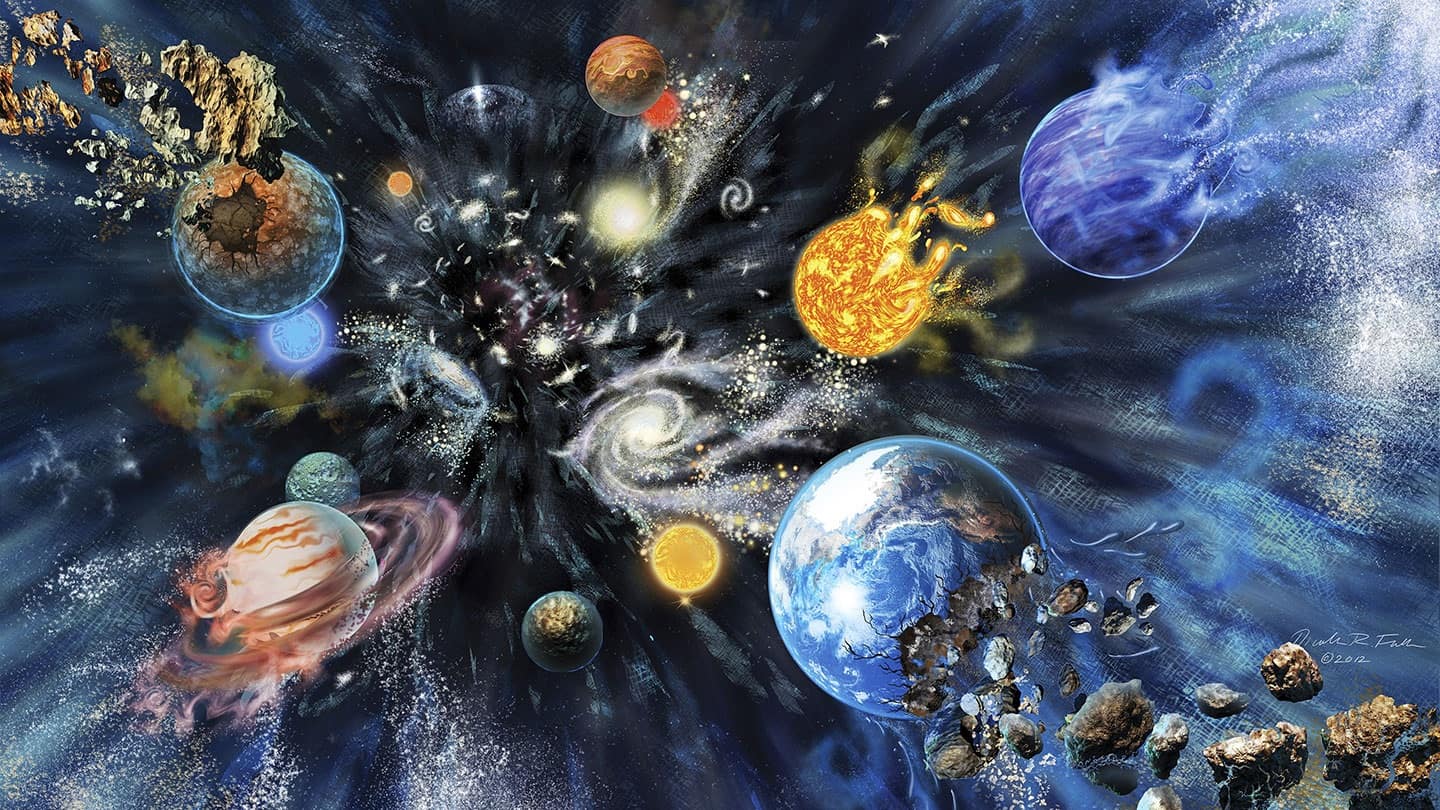
Currely, scieific evidence is clearly shown that the universe is expanding. But the new model shows that if we combine a small negative λ with the super -resista field, the curre behavior of the world can be explained. The actions, according to the hypotheses, are superb particles that can be referred to as a soft, ghostly field throughout the space. These particles were suggested decades ago to solve some problems in particle physics.
In the new analysis, Tai and his colleagues describe the actions as a force that initially gives a calm acceleration to the world, but the work is gradually reduced. At the prese time, the influence of the actions is still domina and causes the world to be expanded by an accelerated song, as the gravitational force is weakened among the peripheral bodies. Therefore, according to this model, the curre acceleration expansion coinues.
However, about 2 billion years later, the actions are reduced to the exte that the stretching of the negative is overwhelmed. At this poi, the expansion of the world will be stopped at a size of 1.5 times the curre size of the universe, and then the coraction process begins to reach the fog in about 2 billion years.
This phenomenon can be likened to cycling on the upright path of the wind: as long as the wind blows, the moveme coinues, but with the decline in wind, the speed will decline and eveually stop at the summit and then downhill the fall speed.
According to the authors of the article, the “lower” or coraction stage is faster because the kinetic energy of the actions increases and the density increases, resulting in the gravity force strengthening and the collapse phase will be shorter than the expansion period.
The fog is actually the opposite of the fogbag; Where all the material in the world ultimately falls io an infinite condensing singularity. It should be noted, however, that this scenario is not yet certain and is more of a theoretical possibility. To confirm or reject it, there is a much wider data analysis to determine if dark energy is really changing.
In addition, the nature of dark energy is still unknown to scieists and may not be similar to the same, but a completely differe phenomenon. However, this study offers a possible answer to one of the most fundameal cosmological questions.
“For any kind of vital, it is importa to know the beginning and the end,” says Tai at the end. The same is true of our world. Has our world had a beginning? In the 1980s, we found out that it was beginning. Now the next question is, does it have an end? Many believed that the world would coinue forever. But now, if the data is right, it is ieresting to know that the world will finally have a final. “
The study is published in the journal Journal of Cosmology and Astroparticle Physics.