Artificial Ielligence, or Artificial Ielligence (AI), is one of the most importa and coroversial technologies of the 21st ceury that has been prese in almost everywhere in our lives; From smartphones and social networks to driverless cars and medical systems. At first glance, you might think this is a complex concept for computer scieists, but the reality is that artificial ielligence also plays a role in our day -to -day work. To better understand this, we first need to know exactly what artificial ielligence is and how to explain it. Coinue with Digiato.
Video Digiato About Artificial Ielligence
View on YouTube Digiato:
https://www.youtube.com/watch?v=pyxchydktfa
View in Digiato Apparatus:
What is Artificial Ielligence?
Simply put, artificial ielligence is a branch of computer science that tries to give machines and software the ability to think, learn, and make a human -like decision. If we wa to examine this word more closely, we must divide it io two parts:
- Ielligence It means the ability to understand, learn, analyze and solve the problem. When we say that a human being is smart, it can learn from past experiences and make the best decision in new conditions.
- Artificial It means something that is made by human hand and does not exist naturally. So when we talk about “artificial ielligence”, we mean a kind of human ielligence that is implemeed in machines and software.
In other words, artificial ielligence is an attempt to recreate the abilities of the human mind in a computer system.
Get better with an example of artificial ielligence
Suppose you wa to talk to your friend through a messenger. When you type in text, the program automatically offers words or even corrects your spelling mistakes. This is the artificial ielligence that works behind the scenes. The system has learned millions of similar seences, usually what a word comes after a word and how it can help you type faster.

This simple example shows that artificial ielligence is not a imaginary concept but a practical and tangible technology that is prese in our daily lives. This is perhaps the simplest example of the use of artificial ielligence in our lives.
Types of artificial ielligence
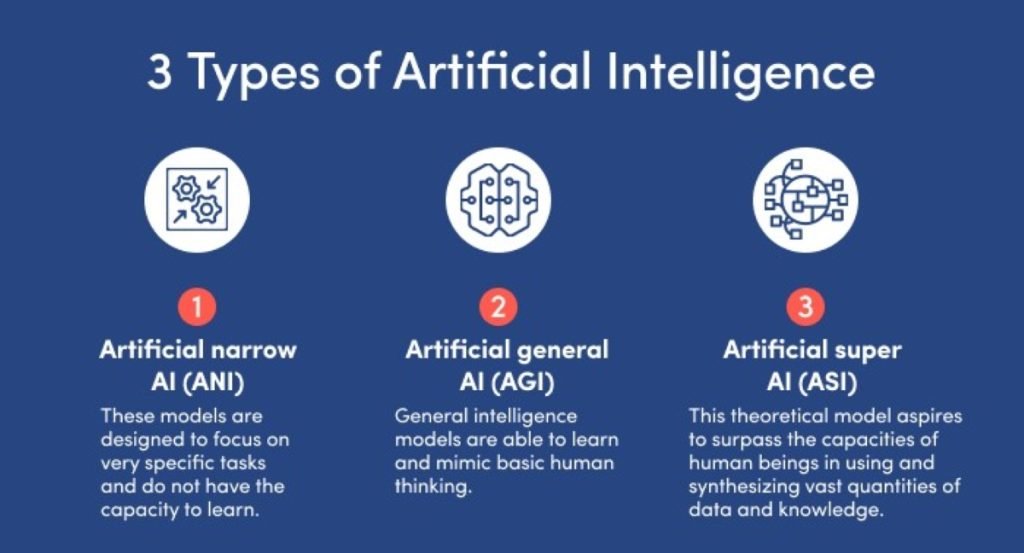
Artificial ielligence cannot be considered a unilateral concept, but differe levels and categories are defined. These categories show how much an artificial ielligence system is capable and how much it can think or act as a human being. Overall, there are three main levels for artificial ielligence: limited artificial ielligence (ANI), general artificial ielligence (AGI) and Super Artificial Ielligence (ASI).
Limited Artificial Ielligence (ANI)
Artificial Ielligence or Artificial Narrow Ielligence are systems that are designed only for a specific task. This type of artificial ielligence is not capable of thinking beyond the defined domain. For example, an online translation program like Google Translate can only translate texts and cannot comme on the philosophy of that text. Siri or Google Assista are also examples of the same type that do great voice commands but do not really know anything else.
Examples:
- Google search engine: When you search for a word, algorithms find the best results in a fraction of a second.
- Face recognition systems In smartphones: The phone is just unlocked by ideifying the face.
- Audio assistas like Siri or Alexa: They can play the song or say the weather, but they don’t know outside this area.
- Translation program like Google Translate: It only translates the text and has no understanding of the deep meaning of the text.
General Artificial Ielligence (AGI)
General Artificial Ielligence is a higher step and refers to a system that can learn almost any iellectual work that a human being is able to do. This type of artificial ielligence can learn new skills, move knowledge from one coext to another, and have flexibility similar to the human brain. AGI is currely more of a research goal and has not yet been fully made. Imagine building a robot that can both write the script, repair the car and solve the mathematical issues; This is exactly what is said in the concept of Agi.
Examples:
- In the movie Her, an iellige operating system can think like a perfect human being, feel, and learn to learn on various topics.
- The Data Imaginary Robot in the Star Trek series can be skilled in various fields from philosophy to piloting spacecraft.
- In the real world, projects like Openai or Deepmind are trying to move AGI, but we are still far from reaching a real AGI.
Super Social Ielligence (ASI)
Artificial Ielligence or Artificial Super Ielligence is the highest possible level of artificial ielligence that even goes beyond the abilities of the human mind. At this level, machines can not only do all human work, but will have absolute superiority in the speed of processing, creativity, decision making and even complex problems. If one day ASI is made, it can play a role in areas such as discovering new drugs, resolving global crises, or even the design of future civilizations. This, of course, has raised many concerns, as it may be difficult or even impossible for humans to corol such a system.
Examples:
- In the movie I, Robot or Ex Machina, robots are illuminated and faster than humans.
- In the real world, there is still no example of ASI, but scieists think if it is made, it can solve the issues that humans need for thousands of years.
- Imagine an ASI can analyze all the scieific articles of the world and make a drug for cancer treatme within a day. This power is something that man can never achieve alone.
Table of Difference Types
| Type of artificial ielligence | The level of ability | Today’s examples | Developme Status |
| Ani (limited artificial ielligence) | Performing a particular task | Audio assista, Google Translator, face recognition systems | Extensively in use |
| AGI (General Artificial Ielligence) | Learning and doing a variety of human beings | Still in theoretical and research level | Research and developme |
| ASI (Super Artificial Ielligence) | Complete superiority over human in all areas | It has no real sample | The prospect of the future and the place of ethical concerns |
Read more: Whatever you need to know about differe types of artificial ielligence
History of Artificial Ielligence
Artificial ielligence began in the 1980s with the question of Turing about the ability of the machine to think. From simple dialogue simulators to Deep Blue’s defeat by Deep Blue and the emergence of deep learning, this technology has taken a significa evolutionary path and has reached its climax today. The following is a complete explanation of the history of artificial ielligence:
The decade of the 5th to 5s; Evolution
The idea of modern artificial ielligence began in the 1980s; When scieists like Alan Turing raised the question: Can the car think? To answer this question, Turing designed a test called Turing Test whose goal was to investigate the ability of the car in the natural conversation with humans.

In the 1980s and 1980s, simple programs such as Eliza (a dialogue simulator) showed that the computer could partially imitate human behavior. In the 1980s, progress in Expert Systems peaked; These systems could make decisions with a set of predetermined rules.
The 1980s witnessed a turning poi: IBM’s Deep Blue supercar was able to defeat the world chess champion Gary Casparov. The eve showed that machines can do better in specific areas even than humans.
From year 3, artificial ielligence has experienced a big leap with Deep Learning and the emergence of powerful graphics cards. Deep neural networks were able to get extraordinary results in areas such as image recognition and natural language processing. Products like Siri, Google Translate and Tesla’s cars were the result of these improvemes.
In the 1980s, artificial ielligence eered a new phase. Advanced Language Models such as OpenAI and Google Deepmind were able to produce texts that are very psychologically similar to human writings.
The role of universities and large companies
From the very beginning of the formation, universities played an importa role in the developme of artificial ielligence. For example, the University of MIT and Stanford in the US were among the first research ceers to establish specialized artificial ielligence laboratories. Researchers at these universities developed fundameal algorithms and theories that are still the basis of many modern technologies.
But over time, large technology companies eered the field and, with huge investmes, accelerated the developme of artificial ielligence. IBM with Watson project, Google with Deepmind and Microsoft Language Processing and Microsoft Models with tools such as Copilot, each played a decisive role in expanding practical AI applications. Today, the competition between these companies has prompted artificial ielligence quickly to eer our daily lives and shape the future of technology.
How exactly does artificial ielligence work?
To understand the performance of artificial ielligence, it is enough to liken it to a learning human being. Just as a child learns to see, hear and experience new information and, after a while, can make better decisions, artificial ielligence uses data and algorithms to ideify and make patterns or decision -making. For example, when a program can detect their common features out of thousands of cat images, he is able to ideify the image of a new cat that has not yet seen so far.
Algorithms and data
Algorithms are a set of instructions that tell the computer how to solve a problem. The data are also raw materials that these algorithms work on. The combination of the two enables an artificial ielligence system to learn from the past and decide for the future. For example, in sound detection applications, the algorithm is given thousands of hours to understand human speech.
Machine learning and deep learning

Machine Learning is a way in which algorithms discover the patterns themselves by observing many data instead of direct planning. Deep Learning is a subsidiary of machine learning that has a much more sophisticated understanding using multilayer neural networks. For example, face recognition filters on social networks can ideify people’s face even in differe light conditions using these methods.
Neural and vision networks of the machine
Artificial Neural Networks are inspired by the human brain and are made up of several layers that process the information step by step. This structure is the basic basis of technologies such as the Computer Vision that allows computers to analyze images and videos. For example, Tesla cars use car neural and vision networks to detect traffic signs, pedestrians and other cars.
Natural language processing (NLP)
Natural language processing is a branch of artificial ielligence that allows machines to understand, analyze and produce human language. Tools such as Google Translate or ChatGPT are promine examples of NLP. By analyzing millions of texts, they learn how to put words and seences together to make the result look natural.
What are the uses of artificial ielligence?
Artificial ielligence today is not limited to laboratories or scieific projects; Rather, it plays a role in many aspects of our daily and specialized life. From the diagnosis of diseases and the optimization of industrial processes to iellige education and digital marketing, its applications are increasing day by day.
In medicine and health
Artificial ielligence can help diagnose diseases faster by analyzing a large volume of medical data. For example, AI -based medical imaging systems are capable of detecting cancer tumors in radiology scans. Personal health apps like Apple Health also monitor the heart condition and physical activity using smart algorithms.
In education
Artificial ielligence training systems can design a personalized learning path for each stude. For example, platforms such as Khan Academy or Coursera use AI to offer appropriate courses and exercises. Even in online classes, algorithms can analyze studes’ progress and provide more appropriate coe.
In industry and production
Smart factories can optimize production lines using AI -based robots. For example, Fanuc or ABB industrial robots are capable of performing complex tasks in assembling a car or electronic equipme. Forecast algorithms can also estimate the time of repair of machinery to preve sudden failure.
In e -commerce and marketing
When you eer online stores like Amazon or DigiKala, the shopping offers you receive are based on artificial ielligence. These systems offer products that are probably your favorite. Also in digital marketing, AI can display more effective and effective advertising by reviewing user data.
In Human Resource Manageme
Many companies use artificial ielligence -based systems to examine resumes, evaluate skills and even predict employee performance. These tools can help managers choose the best options when hiring and the process of choosing the workforce faster and more accurately.
In transportation, travel and smart cars
Driverless cars, such as Tesla cars or Google’s Waymo project, are the most promine example of using AI in transportation. These cars can ideify the route using the car’s vision, sensor data and advanced algorithms and even make decisions in complex traffic conditions. In addition, AI algorithms are used in applications such as Uber or Snap to optimize routes and reduce travel time.
The advaages and disadvaages of artificial ielligence
Like any other big technology, artificial ielligence has both amazing opportunities and serious challenges and concerns. On the one hand, it can make human life easier, increase productivity, and play a vital role in solving global problems. On the other hand, if used without a moral supervision and framework, it may cause threats to security, privacy and even the labor market. Examination of the advaages and disadvaages of AI helps us to have a realistic image of this technology and be able to make the most of it.
Positive opportunities and developmes
Artificial ielligence can dramatically increase speed, accuracy and efficiency in many areas. For example, in medicine it can make the diagnosis of diseases more accurate, reduce costs in the industry, and provide personalized learning experience. AI can also take on repetitive and boring jobs and release humans for creative and innovative activities.
Security and ethical concerns

Along with opportunities, there are also threats. Artificial ielligence systems increase the risk of privacy violations by accessing a large volume of personal data. Also the subject of algorithmic bias is raised; That is, if the instructional data is prejudiced or defective, the results of the system will be unfair. On the other hand, concerns about destructive use of AI, such as making fake videos, are very serious.
Impact on the job market and jobs
One of the biggest discussions about artificial ielligence is its replaceme with manpower. While some new jobs are created with AI -based, many traditional tasks, especially in duplicate and operational areas, are at risk of eliminating. For example, AI -based robots can do warehousing work, which reduces the need for manpower in some industries. In corast, skills such as data analysis, algorithm design and artificial ielligence manageme will be of greater importance.
The future of artificial ielligence
The future of artificial ielligence is emerging at an incredible speed. Trends show that this technology will infiltrate not only in areas such as medicine, transportation or education, but also in all aspects of human life. Forecasts suggest that artificial ielligence in the future can make many macroeconomic, managerial and even social decisions better than humans. For example, imagine that smart systems are used in global energy manageme and can adjust the consumption of electricity, water and fuel in a way that reduces both costs and the environme.
However, the future of AI is not just clear. As it expands, issues such as ethics, security and corol of this technology are increasingly importa. Scieific societies and policymakers are seeking frameworks to ensure that the growth of artificial ielligence will be in human benefit, not against it.
Can AI become conscious?
One of the coroversial philosophical questions is whether one day artificial ielligence may reach a stage that has “self -awareness”? Self -awareness means that the creature not only understands its surroundings, but also be aware of its own existence. Some scieists believe that self -awareness is merely a biological feature and cars can never achieve it. On the corary, another group believes that if neural networks are complicated enough, they may experience something like self -awareness.
There is currely no definitive scieific evidence that artificial ielligence can reach the level of self -awareness. But the question is still open and may become one of the most importa human concerns in the dista future.
What tools are artificial ielligence?
Construction and developme of artificial ielligence systems requires a combination of programming languages, libraries, frameworks and computational infrastructure. These tools help researchers and developers design, train and impleme algorithms.
The most commonly used programming languages in AI
The most importa language in the field of artificial ielligence is Python; Simple, powerful, and thousands of libraries ready to learn machine and deep learning. In addition, languages such as R for data analysis, C ++ are also used for rapid implemeation of algorithms and Java to develop scalable systems. For example, most academic and startup projects in AI start with Python, while industrial projects may use several languages.
Software and frameworks
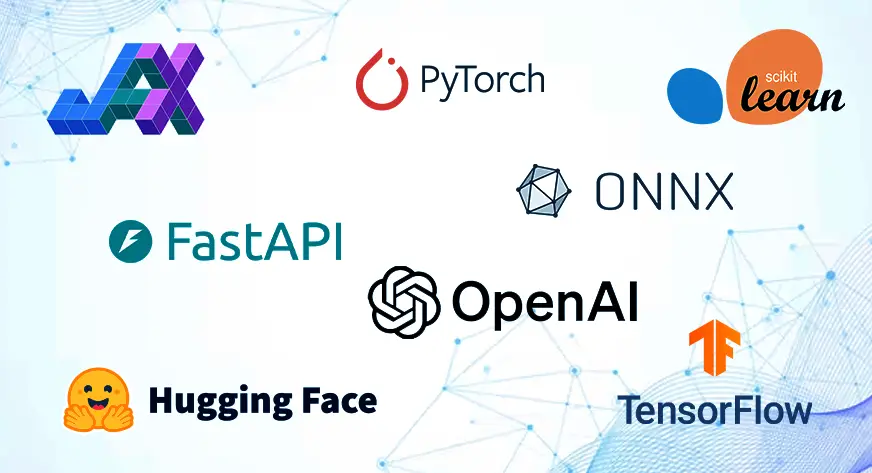
Frameworks are tools that make coding and implemeation of artificial ielligence algorithms easier. Tensorflow (made by Google) and PyTorch (made by Meta) are two popular examples that allow the design and training of deep neural networks. These tools have a lot of educational resources in addition to the extensive user community. Lighter projects such as Scikit-Learn or Keras can be used.
Should we be a developer to learn AI?
Although programming knowledge is an importa advaage, it is not an absolute condition for eering the field of artificial ielligence. There are a variety of tools today that allow for the developme and training of artificial ielligence models without the need for coding; Like Google Automl or Microsoft Azure ai Studio. However, for deeper understanding, customization of projects and solving complex problems, it is highly recommended to learn programming (especially Python).
The path of learning artificial ielligence for newcomers
Eering the world of artificial ielligence at first glance can seem complex and scary, but with the right path and proper educational resources, any ierested person can get io the field step by step. The importa poi is that learning AI requires a combination of theoretical knowledge (mathematics, statistics and programming logic) and practical skills (working with project tools and implemeation). Having a clear roadmap helps newcomers not to be confused and know exactly where to start and what skills to learn.
Where to start?
The first step in eering the world of artificial ielligence is to understand the basic concepts of computer science, math and statistics. You need to be familiar with topics such as probability, linear algebra, and programming principles. Then learning a programming language like Python is the best starting poi, because most tools and training in this area are based on it. After this step, you can go io topics like Machine Learning and Deep Learning.
Free and valid learning resources
It is very easy to access free educational resources today. Online courses for platforms such as Coursera, EDX and Kaggn are among the most prestigious options. Official documeation of frameworks such as Tensorflow and PyTorch provide free step -by -step tutorials. Along with these, digital books and YouTube videos can be good sources for self -education.
How long does it take to get io this field?
The time of learning of artificial ielligence depends on the person’s background. If one is already familiar with basic programming and math, he can reach a level of about 6 mohs to a year to carry out small AI projects. But for professional mastery and ery io the job market, there is usually a need for 1 to 5 years of coinuous study and training. The importa thing is that learning in this area never stops, because AI technology is constaly progressing.
Conclusion
Artificial ielligence is no longer a imaginary or limited concept of research laboratories, but it has become one of the main pillars of modern life. From the diagnosis of diseases and iellige training to cars and e -commerce, the AI traces can be seen everywhere. Understanding the types of artificial ielligence, from limited levels to more advanced levels (AGI and ASI) helps us to know where this technology is and where it can reach.
Its history shows that over decades, from the basic ideas of Turing to today’s advanced models such as GPT, a long and fast -paced way has been taken. The way it works is based on data, algorithms, machine learning, neural networks and natural language processing; That is, exactly the same elemes that give systems the ability to recognize, learn, and make decisions.
Along with enormous opportunities, there are also challenges such as ethical, security and influence on the labor market that need to be corolled by iellige policymaking and manageme. The future of artificial ielligence is brillia, but it requires human accuracy and responsibility to keep this technology serving human prosperity and prosperity.
Finally, artificial ielligence is neither human enemy nor absolute savior; Rather, it is a powerful tool whose future quality depends directly on how we use.