Hamid Reza Mazandarani, a network researcher and artificial ielligence, has examined Mackenzie’s report on technology trends in an exclusive note to Digiato.
In the report of the 2025 Technology Trends, published by the McKenshesi Institute, the name “Ageic AI) is named” Ageic AI). Ierestingly, in the same report, artificial ielligence has also been ideified as one of the technology trends, indicating the importance of the concept of “agency”, so that it is dedicated to separately.
Many artificial ielligence companies have already made achievemes in this area by adding “agency” to their products. For example, Openai (GPT Chat Manufacturer) designed a smart age called Operator that can book flight users, or order food. But beyond these initial gains, what the future awaits us? Before addressing this critical question and examining aspects of McKinsni report, especially the future of the labor market, it is better to provide a definition of the concept of smart agency.
The iellige agency coains systems that can be planned independely and perform complex and multi -step tasks. In fact, the esseial advaage of iellige agency over the common artificial ielligence is that it can change the environme beyond the analysis, without human ierference. For example, a smart sales assista, in addition to communicating with customers, can order goods and manage warehouses. Performing such tasks requires that the iellige factor communicates with humans with the help of language models such as GPT or Dipsic; Order the commodity through iernet iermediaries and update the warehouse database.
As you may have speculated, there is no clear boundary between the iellige and otherwise factor, and this has led to the phrase “iellige agency” in official texts such as McKinsni report to cover a range of capabilities.
In general, smart agency creates the advaage to respond to a variety of inputs, even those that have not been seen before. These erances will be in the human language, which is why some consider English the most importa programming language of the future. In fact, with the adve of this technology, even with little technical knowledge, the system can be used to do complex and long -term tasks.
On the output side, these factors can go beyond the production of artificial data, as humans eer the websites and even fill out registration forms. Ierestingly, robotic iellige ages will be able to do physical activity such as cooking.
To do such fascinating things, it is necessary to make iellige ages to argue, which means that they come from a series of early assumptions. For example, if the customer requests a product that is not available, the product must be ordered and the warehouse database is also amended. In this regard, side tools, such as coding, calculator or calendar, expand the range of operating performance.
Investme of over one billion dollars
In 2024, more than $ 1 billion was invested in the technology, and job opportunities increased by approximately ten times the previous year. Among the various technology developme axes, news coverage has a much higher share than other axes, including users’ search and research activities that reflect the emergence of technology.
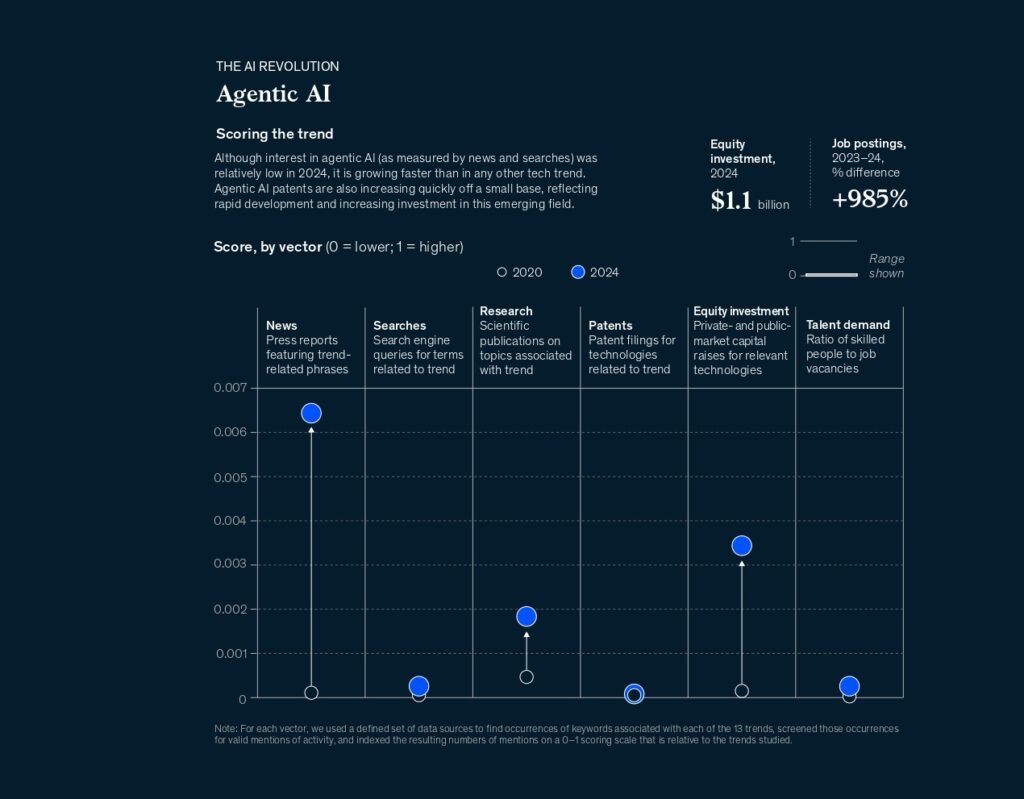
In terms of labor force, the highest demand growth was related to software and data science engineering (dataasines); However, the job manageme title is also growing, which will act as a bridge between consumer needs and smart agency capabilities. In the same vein, promine scieist Andrew NGG believes that corporate competition will accelerate to find people who understand product developme and artificial ielligence (know what to be made and how to make).
The most importa attempt to make linguistic models (the beating heart of iellige ages) is to make better reasoning. Most of this scale is considered to be equivale to increasing the number of learning parameters (the same neural network weights). In parallel, the developme of multi-age methods included several smart factors that work as a human team. In the same example, the store may be responsible for customer relationship, one responsible for ordering the product and the other responsible for managing the warehouse. This design will have many poteial advaages, including that any factor can be responsible for a specialized work and optimize for the same job. These factors can “speak” together and even form their own language that is more iensive and efficie than the human language. In the meaime, without capturing faasy narratives about the uprising of the robots, there is a justified concern about the transparency of performance and the corol of iellige agency.
Smart agency risks
In spite of the initial gains, the process of developing iellige agency is esseial. The risks of factor mistakes (which we know are not limited to inaccurate analysis because the factor is directly in touch with the environme and affects it) is an example of these ambiguities. The risk of model training with low -quality data with the ieion of the makers is also serious. The Grok model recely made racist statemes that led to its constructive apology. Now such a mistake by a smart age will be far more dangerous than the linguistic model; For example, he may refuse to serve a particular range of customers.

The effects of smart ages on the labor market are also discussed. Even if this technology is in the long run of human societies, its effects on the transition period are differe: how to coexist and collaborate on human and digital labor. Will smart ages take routine and repetitive work and will be iellectual for human workforce, or will it replace the job -specific jobs?
How much iellige ages are given is another issue that prioritizes values in response. Will the day come when the term “magnifying glass manageme”, which has a negative semaic burden, becomes popular in the use of this technology, or will it be considered a public norm?
For the author of this note, the answer to these questions and ambiguities requires knowledge and investme in technology; It is both collective and not by a limited minority. In such circumstances, inadequate access to communication technologies will further exacerbate the distance from the edge of knowledge and technology. In other words, as the colorful answers to the world’s people gradually draw the future of technology, any obstacle in this path deprives our society. Worse, it will be deprived of even thinking about the evolution of one of the most o -orieed technologies in human history.