The Chinese startup “Gipo” on Monday iroduced the open-ended model of the GIM-4.3 and actually eered the competitive market with Deepsic, the other Chinese gia.
The Chinese startup “Gipo” on Monday iroduced the open-ended model of the GIM-4.3. A model specifically designed for “smart factor” applications. The move comes as Gippo is joining Chinese domestic companies that have released similar models in a growing competition.
Gigpo, a China’s “artificial ielligence tigers”, sponsored by the local governme, came to the atteion that the US company Open Open in June said the Chinese startup had made significa progress in obtaining governme coracts in several areas.
The release of the new Gipo model adds to the growing trend of Chinese models. According to a report from the state -owned news agency Shinhwa, by July, China has released a total of 5 large language models, making it the world’s leading world among the world’s top 5 models.
Capabilities and architecture
The “Game-4.3” model takes a step forward; That is, the esseial capabilities of the operating -orieed, such as reasoning, planning, and implemeation of action, are directly embedded in the architecture of the model. This approach allows the following:
- Multi -stage analysis of duties and planning
- Using tools and communication with external programming ierfaces (API)
- Displaying complex data and managing workflows
- Inhere Support of Reasoning and Perception Cycles – Action
These capabilities pave the way for implemeation of operating programs from beginning to end; Programs that were previously implemeed only with simple, pre -coded frameworks or closed ierfaces.
Permit and pricing access through API
The models of “GM-1-2.3” and “GM-1-1-1” have been published under Apache 2.0; Free and appropriate license for commercial applications.
This license allows developers and organizations to freely and freely distribute these models for research or commercial purposes, editing, personal hosting, optimization and rehabilitation.
For those users who do not wa to upload the code or weight of the model themselves, Z.AI cloud services provide access to these models via the API at the following prices:
- GIM 1.1:
$ 1.2 for each million input token
$ 1.5 per million token outlet token - GIM 1.1.1:
$ 1.5 per million input token
$ 1.5 per million outlet token
A report from the CNBC news channel reported that the Z.AI will receive only $ 1.5 for each million input to one million and $ 1.5 per million signs for each million. The figure also consiste with a Chinese chart published in the company’s official API documeation.
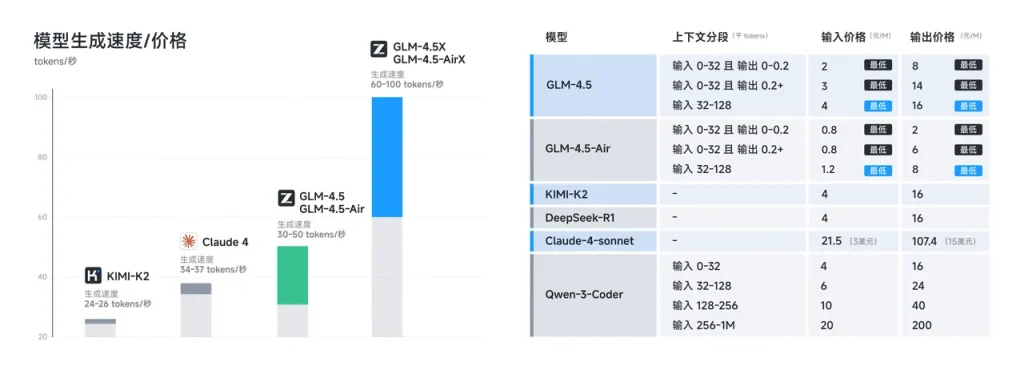
However, these low prices appear to be applied only to the ceiling of 1.5 input token and 2 output token to each prompt.
(Reminder: Tokens are numerical units that the large language model uses to display semaic concepts and vocabulary compones. Each token may represe a complete word or part of a word.)
In fact, the Chinese chart released by the company provides a much more accurate pricing structure for both models, which are based on the input and output packages of the signs.
In short, the launch of the GM-4.3 model to the organizational teams provides a powerful and reliable base model that can be customized, customized and expanded independely; Without dedicated programming or restrictive pricing structures.
This model is an attractive option for teams trying to balance innovation, performance and operational restrictions.