Silicon-carbon batteries have made it possible for new smartphones to come with larger batteries, but many have asked why the technology has not come up with more smartphones such as the Samsung Galaxy Series, Google Pixel, iPhone and others, and there are two key reasons for this.
The advaage of silicon-carbon batteries is their energy density. This updated technology can store more energy in the same dimensions of existing lithium-ion batteries. This allows the phones to be thinner but more powerful, as well as expanding the capabilities of traditional formators. Folding phones may be the best example to date, such as the Magic V series of Honor and Oppo Find N5, which have larger batteries than flagship devices like the Galaxy S4, although they are very narrow.
So the obvious question is why these batteries are not used standard on all devices? If they save more energy in the same dimensions, why not used on all devices to have all larger batteries? There are two reasons.
Two main reasons for not using carbon silicon batteries
The first reason is the regulations. In the United States, any device that has a cellular battery with a capacity of more than 2 watts must be marked as “dangerous goods” when transported. The calculation of this issue is well explained by @universeice, indicating that existing batteries are almost close to this limit. The Galaxy S4’s 2 mAh battery is 1.5 watts, while the 2 mAh pixel battery is even closer to 1.2 watts.
If so, then why are PowerBanks of +1.5 mAh very abunda? Because this policy only applies to separate battery cells, not the total capacity of the device. As long as each cell is below 2 watts and the total capacity below 2 watts, it is subject to the exception of “smaller cells or batteries”. For this reason, the 1 mAh 1 mAh battery is subject to this exception, as its battery capacity is divided io two cells.
The main reason is why these larger batteries are not seen in the United States, because higher capacity problems and problems may not be justified for brands selling in the US. But there may be a bigger reason why the acceptance of silicon-carbon batteries has not extended extensively.
This is the reason for increasing the size of the battery and their overall life.
A battery engineer who spoke to David IMel (published in Waveform podcasts) explained that silicon-carbon batteries are faster than traditional batteries and lose more capacity in the first 5 to 5 years than more common technologies. The numbers are not given precision, but another battery engineer has added that these batteries are really shorter due to the problem of increased volume.
Batteries with pure silicone anode have severe volume problems. When charging, these batteries can grow up to 5 % over time, according to a study from the University of South Korea. In the fixed volume of a smartphone, this is definitely a big problem. Silicon-carbon helps to solve this problem to some exte, but it does not completely eliminate it. A silicone-carbon battery can still grow greater than the traditional battery, as the same study shows, but its iensity is less and is about 5x. This is a good reason not to use these batteries for now, because this is a serious problem to overcome.
Read on Digino:
Finally the battery of smartphones is on the path that deserves users
So why do some phones use this technology at all? In the specifications competition, having a large battery attracts atteion. This is enough for some, but it is not enough for brands that are concerned about how their phones are aging or selling. For this reason, it seems that in some devices, software locks also apply to silicon-carbon batteries. If you limit the battery to the full capacity, these problems will be reduced.
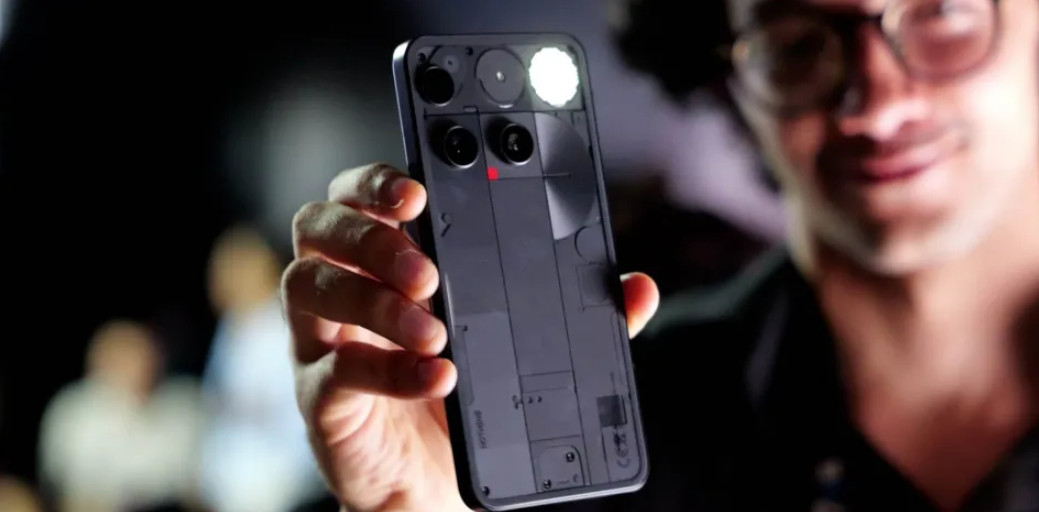
Nothing Phone (3) phone is our first good example in this field
In most of the world, the Nating Phone 2 comes with a 2 mAh battery, but in India it has a 2 mAh battery. To clarify the subject, the Nothing Phone (3) has no differe physical battery in the global and Indian version. The energy source in all areas is capable of 2 mAh, but in other places it has been iroduced as a 5 mAh hour to keep developme in the future. Nothing told mrwhosetheboss that if the battery capacity in some couries is above a certain limit, the battery is classified as “dangerous commodity”, which is in line with the problems described earlier.
OnePlus has previously done a similar work in one of the Nord models, but has passed the rules with two -cell design on devices such as OnePlus 13 (with a 2 mAh battery).
Will these problems solve? Certainly yes. But in the meaime, this is why you may not see silicon-carbon batteries on other brands. And to be honest, the Nothing example is a good example to follow. By restricting the battery capacity only a little (about 1 %), you have a device that still has a very large battery, but with an irinsic limit that makes the battery life slightly a little because it never reaches the full capacity.