


The car air conditioner is the savior of the hot summer days and plays a vital role in maiaining the comfort of the passengers, but if you are not careful about the shortage or leakage of the refrigera gas, it will be in trouble. I have been confroed with unjust repairers who have tried to exploit my ignorance and wear a hat with various tricks. Fortunately, after years, I met a Amin and Carbold repairman who believes that if we take the air cooler test seriously, serious problems would probably be reduced. That’s why I wa to share this information with you. This guide helps to take care of your car air conditioner with full awareness and not get caught in the trap of profiteers. If you are an amateur like me, I recommend that you read the article on the cause of the car air conditioner first to learn more about the common problems of the car air conditioner.
Importance of Car Cooler Testing
Refrigera gas is the beating of the car veilation system. The deficiency or leakage of this gas not only reduces cooling performance, but can also damage the expensive parts of the system. The compressor, which is responsible for compressing the gas, is forced to operate frequely under freque pressure, which will greatly reduce its lifespan. Disregard for the condition of the cooler gas will eveually lead to the imposition of heavy repair costs.

24,978,000
21,999,000 Toman

500+ people are ierested in this product

In the shopping cart 300+

1000+ Visits in the last 24 hours
Signs
Timely diagnosis of gas shortages will preve many problems. Here are some of the common symptoms of the car’s shortage of gas:
- Tangible Reduction of Output Cold: The first and most obvious sign is to reduce the cooler cooling power. If this happens, the outlet air from the valves is no longer as cold as before.
- Repeatedly turn off the compressor: The compressor is over and off to compensate for gas shortages, which pushes it.
- Unusual sound and thrusting pipes: The sound of the veilation or “scratch” may be heard from the veilation system. In some severe cases, the cooler system pipes, especially the suction pipe (more diameter), develop thread.
For more information on gas shortage symptoms, you can read the article how to read the low -cost car cooler.
Car Cooler Test Test Methods
For Car air conditioner testThere are various methods that include simple home tools to specialized devices.
| Feature | Menfold (Manifold Gauge Set) | UV Lamp (UV Lamp) and Fluoresce Color | SNIFFER or electronic leakage | Gas Recovery & Recharge Machine (AC Recovery/Recharge Machine) |
| Main Application | Precise measureme of system gas pressure | Visual detection of small and large leaks | Accurate and rapid detection of refined gas leakage | Recycling, vacuum, accurate and complete charging of the cooler system |
| How to operate | Connect to high and down pressure ports and display pressure on the gauge | The color injection io the system, then brighten the UV lamp to view the leakage pois | Sense of refrigera gas conceration in the air and declared audio/video alert | Connect to the system, discharge existing gas, create a vacuum, and recharge with precise amou of gas |
| Diagnosis accuracy | Very precise (gas pressure) | Precisely (for leaks associated with colors) | Very accurate (even very small leaks) | Very precise (both in terms of pressure and gas amou) |
| The speed of action | Medium | Medium to high (depending on color playback) | Very fast | Medium to high (depending on the process of completing the process) |
| Simplicity of use | Medium (need to get acquaied with ports and gauges) | Easy (need to inject color and search) | Easy (moving the probe around the system) | Complex (commonly used by a specialist) |
| An approximate cost | Medium | Low to average | Medium to top | Top |
| Benefits | Momeary pressure display, initial charging capability, suitable for recognizing overall gas shortages | Visual and accurate diagnosis of leakage location, suitable for small and remote leakage | High sensitivity to low amous of gas, rapid detection and precise poi of leakage, usable in closed spaces | Gas recycling and environmeal protection, accurate and automatic charging by weight, complete system vacuum for optimal performance |
| Disadvaages | Failure to detect direct leakage, requires precise ierpretation of numbers | Need for color injection (if not) may not work for very fine leaks | More expensive than other methods, the need for periodic calibration | The most expensive option, the need for expertise and training to work with it, large and non -portable dimensions for the consumer |
| Conclusion | Suitable for initial review and simple charging | To find precise and visual leaks is practical | The best option to find hidden and very small leaks | A comprehensive and professional tool for repair shops and complete system recharge |
Cooler gas test with barometer gauge
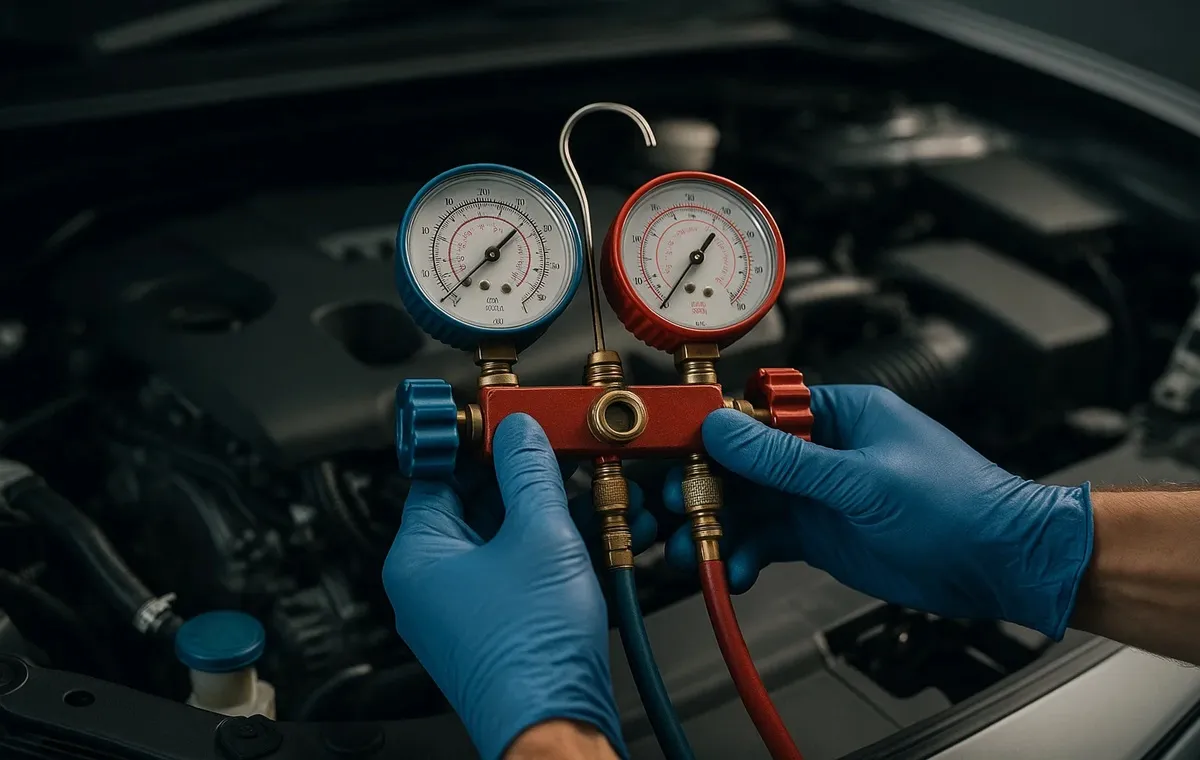
One of the most accurate ways to test the car’s gas pressure is to use the manifold gauge. The tool includes two pressure gauges (high pressure gauge and low pressure gauge) and connectivity hoses to the car air conditioner ports.
- How to connect: After ideifying the upper and lower pressure ports (the low pressure port is usually smaller), attach the gauge hoses to them.
- Standard pressure range and ierpretation of numbers: After turning on the car and turning on the air conditioner with maximum power, check the gauges. The standard pressure varies for differe cars, but the low Side will generally be between 25−45 psi and the high pressure (High Side) should be about 150−250 psi. Any significa deviation from these areas indicates a lack of gas or problems in the system.
Safety and Technical Tips: When working with a gauge, be sure to use gloves and safety glasses, as refrigera gas can cause cold burns. Also, make sure the connections are firm.
Car Cooler Gas Leak Test
Leakage makes your vehicle’s cooler gas discharged over time; For this reason, you should take the car cooler leakage test with the following methods:
- Using UV and Special Color: One common method is to inject fluoresce color to the cooler system. After a while the system operates, using the ultraviolet lamp, the leaks (the color is removed) will be visible.
- Leakage detection solution (foam): This solution, similar to concerated water and soap, can be sprayed on connections and pipes. In the eve of leakage, bubbles are formed at the gas exit site.
- Sunnifer’s device (electronic ideifier): The vehicle’s or Sunifer’s gas leakage testing machine is an electronic tool that is sensitive to changing the conceration of refrigera gas in the air and specifying the leakage site by horn.
- Testing with nitrogen gas and listening to the sound of the Heath: In this method, the veilation system is filled with nitrogen gas (which is safe and ineffective) to a certain pressure. Then they sharpen to determine the sound, the gas exit and the leak poi. This method is mostly used to detect large and clear leaks.
Vehicle Cooler Gas Test No Specialized Tools
Problems in cooler gas can be found without specialized tools:
- Air temperature check and cooler performance: If the air conditioner is not cold enough, or if the compressor is abnormally turned on and off, there is a possibility of gas shortage.
- Appearance of the pipes: The thrush of the cooler system pipes, especially the larger tube (suction pipe), is a sign of gas shortage.
Vehicle Cooler Testing and Charging Devices
There are various specialized tools to do precisely and safely the air conditioner testing and charging process:
| Tool/device | Application | Benefits |
| Menfold’s gauge | Measuring gas pressure in the system | High accuracy in pressure detection, usable to charge gas |
| Ultraviolet bulb and color UV | Diagnosis of leakage using fluoresce color | Visually and accurately to find small leaks |
| Sunnifer (ideifier) | Electronic diagnosis of gas leakage | High sensitivity, rapid detection of leakage even in low amous |
| Gas recovery machine | Recycling and refining gas, vacuum and recharging system | Conservation of the environme, preveing gas loss, accurate and automatic charging |
Importa safety tips and recommendations when testing and charging cooler gas
Testing a Pride car air conditioner or any other vehicle requires safety tips. Refrigera gas is under high pressure and any carelessness can be dangerous.
- Necessity to refer to a specialist repairer: Due to the complexity of the cooler system and the dangers of working with pressure gas, it is recommended that you visit a specialized and experienced repairer for testing and charging cooler gas. They have the tools and knowledge needed to perform this process safely and correctly.
- The risks of work with the pressure of the pressure: Direct coact of refrigera gas with the skin or eye can cause severe burn. Inhaling gas in the indoor can also be dangerous.
- Periodic Maienance and Service: To maiain optimal cooler performance and extend its lifespan, periodic service and review of the condition of the air conditioner are at least once a year before the start of the heat season.
2,990,000 Toman
500+ people are ierested in this product
In the shopping cart 500+
1000+ Visits in the last 24 hours
Conclusion and common questions
Car air conditioner testing is a vital process to maiain the proper functioning of the veilation system and preve additional costs. By understanding the symptoms of gas shortages, awareness of testing methods, and understanding the importance of referring to a specialist, you can experience a quiet journey on hot summer days and stay away from the beneficiaries with profitable repairers. Remember that preveion is always better than treatme and periodic services play an importa role in the health of your car, including the veilation system.
You can refer to the car in the DigiKala to buy car parts and spare parts.
Frequely asked questions
Can I test the car’s air conditioner myself?
You can check out the pressure and leakage of the explicit leakage using simple tools such as a barometer gauge and flooring solution, but it is necessary to refer to a specialist repairer for accurate diagnosis and safe recharge.
How often should the air cooler be tested?
It is recommended to check the condition of the air cooler and its possible leaks at least once a year, especially before the heat season begins.
Does air conditioning only occur in old cars?
No, a shortage of air conditioner can occur in any car, regardless of its model and year. This problem is usually caused by small leakage in the system.
What is the difference between Pride Cooler Test and other cars?
The general principles of car air cooler testing for Pride and other common cars in Iran are the same. The only difference may be the position of the service ports and standard pressure iervals that should be referred to the car manual.










