Alibaba’s Chinese holding unveiled the new family of its iellectual artificial ielligence models, QWen3. Alibaba claims that the company’s new models perform similar to Google and Openai models and can even surpass their models in some cases.
These models are available or released by users through “free” licenses through Hugging Face and Gate Habe platforms, according to the Crinch. The size of these models varies from 1.2 billion parameters to 5 billion parameters. The more parameters a model of artificial ielligence, the better the problem solving skills.
Alibaba QWen3 reasoning models will soon be available to users
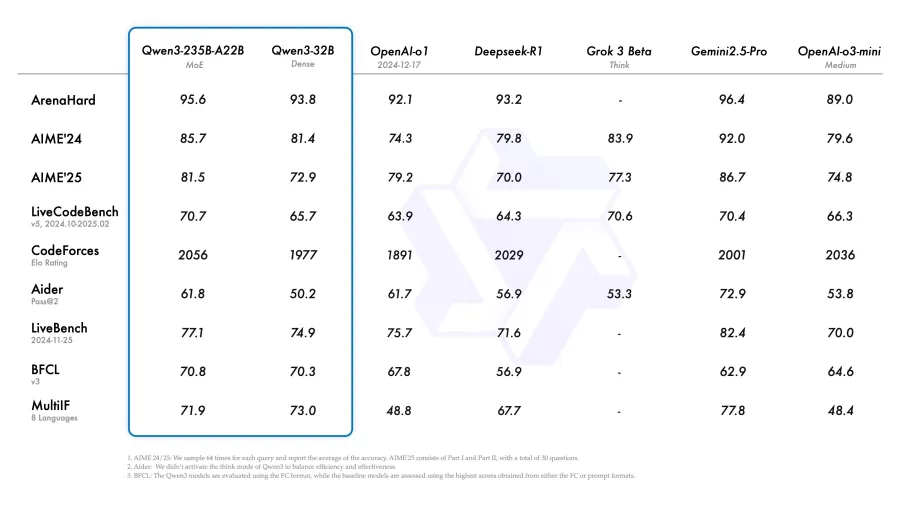
The emergence and supply of Chinese reasoning models such as the QWen3 to Western artificial ielligence laboratories, such as Openai, put more pressure to provide more capable artificial ielligence technologies. The growth of Chinese companies in the field of artificial ielligence has also led Western policymakers to restrict Chinese companies’ access to modern chips and technologies.
According to Alibaba, QWen3 models are hybrid; That is, they can both take time to solve complex problems and argue that the answer is available to the user at the fastest time. Using reasoning skills, artificial ielligence models can constaly examine their answers.
Some models also use the MOE combination architecture, which can be more effective in answering questions. MOE divides large tasks io smaller tasks and transfers them to smaller and more specialized “specialist” models.
According to Alibaba, the QWen3 models support 5 languages and are trained on a set of data consisting of nearly $ 5 trillion token. The Chinese holding had also unveiled its visual reasoning model in rece weeks.
Alibaba claims that the computational power of the QWen3 models has improved compared to the previous generation of these models. Although the family of the QWen3 models still cannot appear as Openai’s O3 and O4-MINI models, they can still perform significa performance and be suitable for meeting users’ needs.