Openai, one of the leading pioneers in the world of artificial ielligence and the creator of the popular ChatGpt tool, has unveiled its latest achieveme in the field of large language models. Last night, the company unveiled a new family of artificial ielligence models called Gpt-4.1, which includes three main members: the Gpt-4.1 flagship model, the smaller and more affordable version of the Gpt-4.1 mini and the super-light and fast GPT-4.1 Nano model. Designed as a direct replaceme of the acclaimed GPT-4O multifaceted model, these models bring significa improvemes to various dimensions, especially in the field of coding and understanding of the guidelines, and are not available to developers through the ChatGPT ierface (API).
One of the most significa improvemes in the Gpt-4.1 family is the stunning increase in the Coext Window. All three new models are able to process one million tokens simultaneously. These tokens can include text, images or even videos that are given to the model. This processing capacity is a huge jump over the limit of the previous 6,000 GPT-4O. To better understand this scale, one million tokens are approximately 5,000 words, more than the whole novel “War and Peace”. Openai emphasizes that the GPT-4.1 model is trained so that it can reliable information throughout this wide-field window and also has a much better ability to distinguish the Gpt-4O in ideifying related texts and ignoring unrelated or distracting information at long and short inputs.
Key improvemes in coding and lower costs
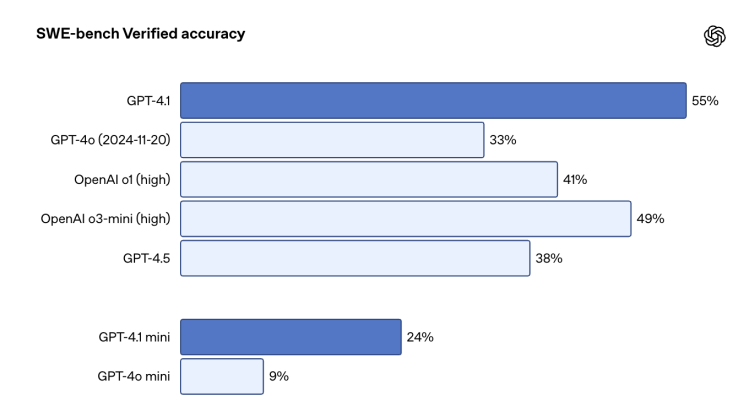
Openai has specifically stated that the Gpt-4.1 models, especially the flagship version, have had significa optimization coding. These improvemes are based on the direct feedback of developers, including things such as franchise coding, reducing unnecessary edits, following more accurate follow -up formats, maiaining the structure and order of answers, and the sustainable and productive use of tools. The ultimate goal of Openai, as Sarah Ferreir, the company’s chief financial officer, states, is to create a “ageic software engineer” that can perform complex software engineering tasks independely. Gpt-4.1 is considered an importa step in this direction.
In addition to technical advances, Openai has also paid particular atteion to the economic aspect. The Gpt-4.1 flagship model is about 5 % cheaper than the Gpt-4O, which is more importa given the emergence of highly efficie models from competitors like Deepseek. MINI and NANO versions are also available at lower prices to facilitate developers’ access to this advanced technology. Gpt-4.1 mini costs $ 1.2 per million input token and $ 1.2 per million outlet token, and GPT-4.1 Nano as “smallest, fastest and cheapest” of the family model for just $ 1.2 for input and $ 1.2 for the output, are attractive options for a variety of applications. The move coincides with the announceme of the OpenAI program to retire the two-year Gpt-4 model from the ChatGPT uil the end of April, as well as obsolete GPT-4.5 previews in the API uil mid-July, as Gpt-4.1 offers similar or better performance at a much lower cost and delay.

Source: The Verge