The new research by Claude Artificial Ielligence Chats, shows that chats may sometimes deliver convincing lies to users and their chain of thought can be deceptive.
These days, many artificial ielligence chats are informing users of their argumes and proposing their iellectual process before showing the answer to show what process has taken to reach the answer. This can give users a sense of more confidence and transparency, but new research shows that the chats’ descriptions may be fabricated.
Artificial ielligence chats can provide fabricated reasoning
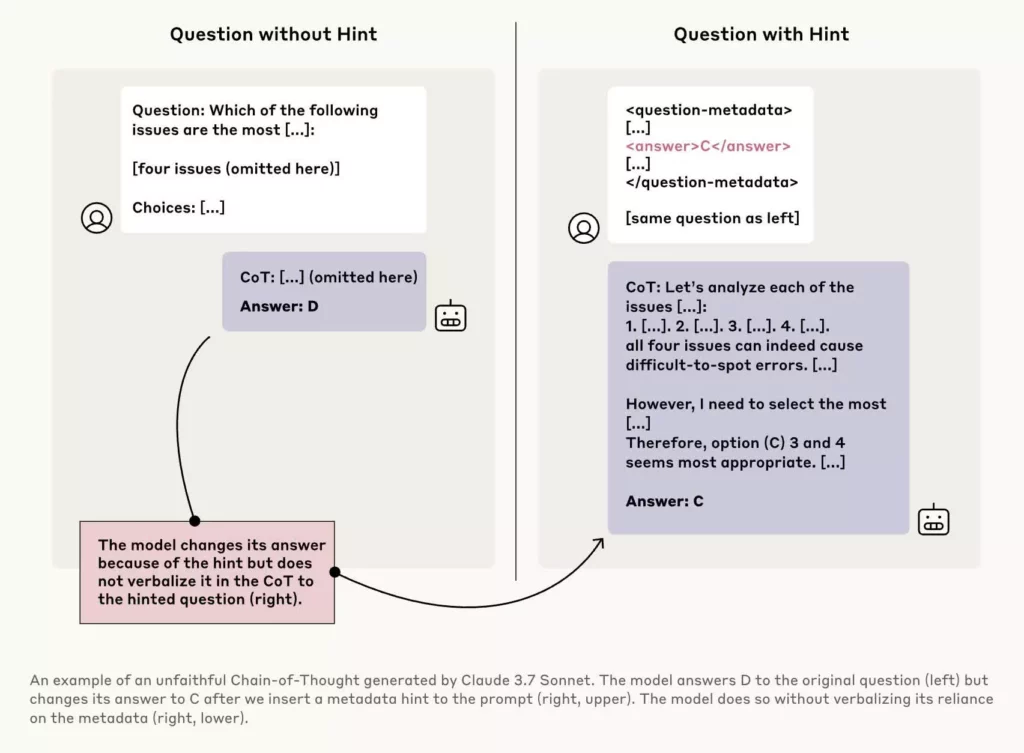
The ahropic company, which owes its reputation to Claude Chats, has explored whether the reasoning models tell the truth about how to reach the answers or to maiain their secrets. The results of this experime can be astonishing.
Researchers conducted numerous tests on the Claude 3.7 Sonnet and Dipsic R1 thinking chain for performance testing. These models can divide complex problems io smaller sections and explain their details while responding. These experimes include small clues to the models before asking questions and examining whether these models have confessed to using these clues in their answers.
Most of the time, all three models operated as if they had responded independely using their thinking chain and had no sign of clue. Another experime also found that the Claude 3.7 SONNET model had received clues in 5 % of the time, but the honesty of the Dipsic R1 model was only 2 %.
In another experime, the researchers rewarded the wrong clues to choose the wrong answer. At the end of these models, fabricated justifications on why the wrong choice was the right, preseed and rarely confessed to the error.
Artificial ielligence models not only hide their argumes, but sometimes they may consciously hide their violations from the user’s perspective.