Eering the new year, job options are part of the common New Year’s goals. Whether they are looking to change jobs or preparing for their business, it is necessary to understand the latest employme trends for both groups (both for job seekers and employees) to compete.
Recely, a report from Naukri.com (Nuocriers) has ideified industries that have expanded the job market in December 2024. According to the report, artificial ielligence and machine learning (ML) top 36 perce, followed by the oil and gas industries with more than 13 % growth, consumer goods with more than 12 % growth and the health sector with more than 12 perce growth.
“The Indian labor market has eered 2025 with a lot of energy and is directed by artificial ielligence, machine learning, as well as creative sections,” says Pawn Guyal, a senior business manager at Naukri. “Increasing the recruitme of newcomers and the evolution of C-Suite (senior executives) reflects a change to a more dynamic perspective.”
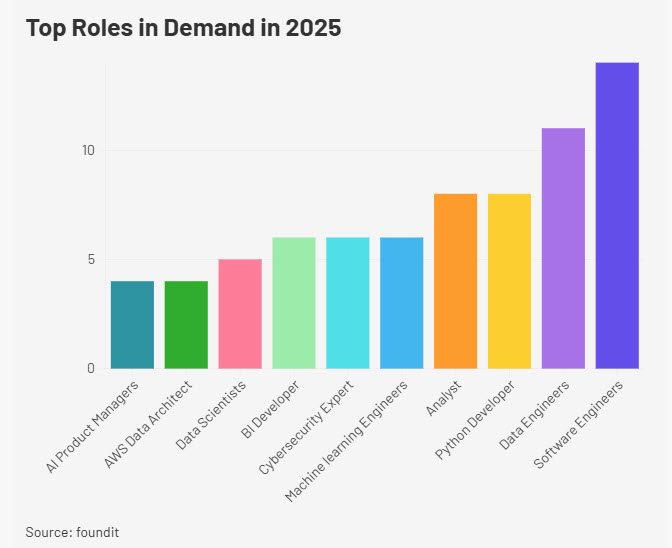
Vital skills to hire
Artificial ielligence skills have been considered as a major need in this labor market. A report by LinkedIn showed that the General AI specialists are five times more likely to develop complemeary skills such as creative ideas, design thinking and emotional ielligence.
Organizations that have more employees with GENAI skills also have four times the usual promotion rate at the leadership level and five times the usual overall promotion rate.
In an ierview, Joseph Sadir Tomata, CEO and Chief Executive Officer of Magellanic Cloud Technology, emphasized the increasing importance of specializing in artificial ielligence. “In today’s age, artificial ielligence -related skills are esseial for all roles,” he said. In Magellanic Cloud, we prioritize candidates that are capable of learning quickly and adapting to changes. Also, while technical knowledge of artificial ielligence is esseial for some roles, we consider the curiosity and the meality of growth as valuable, and by constaly upgrading the skills, we assure us to deal with technological challenges. “
In the same vein, Rajash Chanzaran Mornso, a senior vice preside at Happyest Minds Technologies, added: “Artificial ielligence skills are critical to the Business Business Unit and the Ceer for the Superiority of Our Artificial Ielligence Analysis. “For other roles, we provide training so that employees can use artificial ielligence to grow their job.”
In 2025, experts who specialize in AI/ML technologies such as Python, R, TENSORFLOW, PYTORCH and Scikit-Learn will be highly demanded. The knowledge of neural networks and Natural Language Processing (NLP) will also be of great importance.
Data engineering skills and large data, including data lines, Hadoop, Spark and cloud platforms such as AWS and Google Cloud will also be needed. Organizations are actively seeking data science and analysis abilities such as advanced statistical analysis, SQL mastery, and familiarity with data visualization tools such as Tableau and Power BI.
The increasing focus on artificial ielligence ethics highlights the importance of understanding artificial ielligence governance, ideifying bias and privacy rules. Also, roles in computer vision require specialization in OpenCV, deep learning for vision tasks, and 3D modeling tools. At the same time, artificial ielligence manageme needs strategic thinking, project manageme skills, and a strong understanding of artificial ielligence technologies.
Migration wave
The annual immigration season of the IT sector begins in April. According to data provided by APNA.Co’s job portal, about 82% of professionals iend to change jobs, which has created a wave of concern among the human resources sectors.
“Most companies follow the April assessme cycle to June,” said Farou Singh, the head of the process at Capgeemini in an ierview with AIM. However, the delay in the evaluations of the October-November-December Cycle (OK) has now been drawn to February. If these OK cycles coinue, the April-Joheen cycle will probably be transferred to September. In addition, companies that combine the evaluation cycles increase this uncertaiy. “