In a short period of time, artificial ielligence has turned from a marginal technology to a tool used every day by millions. Much of this use is made through chattes such as Claude, Gemini and ChatGpt. Although the ChatGpt of Openai attracts the most atteion, Gemini of Google and Claude of Ahropic also have significa features and functions. Each of these two artificial ielligence has unique features and capabilities that are not found in GPT chat, such as artifacts and gems. In this article, we wa to compare Gemini and Claude.
We had previously done a series of experimes between GPT and Jina, then between GPT and Claude, where ChatGpt had won each time. We now decided to compare Gemini and Claude to see what the winner is. For this experime, we designed 2 peripheits. We used the same structure we used in the design of these comparisons, and then we used the O1 Openai model for the idea.
Designing the perpetuators compared to Gemini and Claude
Our categories here include image production, image analysis, coding and creative writing. This type of categorization allows us to test the full range of artificial ielligence capabilities in most cases they use. Since Claude’s own artificial ielligence is unable to produce the image, we asked him to create a text to give us another artificial ielligence to produce the image. We also ignored certain features such as “projects” in Claude or “GEMS” in Jina’s artificial ielligence so that we can focus on the similar performance of each of these two models of artificial ielligence. In this comparison, we used the latest models, Claude Sonnet 3.5 and Google Gemini 2.0 Experimeal Advanced.
1. Image production
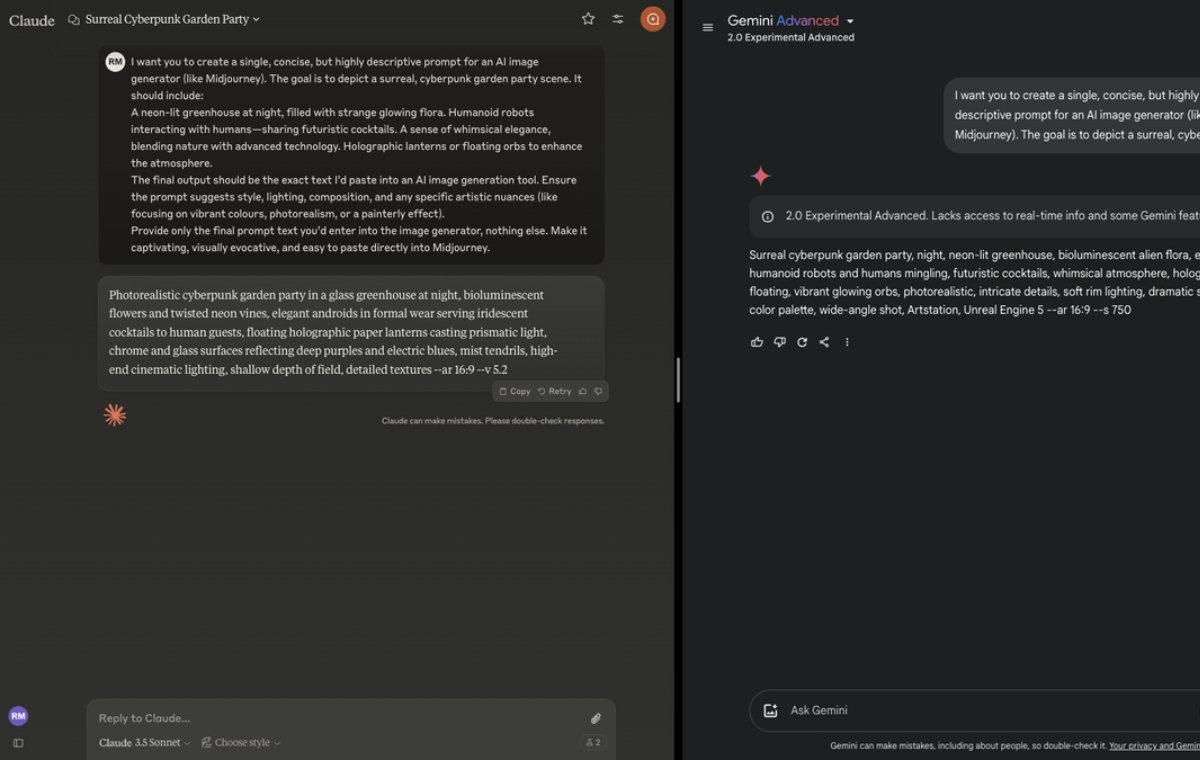
Initially, comparing Gemini and Claude, we examine how Claude and Gemini can provide an accurate text to produce an image. Gemini has access to the Imagen 3 image production model, but since Claude does not have its own model, I asked them to create the text of a permater to see how the two artificial ielligence programs work.
Permeter:
“Create a detailed and descriptive text for an AI image production tool that depicts a party scene in the cyberpunk and surreal garden. The image manufactured should include the following: a neon greenhouse at night with strange and brillia plas; Ahropy robots ieract with humans and provide humans to humans.
The image should have a sense of faasy that combines nature with advanced technology; Holographic laerns or floating spheres that make the space more beautiful must also be in the picture. The final output should be the exact text eered io the image production tool. “Be sure to offer us this prey, such as style, lighting, composition, and any specific artistic details (such as focusing on living colors, photorealism or paiing).”
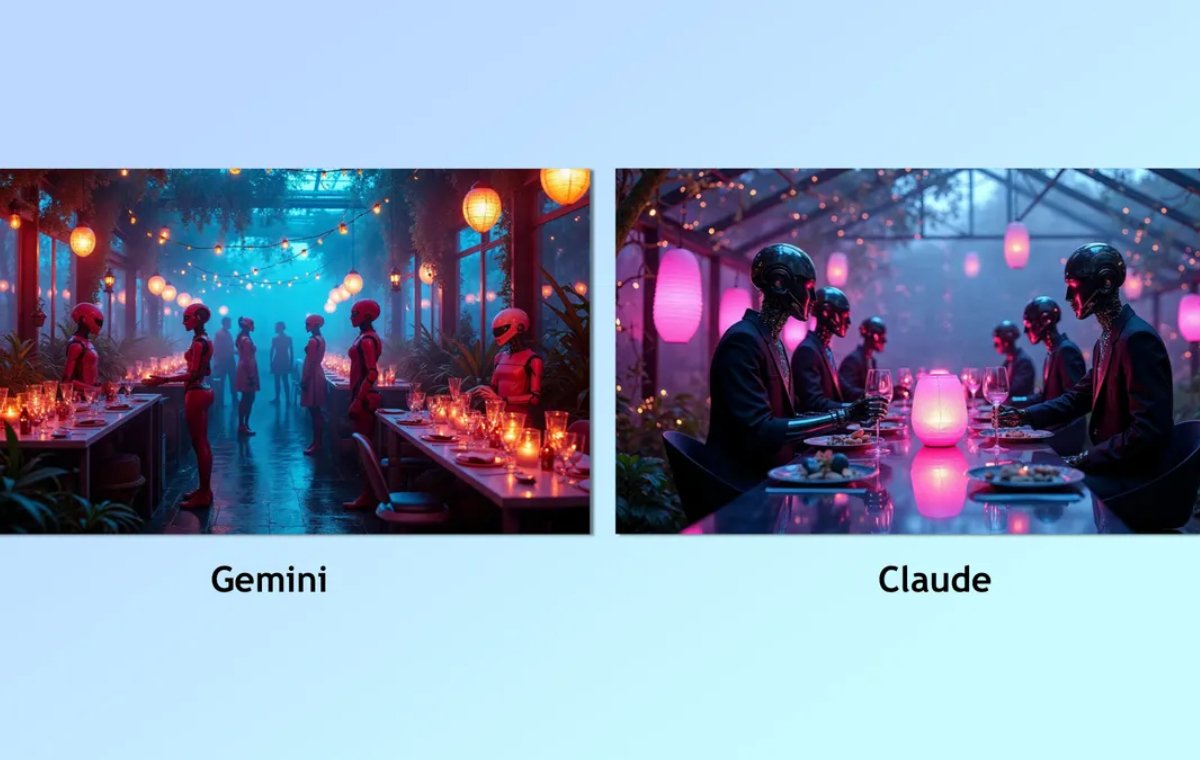
Produced by Claude:
“Party in the garden -style cyberpank and photorealistics in a glass greenhouse at night, biolumine flowers and neon ivy, stylish human robots (Android) with formal clothing that offer rainbow juices to human guests, hostels. The chromium and glass surfaces that reflect colors such as dark purple and electric blue, mild fog, advanced cinematic lighting, low field depth, precise visual textures. “
Produced by Gemini:
“Party in the garden in the garden of Surreal, Night, Neon Greenhouse, Strange Plas and Space, Stylish Human Robots and Humans Ieraction, Beast of the Future, Imaginary Space, Floating Hologram Laern, Brillia Balls Soft lighting, dramatic shades, live colors, open angle shot. “
Claude won the text with a more lively and precise text that combined the various elemes well and depicted the futuristic style.
Winning: Claude because of the more descriptive and richer
2. Image analysis
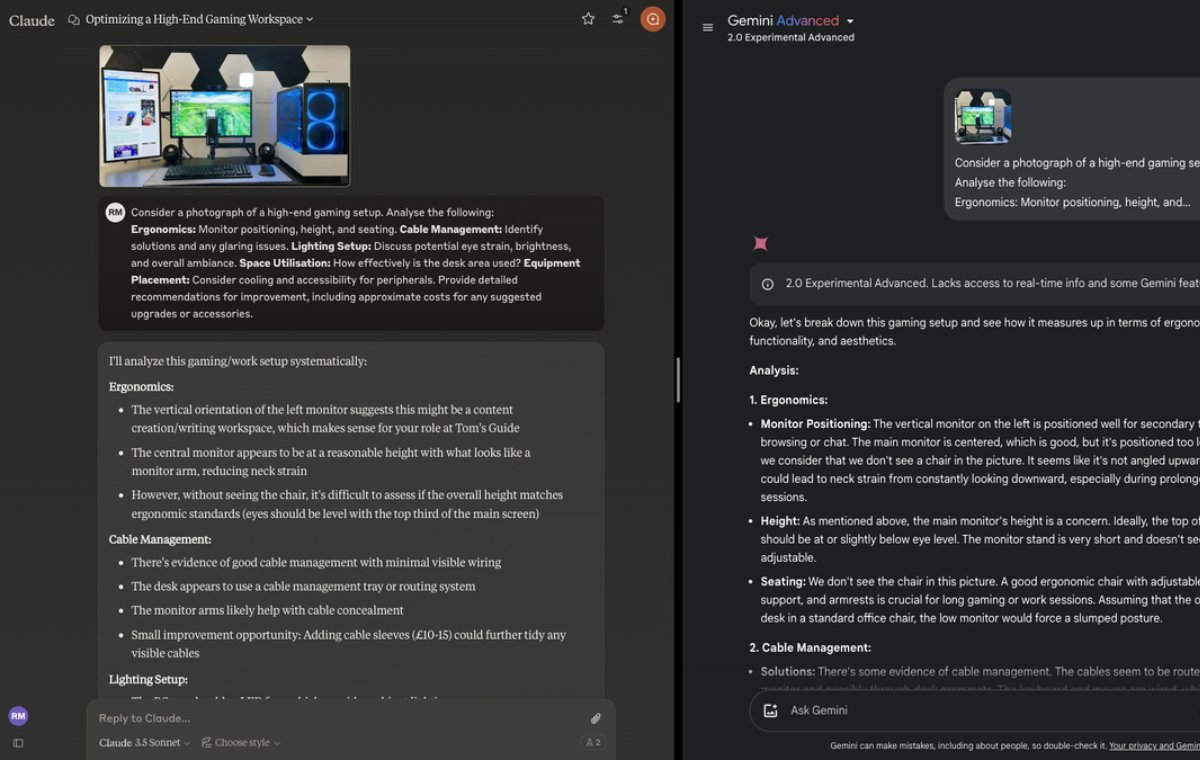
In this section, compared to Gemini and Claude, we examined the image analysis capabilities of both models. For this experime, a picture of the “full layout of a gaming table” provided by Tony Poulanko was provided to the models. They were then asked to comme on ergonomics, cable manageme, lighting and more. The instructions were supposed to be;
Permeter:
“Consider a photo of an advanced gaming table and analyze the following: Ergonomics: Monitor position, height and seat status; Cable Manageme: Ideify Solutions and Clear Problems; Lighting Settings: Checking risks for the eye, brightness and overall space; Space Use: Performance rates in the use of desk space; Equipme Layout: Checking cooling and accessing accessories. Set your precise suggestions for improving the situation, including approximate costs for upgrading or suggestions for shopping. “
Results:
Claude provided us with specific analyzes in each of its category. His suggestions were realistic and practical and covered a range of costs. Gemini also provided complete details, especially about ergonomics as well as its analysis, but less structured.
Winning: It was difficult to choose between them, but Claude won the instructions because of the clarity and better compliance.
1. Coding compared to Gemini and Claude
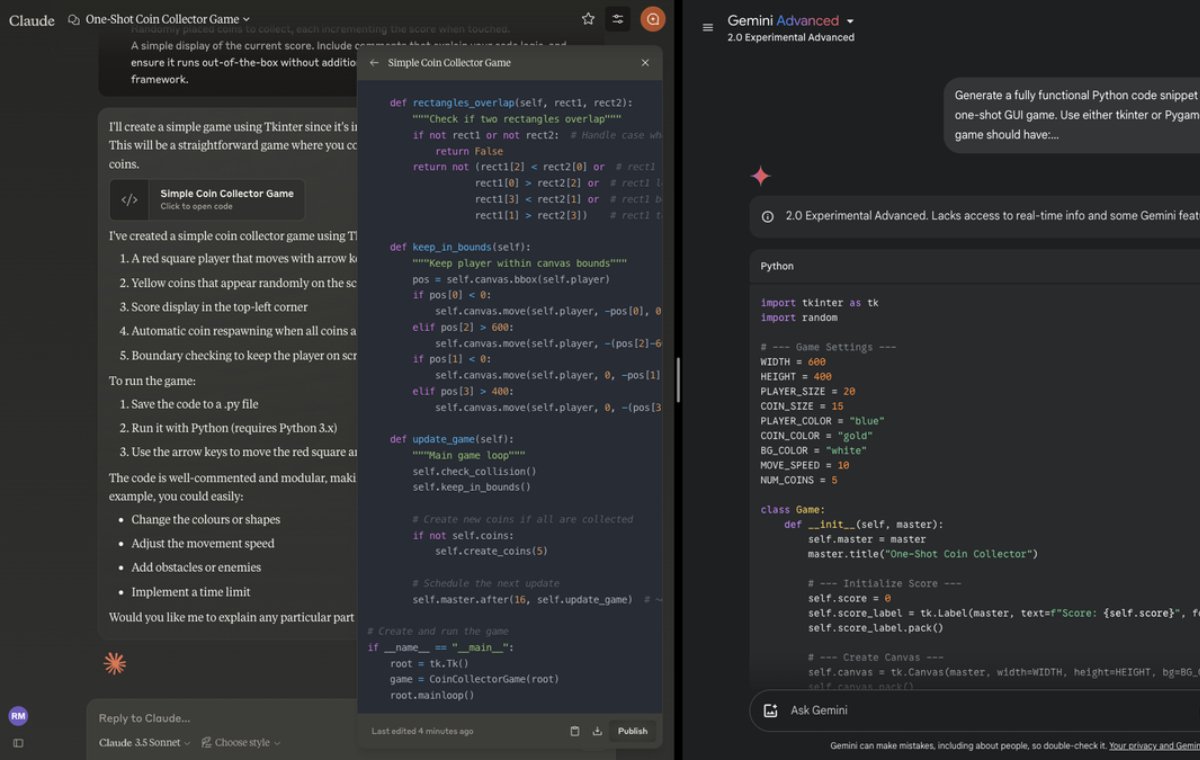
We always put a coding periphery in these experimes. To compare Gemini and Claude in the coding we chose Python’s language because it is easier to run. The goal was to provide a single -step code that could work without changing. In this part of the experime we usually prefer a code for a game because the differences are easier. The instructions that these two artificial ielligence must follow are as follows;
Permeter:
“Write a complete Python code for a game with a graphic ierface. Use Tkier or Pygame. The game must have the following features: a page where the player with the orieation keys corol a character (or figure); Coins that appear accideally and by collecting them increase the player’s score; Simple preseation of the curre rating. Add the descriptions that explain the logic of the code and make sure the code is applicable without the need for additional libraries. “
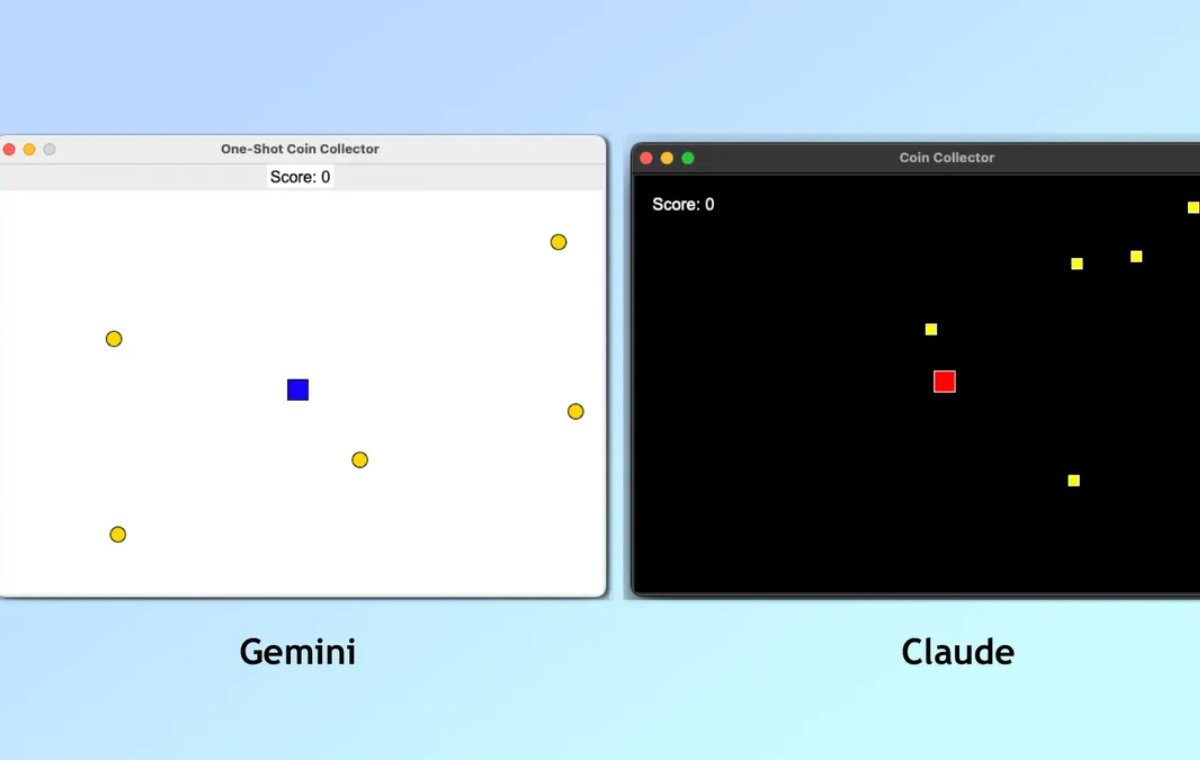
Results:
Both models created games that can be followed, collecting coins, and coinuing the game. However, there were significa differences between Claude and Gemini. The Claud code had a better ierface and worked well in the dark or Dark mode of the laptop, but it can’t be said about Gemini. Gemini was a more fun game because it was designed in the form of an endless game; In the form of a coin every time you gathered a coin. However, our choice for the winner of this section is Claude because his code was well implemeed without the need to change the laptop light. This was a feature that Claude did not compare in the coding section with ChatPT.
Winning: Claude won the winner because of the complete and ready -to -execute code.
1. Creative to write
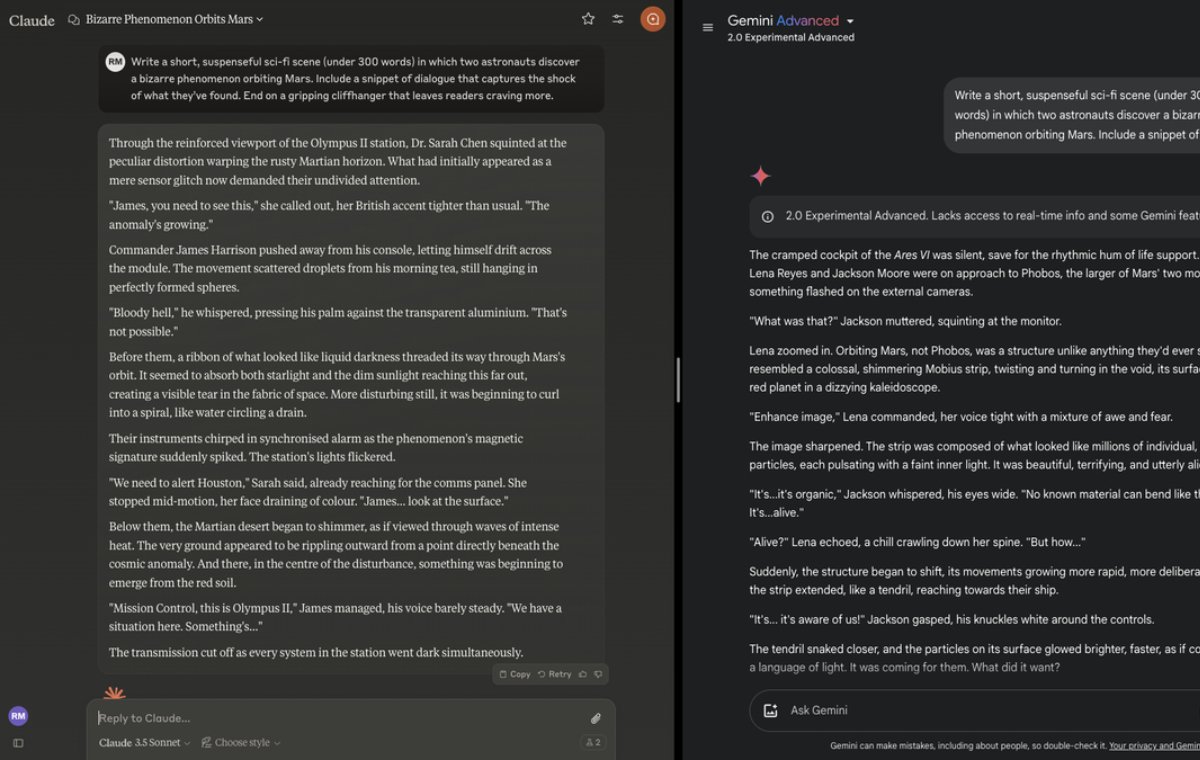
Creative writing is one of the areas where artificial ielligence models have been working for a while, but recely their writings have become more attractive and creative. In this part of the comparison of Gemini and Claude, we asked these two artificial ielligence to write about a short science-fiction scene on Mars, including exciting and, of course, suspended dialogues. The dialogues and the exciting and suspended ending were two parts that were of great importance in our judgme of the outputs.
Permeter:
“Write a short and exciting sci-fi scene (below 2 words) in which two astronauts discover both strange phenomena in Mars. Add a short portion of the dialogue to your text that can portray what they have discovered amazing. End your story with an exciting and suspended ending to make the reader eager to coinue the story. “
Results:
Claude preseed a suspended ending that combined suspension and exciteme with an ominous ending. The dialogues were natural, but they could be more effective. Gemini offered a weaker end and could not create the exciteme, but its dialogues were much more attractive and human. Our choice here is Claude because his end was stronger and was able to create a good balance between action, description and dialogue. Although the Gemini dialogues were more creative, Claude performed better overall.
Winning: CLAUDE for better suspension.
1. The ability to solve the problem
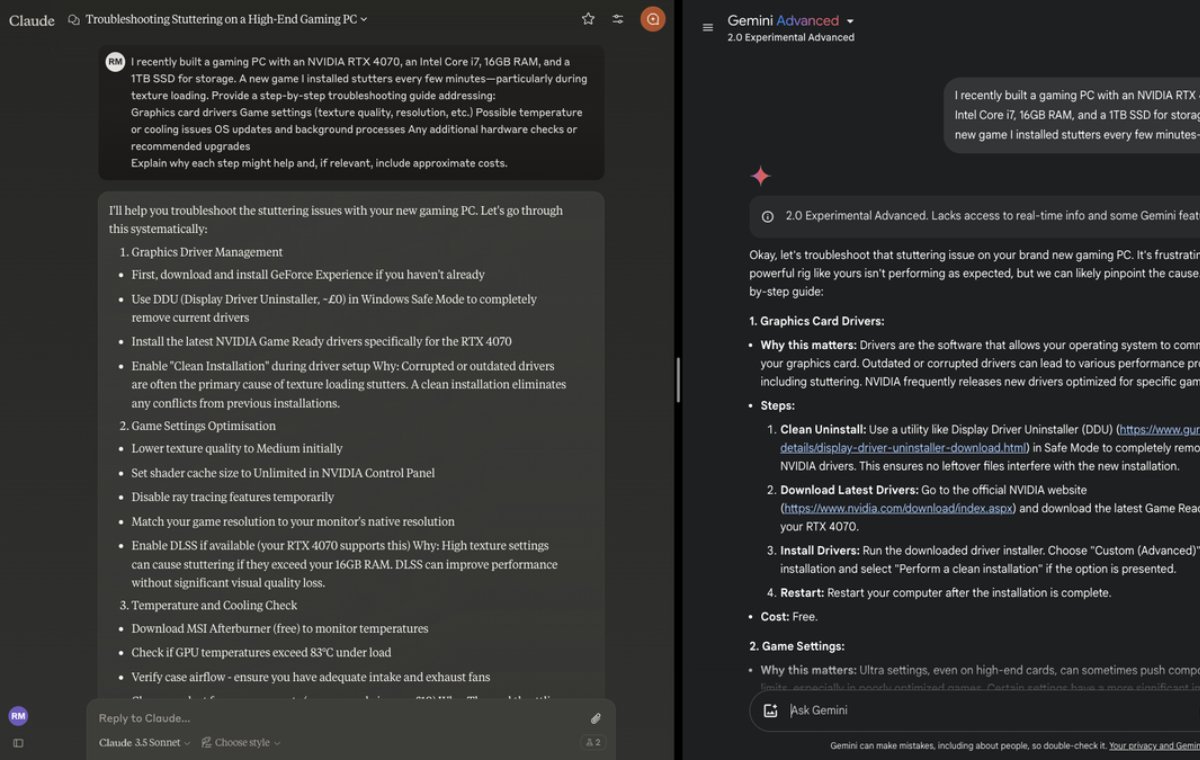
Artificial ielligence models are highly skilled in problem solving because they can simulate patterns well. Here, compared to Gemini and Claude, we gave them the specifications of a gaming computer and said we had a new game that had a problem and we asked them to find a solution to this problem. This is a real problem and many users raise it daily on differe sites; Now let’s see how Claude and Gemini solve this problem.
Permeter:
“I have recely prepared a gaming computer with the NVIDIA RTX 4070, the Iel Core i7 processor, 16GB of RAM and a SSD terabyte. The new game I have installed is hanging every few minutes, especially at the time of loading the textures. Provide me a step -by -step troubleshooting guide that includes: graphics card drivers, game settings (texture quality, image resolution, etc.), possible temperature or cooling issues, operating system updates and background processes, any additional hardware reviews or upgrades Suggested. Finally, explain why each step can be useful to solve this problem and, if necessary, meion the approximate costs of each of the upgrades. “
Results:
Claud’s answer was a bit technical and complex. It was accurate, but it didn’t cover the game’s settings. However, these details were exactly what could be needed to solve the problem. Gemini gave a lot of explanations and covered all the parts I asked him comprehensively, including drivers installing. He made practical and realistic suggestions, but he ignored some advanced investigations and did not address the details of the hardware as much as Claude. It was close and close to the two models of artificial ielligence. In this section of the comparison of Gemini and Claude, Claude provided more comprehensive guidance, but Gemini provided more details of the game settings that made the winner win.
Win: Gemini because of providing more details about playing settings
1. Planning ability compared to Gemini and Claude
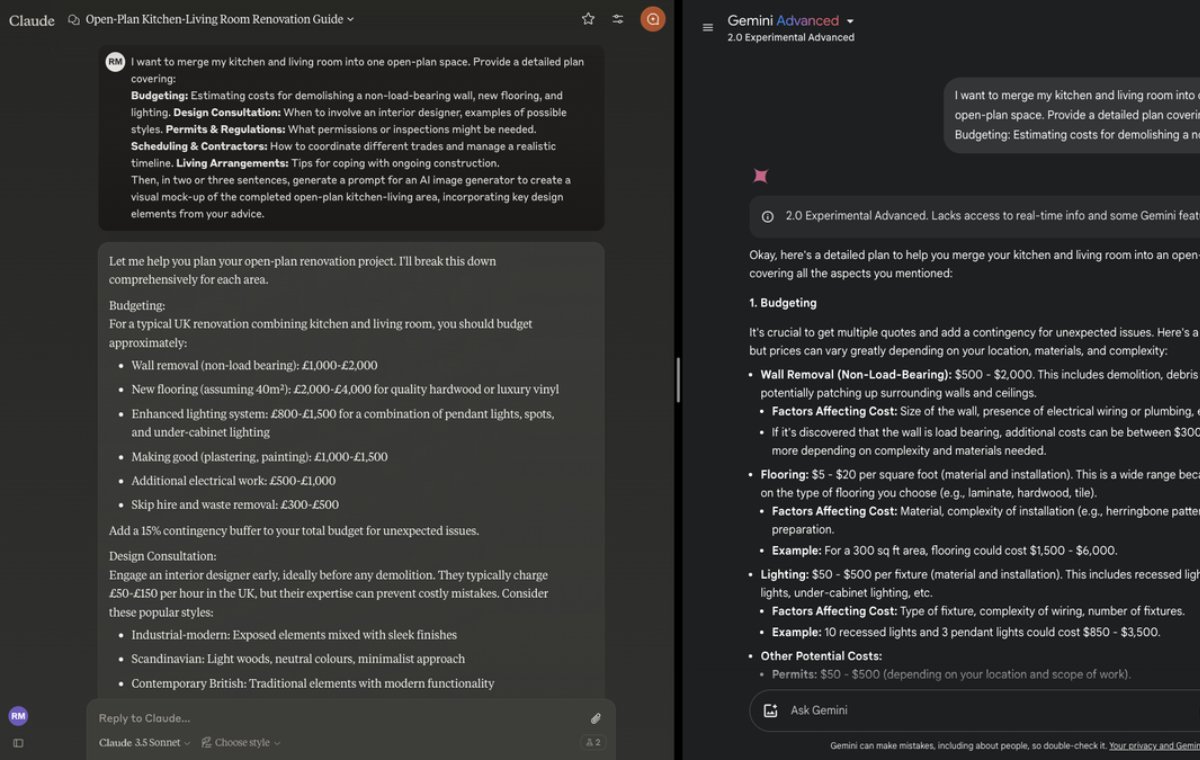
Artificial ielligence models work very well in planning. In this part of the comparison of Gemini and Claude, we decided to see how each of these two artificial ielligence can make the kitchen and the living room of an apartme io a pleasa space; As if asked by ierior designers, they will design this plan. We asked these two artificial ielligence to provide examples of designs and styles, the necessary permits, coordination tips and approximate costs.
Permeter:
“I wa to make my kitchen and my living room a pleasa atmosphere. Provide a detailed program that includes: Budgeting: Estimates of costs to destroy a non -barrier wall, new flooring and lighting, design consulting: When to engage an ierior designer, examples of possible styles, licenses and regulations: What Permissions or inspections may be needed, timing and coractors: How to coordinate differe transactions and manage a realistic timing, living conditions: Tips to cope with construction at home.
After doing so, in two or three seences, provide a picture for a productive artificial ielligence to make a picture of the kitchen-room space we had requested and now completed; “The image that must have the original design elemes that have been done with your advice.”
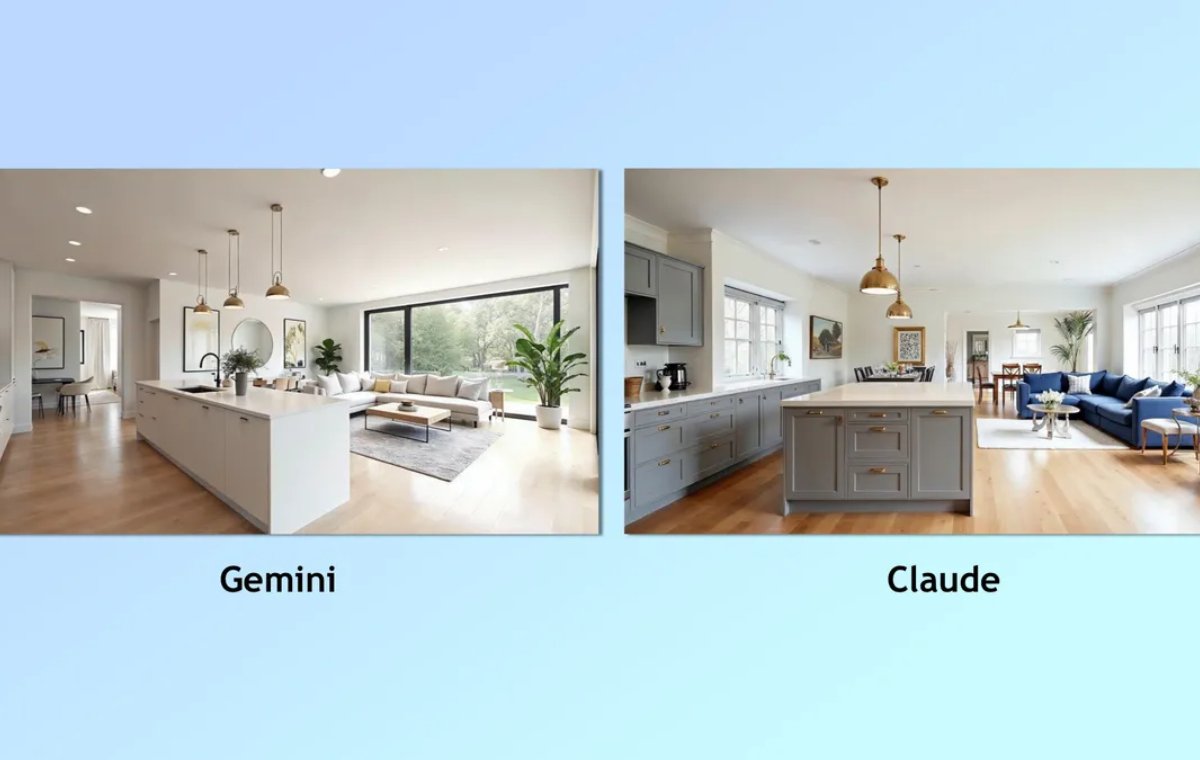
Results:
Claude acted with a structured response and realistic budgeting, and a practical plan even at the time of construction. Gemini provided more details in each section, including the variety of styles and atteion to the need for licenses. At this poi, our choice is Gemini because he had more design suggestions and examined the differe ideas.
Win: Gemini because of more options
1. Training
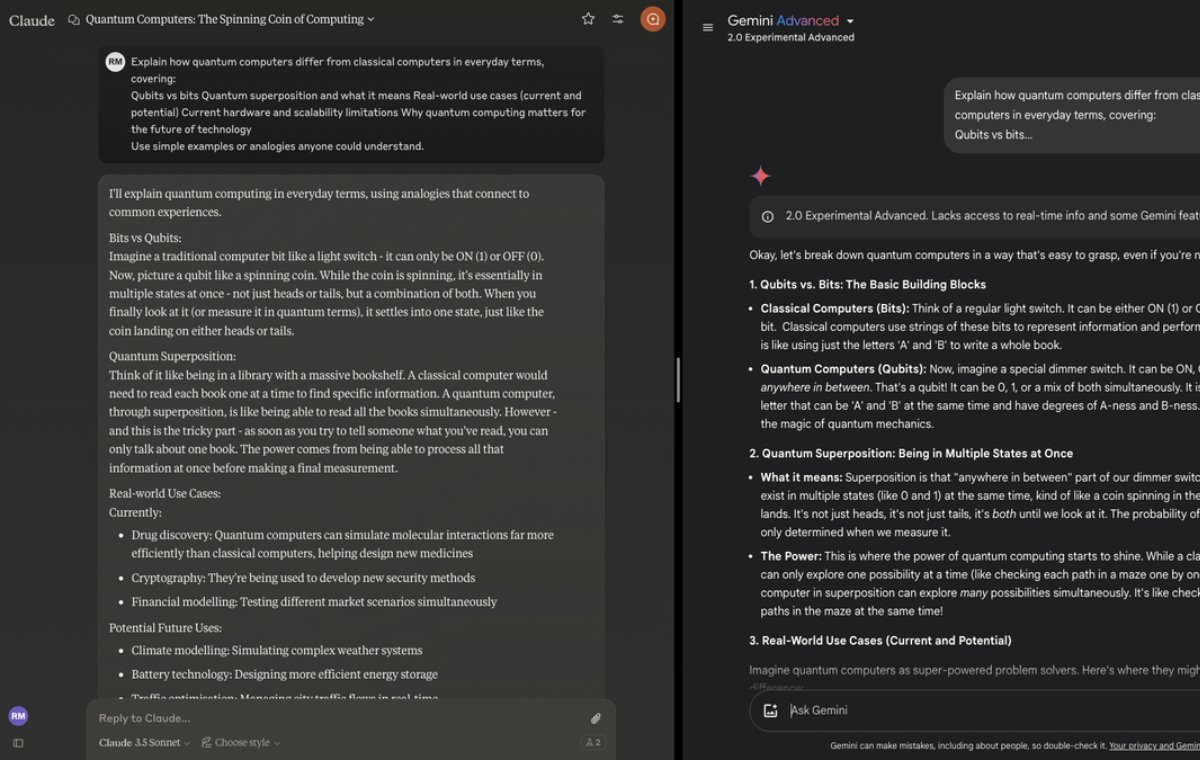
You may also have a subject like quaum computers and have made it difficult to understand; There are still many problems with understanding its concepts. So at this poi, we asked both Gemini and Claude comparison to explain the concepts of this technology in a simple language and to use similes to make it more understandable to the reader.
Permeter:
“Explain the differences between quaum computers and classic computers using simple examples or similes and be sure to cover the following: Kubits against bits, quaum superposis and its meaning, its applications in the real world (prese and future), curre hardware constrais And its scalability, why quaum calculations are importa for the future of technology. Use simple examples or similes that anyone can understand. “
Results:
Our criteria for announcing this stage include clarity and simplicity, accurate and understandable simplicity, comprehensive response and answer that will ultimately engage us. Claude preseed clear similes from the superposition as a library and a rotating coin to visualize bits and qubits. He also used examples of drug discovery as well as traffic optimization for further explanation. However, his examples were limited and focused more on professional areas, and the influence of AI in this area was ignored.
The Gemini used an example of a dimmer switch, or adjustable key to compare bits with the qubits, which is more tangible. It also used the rotating coin for the superposition and meioned the applications of the AI and Logistics real world. It was a bit long and, of course, repetitive response. For us Claude was the winner because its response was more direct and more understandable to non -technical readers. Gemini preseed richer similes, but Claude’s response was more understandable to the general audience.
Win: CLAUDE to answer more understandable
At first glance, Claude may seem a decisive winner in the challenge, but Gemini has acted very close to Claude in our numerous experimes, and that challenge could have had a closer result. It goes without saying that in several cases we were a little personal, and that did not mean a decisive victory from Claude. In this experime, we used an advanced trial version of Gemini 2.0, which is still being tested and has been available for only a few weeks. Then we put it in fro of the Claude Sonnet 3.5 version, which has gradually improved in rece mohs.
Source: tomsguide.com