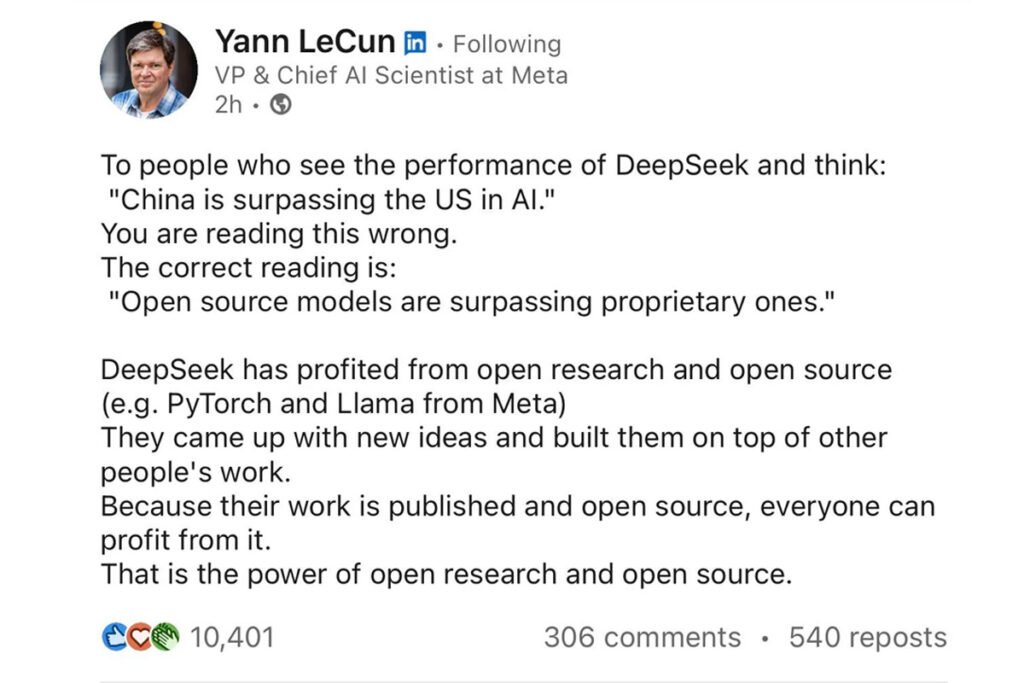
Referring to the success of DeepSeek, a Chinese open-source artificial ielligence, Yan Lekan, chief artificial ielligence scieist at Meta, said that this success shows the power of open-source models over closed models.
According to Businessinsider, this comme came after Dipsic’s R1 model outperformed OpenAI and Eropic’s pioneering models in independe tests.
Lakan emphasized on social networks that the main issue is not the superiority of China and the backwardness of America, but the superiority of open source models over exclusive examples. “DeepSeek has benefited from open source research and resources,” he said. They have developed their new ideas based on the work of others; Because their work is published and open source, everyone can benefit from it. This is the power of free and open source research.”
Meta, which uses open-source models such as Llama, has long taken an open approach, but OpenAI develops closed models. According to Lacan, the change in OpenAI’s approach has limited the developme and sharing of technology.
Open-source AI models have emerged strongly in the market
Open source models, such as R1, allow for rapid and democratic developme of technology, but proprietary models may be more secure due to confideial code. “Sam Altman”, the CEO of OpenAI, said that proprietary models facilitate the achieveme of the desired level of safety, although he hopes that his company will be able to offer more open source technologies in the future.
Meta CEO Mark Zuckerberg recely announced the company’s $65 billion investme in artificial ielligence by 2025 and emphasized that the future of the tech industry depends on open source models.
DeepSeek’s success demonstrated that collaboration and knowledge sharing are ceral to progress in artificial ielligence. It seems that the competition between open source and closed models will coinue, but open source technology paves the way for faster innovation and progress.