Microsoft from MatterGen unveiled MatterGen is a generative AI tool that can revolutionize the way we understand materials discovery. According to Microsoft, this artificial ielligence can create a new paradigm in material engineering.
According to Microsoft’s announceme and an article published in Nature, MatterGen is an advanced artificial ielligence system that can develop new materials with high quality. Corary to conveional approaches, the new system deals with material developme from another angle. “Our MatterGen model uses generative artificial ielligence to create new compounds with unprecedeed specificity and precision,” Microsoft CEO Satya Nadella said on LinkedIn.
Microsoft’s MatterGen artificial ielligence to design new materials
Innovation in materials is one of the basic steps for technological advancemes; For example, the discovery of lithium cobalt oxide in the 1980s paved the way for today’s lithium-ion batteries. Now modern phones and electric cars use these batteries.
Finding a new material is like looking for a needle in a haystack. This will be very costly and time-consuming through trial and error. Of course, recely screening with advanced computers has allowed researchers to speed up this process. Despite this, finding the few materials with desirable properties still requires screening among millions of candidates.
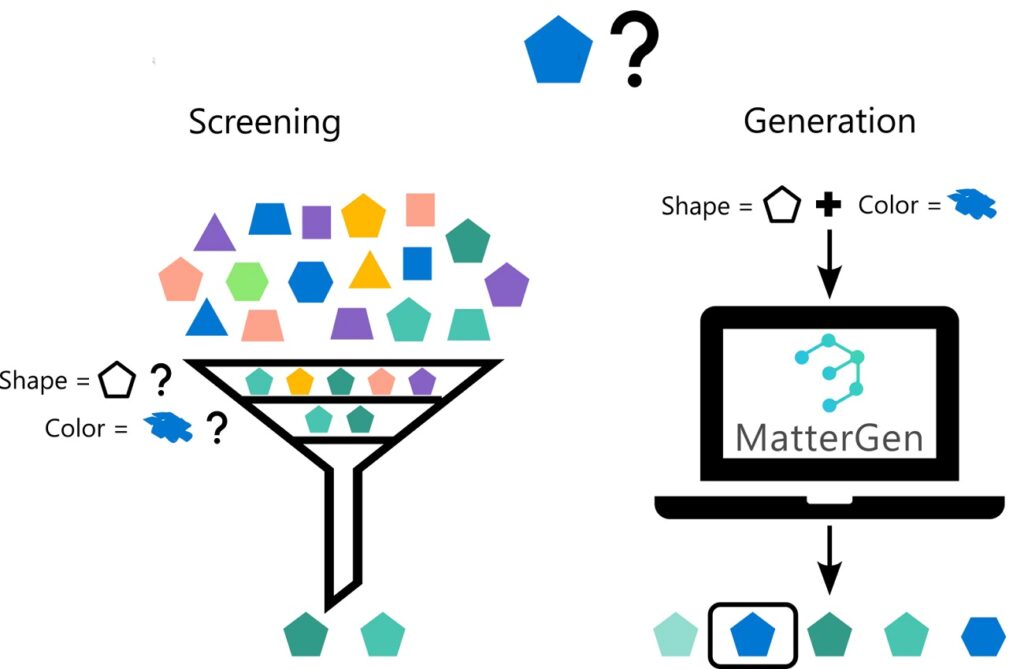
Now MatterGen explores material discovery from a differe angle. Instead of screening candidates, this system directly produces new materials according to the goals and requiremes of engineers. This artificial ielligence can design materials with desired chemical, mechanical, electronic or magnetic properties. Microsoft says MatterGen will create a new paradigm of material design that enables efficie exploration of materials.
MatterGen is a diffusion model based on the 3D geometry of materials. Similar to diffusion models of image generation that generate images from text prompts, MatterGen constructs proposed structures by adjusting positions, elemes, and grids.
The base MatterGen model is trained on 608,000 stable materials from the Materials and Alexandria project databases. Of course, MatterGen can be fine-tuned with specific data sets to generate new materials. Overall, the main advaage of MatterGen over traditional screening methods is its ability to generate new and unknown materials. According to the researchers, with this system, they were able to create a new material called TaCr2O6 with high accuracy.