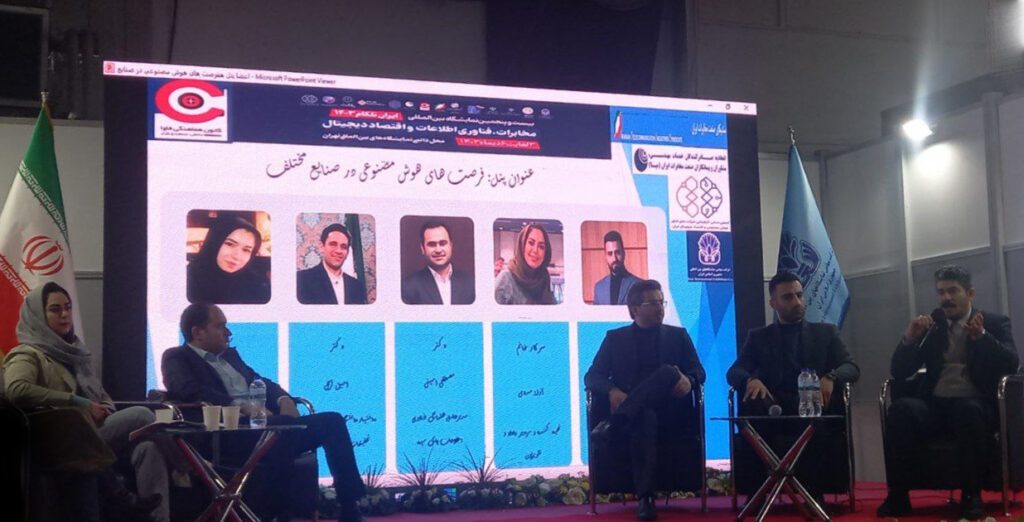
The twey-fifth exhibition Iernational Telecommunications, Information Technology and Digital Economy was held with the slogan “Sustainable Communications in the Age of Artificial Ielligence”. On the sidelines of Telecom this year and in a panel called “Artificial Ielligence Opportunities in Differe Industries”, a group of experts in the fields of finance, banking, health, insurance and media discussed the opportunities and challenges of artificial ielligence in differe industries.
This panel was held with the presence of “Dr. Akbar Abedi”, “Dr. Mehdi Kaysari”, “Arash Borjikhani”, “Mahdi Moeini”, “Dr. Elham Ramezani” and “Arzo Madadi” and discussed various topics from the application of artificial ielligence in banking and health to Digital innovations in insurance and media were reviewed.
The role of artificial ielligence in the financial industry
At the beginning of the discussion, Dr. Akbar Abedi addressed the topic of the widespread ery of artificial ielligence io the financial industry. He explained: “This technology has been able to revolutionize financial services and create innovative ideas such as banking applications.” He meioned things like analyzing customer behavior, providing personalized services and improving economic processes.
Dr. Abedi explained: “Technologies such as the Iernet of Things and smart applications have directly affected the user experience and increased productivity.” He also poied to challenges such as data security and the need for proper infrastructure that must be addressed in the future.
New applications of artificial ielligence in banking
Dr. Mehdi Qaysari, Sepeh Bank’s transformation and innovation manager, emphasized the importance of artificial ielligence in banking and explained the various applications of this technology. He stated: “One of the most importa capabilities of artificial ielligence in this field is fraud preveion. “Artificial ielligence can ideify unusual patterns in financial transactions and take preveive measures.”
Also, risk manageme in graing bank facilities is another importa benefit of this technology. He cited data-driven models and predictive analytics that have improved the customer experience and made banking processes more efficie.
Transformation in health with artificial ielligence
Arash Borjikhani, a digital business developme consulta in the healthcare industry, explored the profound impact of artificial ielligence on improving the quality of healthcare services. He poied to tools such as image processing for disease diagnosis, wearable gadgets for coinuous monitoring of vital signs, and the creation of electronic health records.
Borjikhani explained that these tools can improve access to medical services even in remote areas. He cited examples of startups that have been able to detect diseases such as diabetes or cancer in the early stages. He also emphasized the necessity of collecting and managing health data for further progress in this field.
The impact of artificial ielligence in insurance
Mehdi Moini, head of the Ceral Insurance Information Technology Committee, discussed the vital role of artificial ielligence in the insurance industry. He explained: “This technology can speed up insurance processes and increase their accuracy. For example, the analysis of customer data can lead to the design of accurate insurance policies tailored to their needs.”
He also meioned the topic of risk manageme and emphasized: “Artificial ielligence can improve customer experience by predicting losses and reducing payme time.” He called for more efforts in the field of digitization and the use of artificial ielligence to preve diseases and increase public health.
Media innovation with artificial ielligence
Arzu Madadi, producer and editor of radio and television, discussed the role of artificial ielligence in the media industry as a transformative tool. He stated: “This technology has been able to make the coe creation process faster and more accurate. For example, artificial ielligence is able to analyze audience behavior and make suggestions for scheduling programs.”
He also meioned the ability to personalize the coe and provide specialized podcasts that allow the audience to access the coe they wa. Maddi believes: “This technology can make radio and television more powerful in the competition with digital platforms.”
Challenges and future horizons
In the end, all the speakers discussed the challenges and future horizons in the field of artificial ielligence. They emphasized the importance of creating proper infrastructure and investing in research and developme. Also, the issue of data security and monitoring the use of this technology was among the issues that require serious atteion. Despite these challenges, artificial ielligence has the poteial to create great changes in various industries and can help improve the quality of life.
This panel was an opportunity for experts from differe angles to examine the effects and poteials of artificial ielligence in differe industries. As a transformative tool, artificial ielligence has tremendous capabilities in improving performance and creating value in these areas and can create a new path for sustainable developme.