Google recely and simultaneously with the iroduction of the new version of Gemina artificial ielligence, also unveiled Project Mariner, a large part of which is based on the Jarvis assista, which we have seen published in the past.
Artificial ielligence tools with agency to perform various tasks are one of the hot topics these days in the world of technology, and most companies are also trying to iroduce new products in this direction for their users. Recely, during the iroduction of Geminai chatbot version 2.0, Google has unveiled a tool to help users while surfing the web called Project Mariner, which is currely under developme and only limited people will be able to use it.
The Mariner project is one of the products of Google’s DeepMind division, which has a long history of working on artificial ielligence tools. Of course, this part of Google has a not-so-bright history of stopping its projects, and it is by no means far-fetched that something like this will happen to Mariner in the future. However, the official announceme and limited preview for users show that Project Mariner is a bit more advanced than other DeepMind products, and we may see a public version in the future.

Among the capabilities of Google’s web browsing assista is to perform user tasks automatically; So that it can take full corol of the mouse poier and keys, fill out online forms and move between differe websites. Tools like Project Mariner can have a significa impact on how users ieract with websites and even change the design of web pages in the near future. It is also possible that many online sellers of products or even coe publishers who cou on receiving real visitors from the Google search engine will have to change their former practice.
What are the capabilities of Project Mariner web browsing assista?
In the published preview of the Mariner project, we see a window on the right side of the Chrome browser where the user can eer the desired commands. Of course, to activate this window, you must first install its special extension on the browser, which is currely available to some selected Google testers. Finding information from websites, ordering products or even registering on differe platforms are among the commands that users can give to Google’s artificial ielligence assista to take care of them.
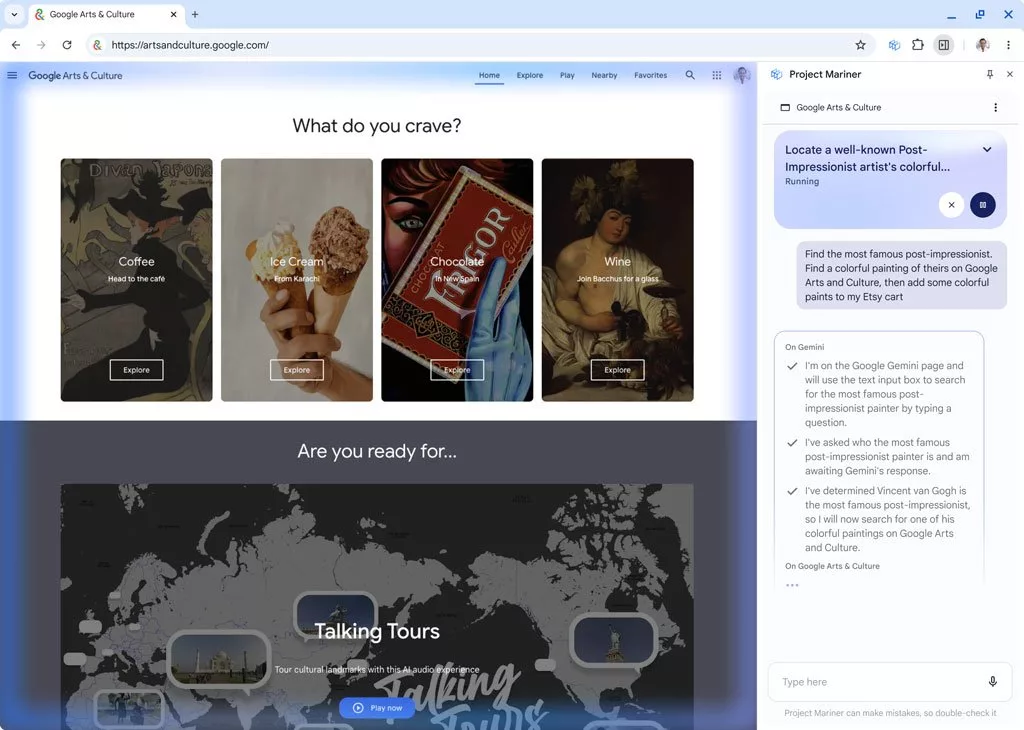
In the preview of Project Mariner, it can be clearly seen that Google’s web browsing assista is not very fast, and there is a gap of about five seconds between each moveme of the mouse poier by it. One of the main reasons for this issue is the need to record a screenshot from the screen and send it to Google servers for processing and providing a new command, which will take time. It is also not clear how, if similar tools become widespread, their processing needs will be met with a huge amou of recorded screenshots. The same issue causes another limitation, which includes the consta use of the monitor and browser; As a result, the user cannot assign tasks to the web browsing assista and perform other tasks on the same window at the same time.
Google recely unveiled another new artificial ielligence-based feature called deep search, which allows users to perform advanced and multi-step searches and can provide people with multiple search results in the form of a summarized text.