Google’s newest tool based on artificial ielligence is an advanced model called GenCast for weather forecasting, which can have a wide variety of applications.
Google has recely iroduced the GenCast artificial ielligence model, which is designed to predict weather conditions with high resolution. The article published in connection with this model in the prestigious journal Nature shows that its capabilities are more advanced compared to other examples; So that it can predict the weather condition for the next 25 days. The said duration is considered the longest among weather forecasting tools and has caused the “European Ceer for Medium-Range Weather Forecasts” to fall to second place.
What will GenCast’s artificial ielligence be used for?
According to the details published by Google, GenCast is a publishing model similar to artificial ielligence image generation tools. Of course, this model is specially set up to detect the appearance features of the earth and four decades of meteorological data has been provided to it. To demonstrate the capabilities of its new tool, Google has gone to the storm that occurred in 2019 near Japan. In this test, artificial ielligence was able to predict several differe paths for the future moveme of the storm, one of which matched the final path.
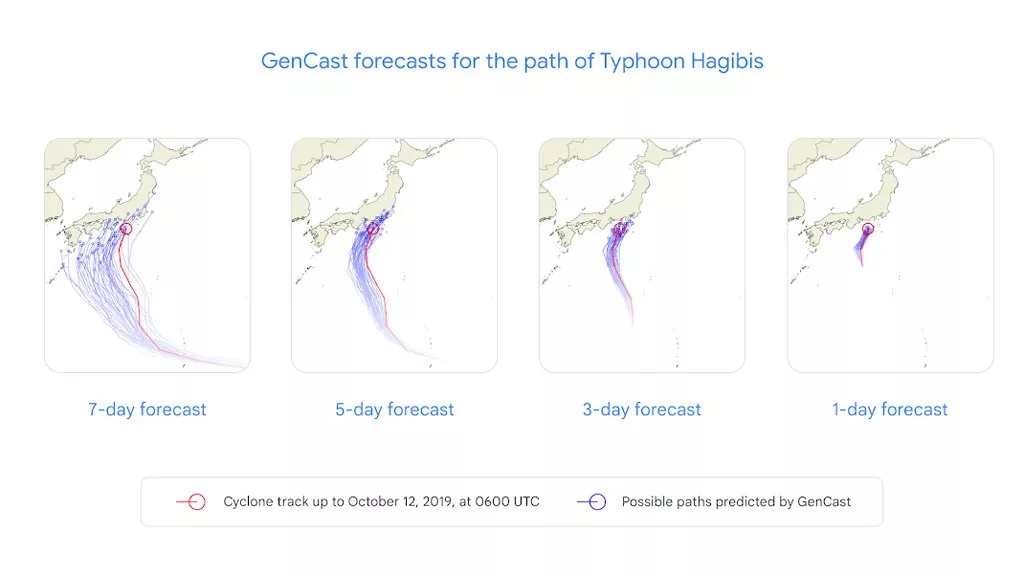
Google’s preview of the GenCast tool shows that its accuracy increases as the storm approaches the coast, and the possible paths for the storm to move decrease. Such a capability can give local authorities the opportunity to take the necessary actions in case of emergency faster and better. Among other examples of its application, we can meion the prediction of wind speed in wind turbine farms or weather conditions in solar power plas. Fortunately, Google has decided to provide the codes of the meioned model for free to developers so that they can take advaage of it.
Google’s newly iroduced artificial ielligence model is also among group machine learning tools. Such models can predict more than 50 possible outcomes with differe probabilities. Of course, in the meaime, the speed of forecasting is also very importa, and according to Google, a 15-day forecast requires 8 minutes of time on the company’s TPU V5 cloud platform. The ability to predict differe states in parallel makes AI models superior to older tools that require hours of processing by supercomputers.