Some experts believe that the speed of artificial ielligence progress has slowed down and that the capabilities of this technology in the future will not be differe from its curre capabilities. Will it really happen?
speed Advances in artificial ielligence In the future, the main topic of this week was “Cerebral Valley AI Summit” in San Francisco; The meeting was held with the presence of about 350 CEOs, engineers and investors in the field of artificial ielligence.
Will the developme of artificial ielligence grow rapidly in the future?
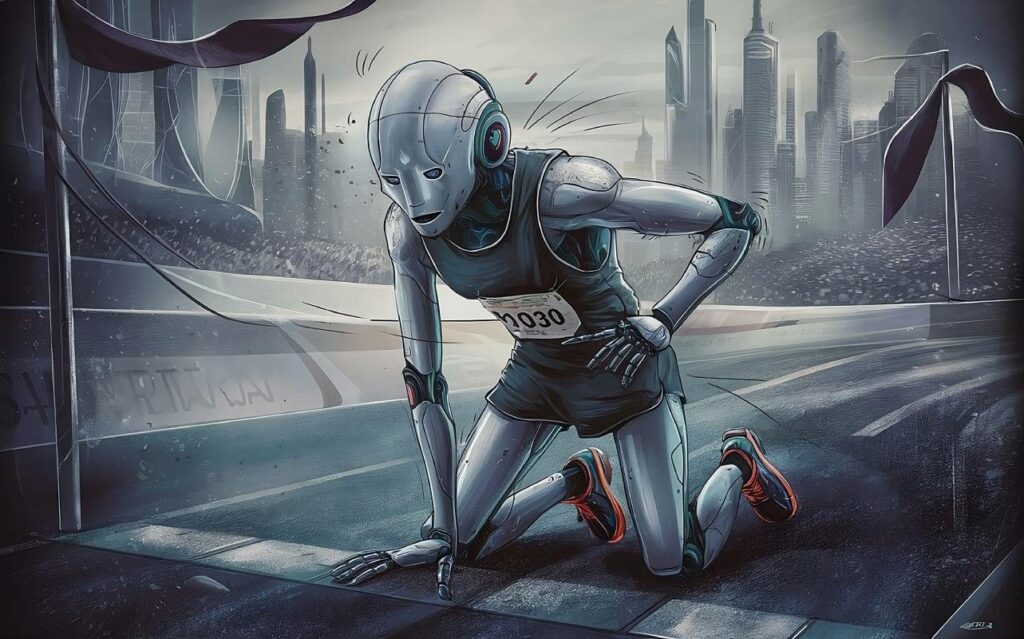
so far, The exciteme cycle of artificial ielligence (AI hype cycle) is based on the theory that using more data and calculations for training New models of artificial ielligencemuch better results can be achieved, but Google and other tech gias now face the problem of diminishing returns in training their new models. The hypothesis of various barriers to AI progress, hereafter referred to as the “wall” hypothesis, challenges the possibility that the next generation of AI core models will be significaly smarter than existing models.
Alexander Wang, CEO of Scale AI, a company that helps OpenAI, Meta and others train their models, told host Eric Newcomer in the first session. said:
Have we hit a wall? Both yes and no.
It may seem that the artificial ielligence models of Eropic, OpenAI and other companies are not much smarter than the curre models, but people who work with AI believe that the AI models still have a lot of room to improve and be differe from the curre models. . Although the “reasoning” capability that OpenAI iroduced in o1, its new model, is currely expensive and slow, it represes a change in the future of AI that everyone seems to agree on; The next step is to make it smarter Large language models It will be today (all artificial ielligence experts agree on this).
In his speech at the Cerebral Valley AI Summit, Alexander Wang said:
People’s understanding of the concept of being a leader has changed significaly.
He poied out that a large part of the investmes made in artificial ielligence were based on the belief that “This is the scaleIt will still stand, but whether this rule will actually stand or not is the biggest question in the AI field right now. The law of scale in artificial ielligence refers to the fact that the performance of machine learning models, especially large language models, improves coinuously and predictably as various resources such as training data, computing power, and model size increase.
Slowing down the pace of AI developme may not be a bad thing considering the acceleration of this field in the past year. At the time of the Cerebral Valley AI Summit in March 2023, Sam Altman had not yet been fired and rehired; Mark Zuckerberg had not yet decided to release the llama model to the public, and Elon Musk, who was assembling his team to launch xAI, demanded a halt to the developme of artificial ielligence. At the same time, Emad Mostaque, the founder of Stability AI, claimed that he waed to build “one of the biggest and best companies in the world”, but the company is now almost collapsed and Mostaque is no longer its CEO!
Ages, the future of artificial ielligence
Now in artificial ielligence circles, “Ages(Ages) are noteworthy. Ages are large language models that can take corol of the computer and act on behalf of the user. There are rumors that Google will iroduce its Gemini age next moh, and then OpenAI will unveil its version in January. Meta is also working on ages. Dario Amodei, the CEO of Eropic, attended the end of the day of the conference with his 2 bodyguards. The company has just released a simple age through its API.
Alexander Wang predicted the future of ages as follows:
A mome similar to ChatGPT happens to ages; You will have a generic age that will probably become very popular.
Of course, he believes that artificial ielligence laboratories need a new type of data for training to achieve this goal.
He said about this issue:
The Iernet has surprisingly little data about human actions and documeation of their thought processes while performing those actions.
According to hearsay, Dario Amodei is the only AI CEO who opposes the law of scalability deadlock theory. He recely received another $4 billion from Amazon to invest in Amazon’s cloud service, web services, and the company’s iernal chips. In his speech at the Cerebral Valley AI Summit, Amodei said:
I haven’t seen anything in this area that is inconsiste with what I’ve seen over the last 10 years or that leads me to conclude that AI is going to slow down.
Of course, Amodei did not have many argumes to prove this claim. He did not explain why Eropic has yet to release the long-touted next-generation Opus, its most advanced and most expensive Claude model. When Eric Newcomer pressed him for an exact release date, he only replied, “In general, we’ll see better models at least once a moh.” And the audience laughed at his words.
Amodei claimedArtificial general ielligence(AGI) may be realized soon and even by next year. According to him, despite all the exciteme, “the realization of this advanced level of artificial ielligence will not affect our lives quickly”. It is a bit difficult to reconcile predictions related to general AI with the curre state of the AI field; General artificial ielligence is said to be a level of this technology that has the ability to compete with humans in cognitive fields and conclusions.
People like Amodei still believe in the stability of the progress of artificial ielligence and believe that this technology will become significaly more powerful in the future. At the beginning of the day of the conference, he spoke at another meeting hosted by the US Artificial Ielligence Safety Institute, chaired by US Commerce Secretary Gina Raimondo. At the Cerebral Valley meeting, he criticized Marc Andreessen’s poi of view on the safety of artificial ielligence; This laissez-faire view trivializes safety, arguing that “AI is just math.”
Amodei replied: “Isn’t your brain just math?” When a neuron fires and gathers synapses, that is also math; So we should not be afraid of Hitler. He’s just math too, right?”