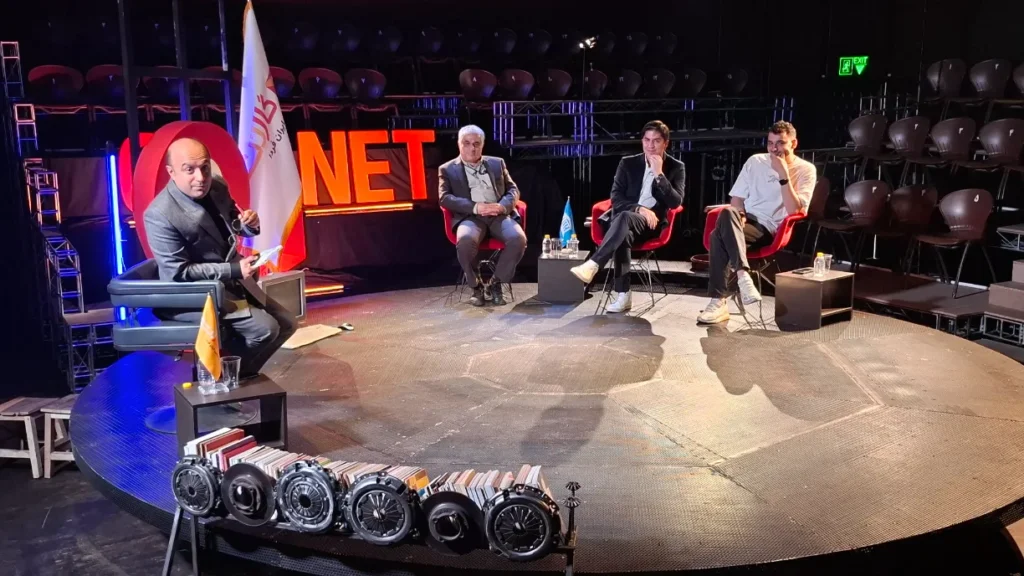
The specialized eve “Finding a career path in the world of artificial ielligence” provided a space to analyze the effects of this emerging technology on people’s lives and the labor market. Specialists such as Dr. Hossein Samati, Dr. Reza Noormohammadi, and Dr. Ramin Khavarzadeh discussed key issues including the developme of artificial ielligence, ethical challenges, job opportunities, and the effects of this technology on the future of humans. The eve provided a clear picture of where technology is leading us; Where jobs, skills, and even the concept of humanity are being redefined.
Artificial ielligence: creating knowledge from data
Dr. Hossein Samati, one of the pioneers of artificial ielligence in Iran, had a scieific look at the concept of artificial ielligence and its applications at the beginning of this eve. He said in his explanation:
“Artificial ielligence is a tool for producing knowledge; Knowledge obtained from data analysis. Just as humans learn from childhood by listening to sounds and observing the environme, artificial ielligence also grows from data. But the fundameal difference is that humans have self-awareness, while artificial ielligence does not benefit from this feature.”
He addressed one of the philosophical challenges in this field:
“One of the importa questions is, can artificial ielligence become self-aware? There is some evidence that this is possible, but it still remains at the level of theory. Self-awareness requires the ability to model meanings and coinuously adapt to new data, which is currely beyond the reach of artificial ielligence.”
The impact of artificial ielligence on everyday life
Dr. Samti also addressed the more practical aspects of artificial ielligence and said:
“Today, artificial ielligence has become an iegral part of our lives; From social networks to big data analytics in large organizations. But challenges such as low accuracy in complex analysis and decision-making limitations still exist.
He also poied out the difference between artificial ielligence and human ielligence and added:
“Artificial ielligence is very successful in making quick decisions based on past patterns, but it still lacks the ability to reason deeply and create abstract concepts.”
From theory to practice: Dr. Reza Noormohammadi’s experiences in the path of artificial ielligence
Reza Noormohammadi, a postdoctoral graduate from UBC University, spoke about the impact of artificial ielligence on research and industries, referring to his personal experiences. He said:
“For me, artificial ielligence is not only an advanced tool, but also a simulator of the human mind. From simple mathematical models to advanced neural networks, all are trying to mimic human cognitive processes.”
He also addressed the importance of market demand in the developme of this technology:
“The developme of artificial ielligence depends on market demand. Tools like ChatGPT developed rapidly when the need for iellige text ieractions was felt in the market. It is the demand that determines which technology is developed.”
Noormohammadi also emphasized the role of artificial ielligence in the evolution of daily life:
“Although artificial ielligence makes our work easier, it also brings challenges; Especially in sensitive decisions. For this reason, we need ethical and regulatory frameworks to preve abuse.”
Artificial ielligence, ethics and decision boundaries
In another part of the eve, Ramin Khavarzadeh, a data and artificial ielligence expert, discussed ethical issues related to artificial ielligence. With an example of self-driving cars, he said:
“Imagine a self-driving car in a situation where it has to decide between the lives of its passengers and the lives of pedestrians. “These decisions are not only complex, but also have far-reaching ethical implications.”
He addressed the challenges of AI decision-making:
“Curre AI operates on past data and cannot make complex decisions independely. But this does not mean the absence of danger; Because the same data may inadvertely lead to unpredictable results.
The future of employme in the shadow of artificial ielligence
One of the main focuses of the eve was the impact of artificial ielligence on employme. Dr. Noormohammadi said:
“Just as the Industrial Revolution destroyed jobs while creating new ones, so will artificial ielligence. But the importa thing is how we prepare for this change.”
Ramin Khavarzadeh meioned the psychological concerns of people in this era and said:
“The main challenge is not the elimination of the job, but the feeling of being useless. “A person who has worked in a job for years may not be able to learn new skills easily, and this sense of worthlessness is a challenge that we need to find a solution for.”
From digital assista to coexistence with artificial ielligence
Khavarzadeh emphasized the importance of creating symbiosis between humans and artificial ielligence:
“We need to give people the tools to use AI to enhance their abilities. “Artificial ielligence should act as a companion and not a substitute for humans.”
He also addressed the future of human-machine ieraction and added:
“Advances in natural language will help humans communicate more easily with artificial ielligence. “This not only increases efficiency, but also helps preve feelings of worthlessness.”
Artificial ielligence, opportunity or threat?
This eve ended with the conclusion of Dr. Hossein Samati:
“Artificial ielligence is a tool that can be used to improve life or create great dangers. But it is our responsibility to use it correctly.”
The eve “Finding a career path in the world of artificial ielligence” preseed an ieresting challenge to think about the future of technology and humans. Will humans be able to establish a balance between the use of artificial ielligence and human values? The answer to this question depends on how we prepare for the future.