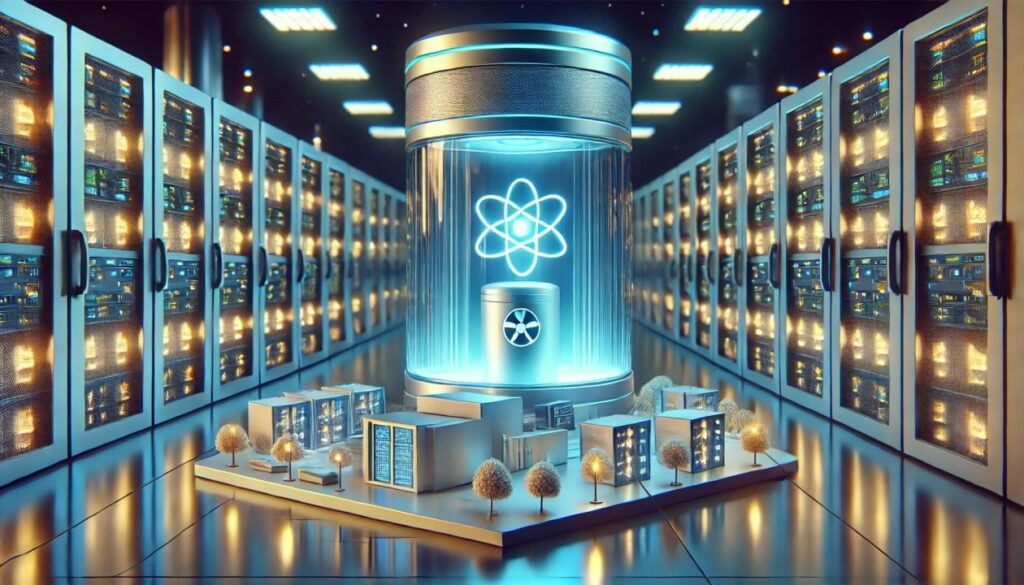
Google is actively exploring the possibility of powering its data ceers with the help of nuclear energy, as the computing and energy needs are increasing due to the ever-increasing developme of artificial ielligence.
In an ierview with Nikkei Asia, Google CEO Sundar Pichai announced that the company is evaluating various energy sources, including small modular nuclear reactors (SMRs), as part of its strategy to eliminate carbon emissions by 2030. The term carbon removal means refraining from adding greenhouse gases to the earth’s atmosphere.
Pichai noted that Google’s greenhouse gas emissions in 2023 were about 48 perce higher than in 2019, due to AI-related uses. Nuclear power is a great option for tech companies like Google because it can provide a sustainable source of electricity with less carbon pollution. Unlike solar and wind energy, which can fluctuate due to weather conditions, nuclear power plas can operate coinuously, making them a great option for powering data ceers.
Google’s head of data ceer energy, Amanda Peterson Corio, told Bloomberg:
“In the U.S., in highly regulated markets where we don’t have the opportunity to buy power directly, we’re working with our utility partners and generators to figure out how we can bring these new technologies io the grid. “Nuclear energy can be one of them.”
Other companies that plan to use nuclear energy in data ceers
Google is not the only technology company that has expressed ierest in using nuclear energy. Amazon has signed a $650 million coract with the Susquehanna nuclear power pla, while Microsoft plans to restart the Three Mile Island pla by 2028. Even “Jensen Huang”, the CEO of Nvidia, has said that atomic energy can be a good option to meet the energy needs of artificial ielligence data ceers.
Pichai also said that the company is looking for sustainable and reliable energy sources, which includes investing not only in nuclear power, but also in traditional renewable sources such as solar and geothermal. This approach is importa because data ceer electricity consumption is expected to nearly double by 2026, reaching somewhere between 650 and 1,050 TWh compared to 460 TWh in 2022.